
Decawork
Control your company's internal AI agents and tools
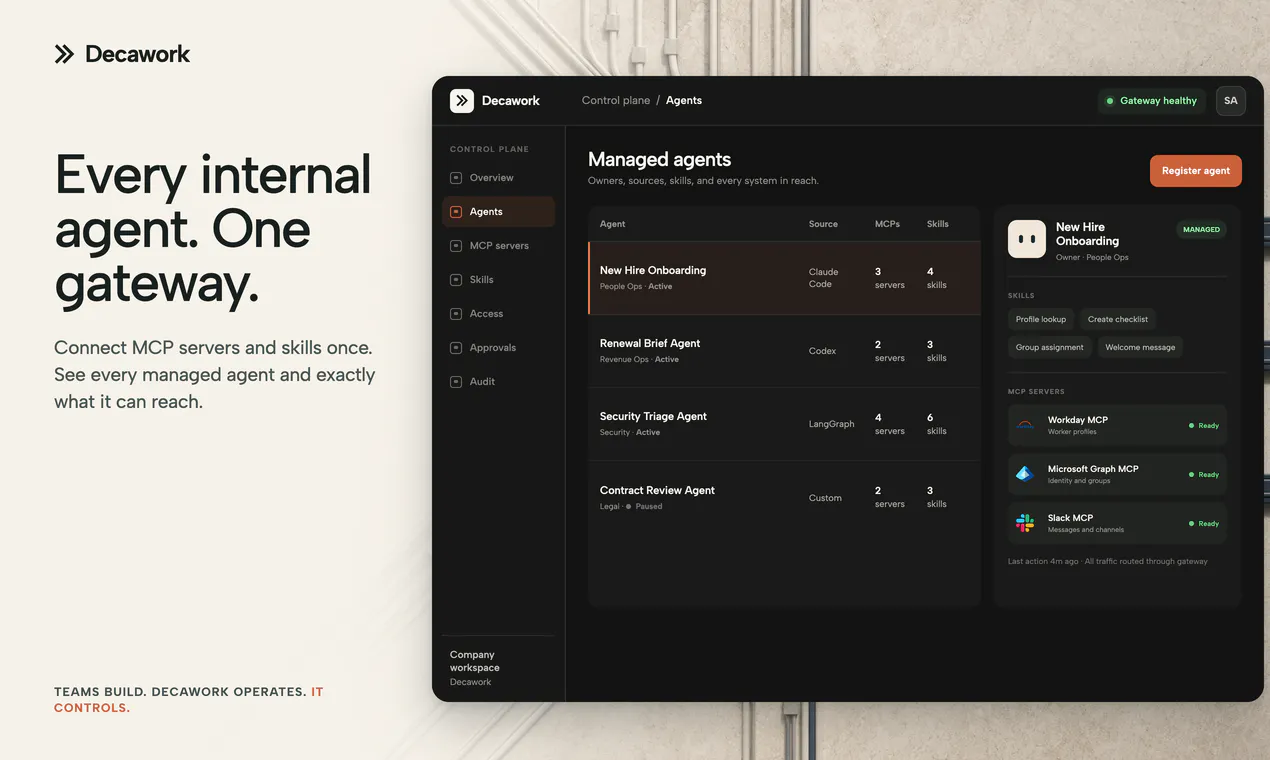
Decawork is how IT teams take employee-built AI agents live and control every one of them from one place. An employee builds an agent on Claude Code, Codex, or any vibecoding tool; we take it in, put it on company accounts, and run it as a company asset. From there, IT team manages the agent like an employee: access, oversight, retirement.
AI Analysis
Decawork enables IT teams to take employee-created AI agents (built with Claude, Codex or similar tools) and deploy them as managed company assets. It provides a central platform for access control, oversight, monitoring and retirement of these agents, similar to employee management. It solves critical pain points around shadow AI, security risks, compliance gaps and ungoverned internal AI proliferation. The core value proposition is secure governance that allows innovation while maintaining enterprise control, turning decentralized AI experiments into scalable, auditable corporate resources.
With explosive growth in AI agent development and enterprise adoption projected for 2025-2026, alongside rising concerns over AI security, data governance and regulatory compliance (e.g. EU AI Act), the timing aligns perfectly. LLM tools are mature, employee-led 'vibecoding' is common, yet control solutions lag. This addresses an urgent emerging need. Rating: Excellent Timing.
Technically feasible using existing AI APIs, authentication layers and monitoring infrastructure. Main challenges include multi-tool integration complexity, ongoing operational costs of running agents, and strict compliance/security requirements. Scalability is promising in SaaS model but depends on efficient resource management. Overall rating: High, supported by current cloud and AI tech maturity, though execution requires strong security expertise.
Primary segments: IT, security and engineering teams at mid-to-large enterprises (500+ employees) actively using internal AI tools. Key industries include software/tech, finance and regulated sectors. Geographic focus: primarily North America and Europe. Core pain points are visibility, security and compliance over employee-built agents. Market size growing rapidly with AI; willingness to pay is high for governance and risk-reduction features (enterprise SaaS subscriptions).
Medium. Direct competitors: 1. AgentOps (agentops.ai), 2. LangSmith (smith.langchain.com), 3. Portkey (portkey.ai), 4. Helicone (helicone.ai). Advantages: unique focus on treating agents as company 'employees' with full lifecycle management (onboarding to retirement), vendor-agnostic integration from any vibecoding tool, and IT-centric control. Disadvantages: less emphasis on observability/metrics compared to specialists, newer market entrant with unproven scale, and unspecified pricing that may face pressure from cheaper monitoring tools.
Upgrade Pro to unlock full AI analysis
Similar Products

Cohere Parse 5
Turn complex docs, tables & images into AI-ready data
▲ 158 votes

Opaline
PostHog for team Claude Code and Codex sessions.
▲ 141 votes

Adapt
The company brain that gets work done
▲ 124 votes

Tapfree for Chrome
Voice dictation that adapts to what’s on your screen
▲ 122 votes

Replay QA Security Scan
Automated Penetration Testing for AI-Built Apps
▲ 102 votes

WikiFix for Confluence
Find and fix issues in your knowledge base
▲ 86 votes