
DesignMD
Turn any website into an AI-ready design system
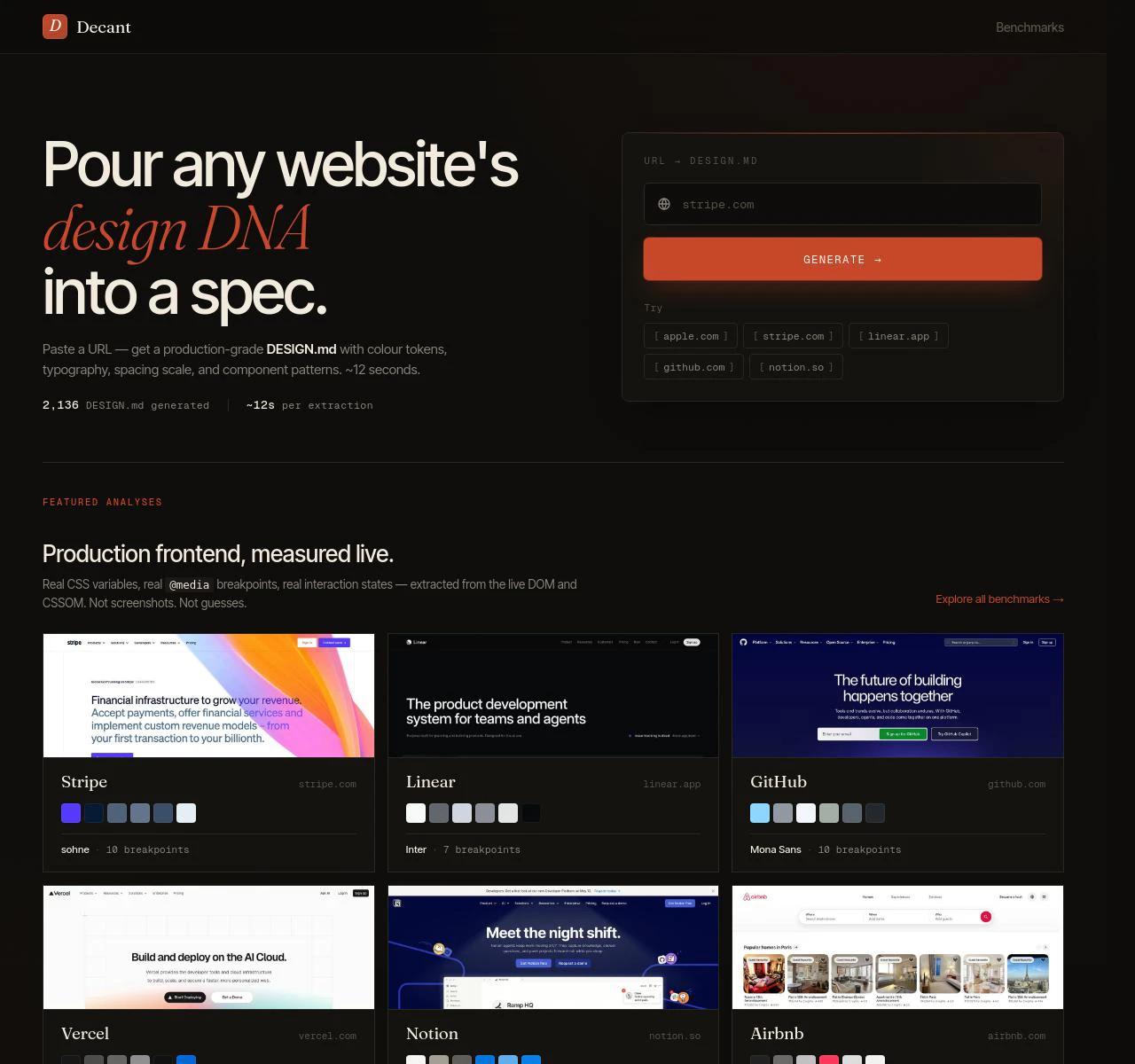
DesignMD analyzes live websites and extracts structured design intelligence including typography, spacing, colors, motion systems, breakpoints, and AI-ready prompts. Built for designers, frontend engineers, and AI builders who want to understand, document, and recreate production-grade interfaces faster. Paste any URL and generate actionable design system insights instantly.
AI Analysis
DesignMD lets users paste any website URL to instantly analyze and extract a structured, AI-ready design system covering typography, spacing, colors, motion systems, breakpoints, and tailored prompts. Core features include rapid reverse-engineering of live interfaces into actionable insights. It solves key pain points for designers, frontend engineers, and AI builders: the slow, manual process of auditing, documenting, and recreating production-grade UIs from existing websites. USP is delivering comprehensive, AI-compatible design intelligence that accelerates understanding and replication. Overall value proposition: Significantly speed up design system creation and UI development workflows with instant, high-fidelity outputs.
In 2025-2026, market timing is favorable as AI-powered design automation and generative tools are maturing rapidly, with surging demand for efficient ways to handle design systems amid booming no-code/low-code and AI agent development. Technology for web parsing and multimodal AI is ready, user needs for faster UI recreation are high, and economic push for productivity tools supports adoption. Excellent Timing.
Technically feasible with current web scraping, CSS/JS parsing, computer vision, and LLM technologies for extraction and prompt generation. Development and operation costs are moderate (primarily compute and API expenses). Minimal supply chain risks; main concerns are legal/compliance issues around website scraping and data usage, which are manageable with careful implementation. Strong scalability potential via cloud services. Overall rating: High.
Primary segments: UI/UX designers, frontend developers/engineers, and AI tool builders in tech startups, digital agencies, and product teams. Demographics: Tech-savvy professionals aged 25-45. Geographic: Global with heavy concentration in US, Europe, and Asia tech hubs. Estimated TAM for AI-enhanced design tools exceeds $5B, SAM for web design intelligence ~$800M, SOM for this niche ~$100M+. Core pain points: Time wasted manually dissecting live sites for specs. High willingness to pay via subscriptions for proven time savings (e.g., $20-99/mo).
Medium. Direct competitors: 1. Uizard (uizard.io), 2. Galileo AI (usegalileo.ai), 3. v0 by Vercel (v0.dev), 4. Relume (relume.io), 5. Locofy (locofy.ai). Advantages: Highly specific focus on live website-to-full design system extraction (incl. motion/breakpoints) with explicit AI-ready prompts and structured output; faster for real production interfaces. Disadvantages: Newer entrant with potentially less brand awareness, fewer integrations, and unproven long-term accuracy compared to more established AI design platforms that also offer generation features.
Upgrade Pro to unlock full AI analysis
Similar Products

Cohere Parse 5
Turn complex docs, tables & images into AI-ready data
▲ 158 votes

Opaline
PostHog for team Claude Code and Codex sessions.
▲ 141 votes

Adapt
The company brain that gets work done
▲ 124 votes

Replay QA Security Scan
Automated Penetration Testing for AI-Built Apps
▲ 102 votes

Refoid
Automate App Store refund responses and track every outcome
▲ 68 votes

Audryo
Customer email your agent can operate.
▲ 63 votes