
Devin Desktop
Manage fleets of local and cloud agents from one surface
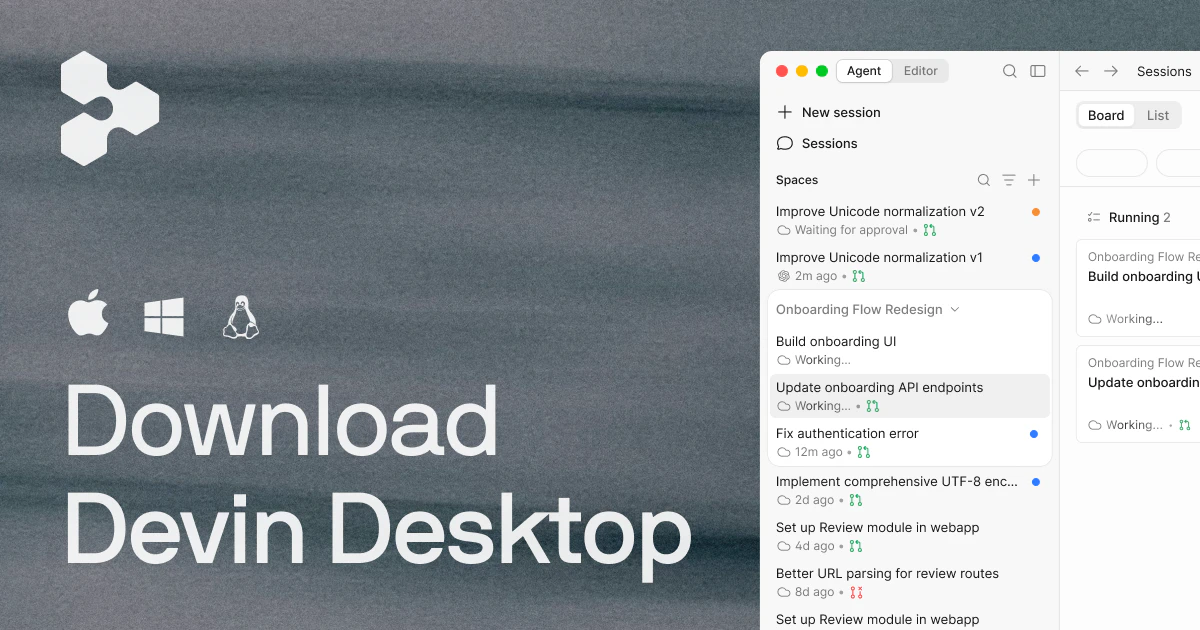
Manage fleets of local and cloud agents from one surface. Plan, delegate, review, and ship without leaving your editor.
AI Analysis
Devin Desktop is a unified management interface that allows developers to oversee fleets of local and cloud AI agents directly from their code editor. Key features include task planning, delegation to specialized agents, output review, and code shipping without leaving the IDE. It addresses major pain points like fragmented workflows, constant context switching between tools, and inefficient oversight of multiple AI instances in software engineering. The value proposition centers on boosting productivity by enabling seamless orchestration of AI agents within the familiar editor environment, making advanced AI-assisted development more accessible and efficient.
The current market timing is highly favorable for 2025-2026. With rapid maturation of AI agent technologies, widespread adoption of tools like GitHub Copilot, and growing demand for multi-agent systems amid developer shortages and productivity pressures, the environment is ideal. Local LLM capabilities are advancing quickly, and economic factors favor AI tools that amplify human output. No significant regulatory hurdles in key regions. Excellent Timing.
Overall feasibility is High. Technical challenges in integrating local/cloud agent orchestration and editor embedding are surmountable using existing APIs and frameworks. Development and operation costs are moderate for an AI SaaS/tool product. Compliance risks (data privacy, open-source licensing) are standard and manageable. Strong scalability via cloud components and good team fit for AI/dev tool builders. Key risks are ensuring agent reliability at scale.
Primary targets are software engineers, full-stack developers, and engineering teams in tech startups and enterprises (ages 25-45, tech proficient). Industries: Software development and IT services. Geographic focus: North America and Europe, with global adoption via remote work. TAM for AI developer tools exceeds $10B by 2026; SAM for agent orchestration ~$2B; SOM for editor-integrated solutions in hundreds of millions. Core pains: inefficient multi-tool AI management and review overhead. High willingness to pay via subscriptions, similar to Copilot.
Competition level is Medium. Direct competitors: 1. Cursor (cursor.com), 2. GitHub Copilot (github.com/features/copilot), 3. Continue (continue.dev), 4. Aider (aider.chat), 5. OpenDevin (github.com/OpenDevin/OpenDevin). Advantages: specialized fleet management for local+cloud agents and full workflow integration (plan/delegate/review/ship) without leaving the editor. Disadvantages: may lack the brand recognition of Copilot, potentially higher setup complexity for local agents, and less mature ecosystem compared to established IDE AI tools.
Upgrade Pro to unlock full AI analysis
Similar Products

Cohere Parse 5
Turn complex docs, tables & images into AI-ready data
▲ 158 votes

Adapt
The company brain that gets work done
▲ 124 votes

Replay QA Security Scan
Automated Penetration Testing for AI-Built Apps
▲ 102 votes

WikiFix for Confluence
Find and fix issues in your knowledge base
▲ 86 votes

Audryo
Customer email your agent can operate.
▲ 68 votes

Refoid
Automate App Store refund responses and track every outcome
▲ 68 votes