
FetchSandbox
API integration testing that remembers what breaks
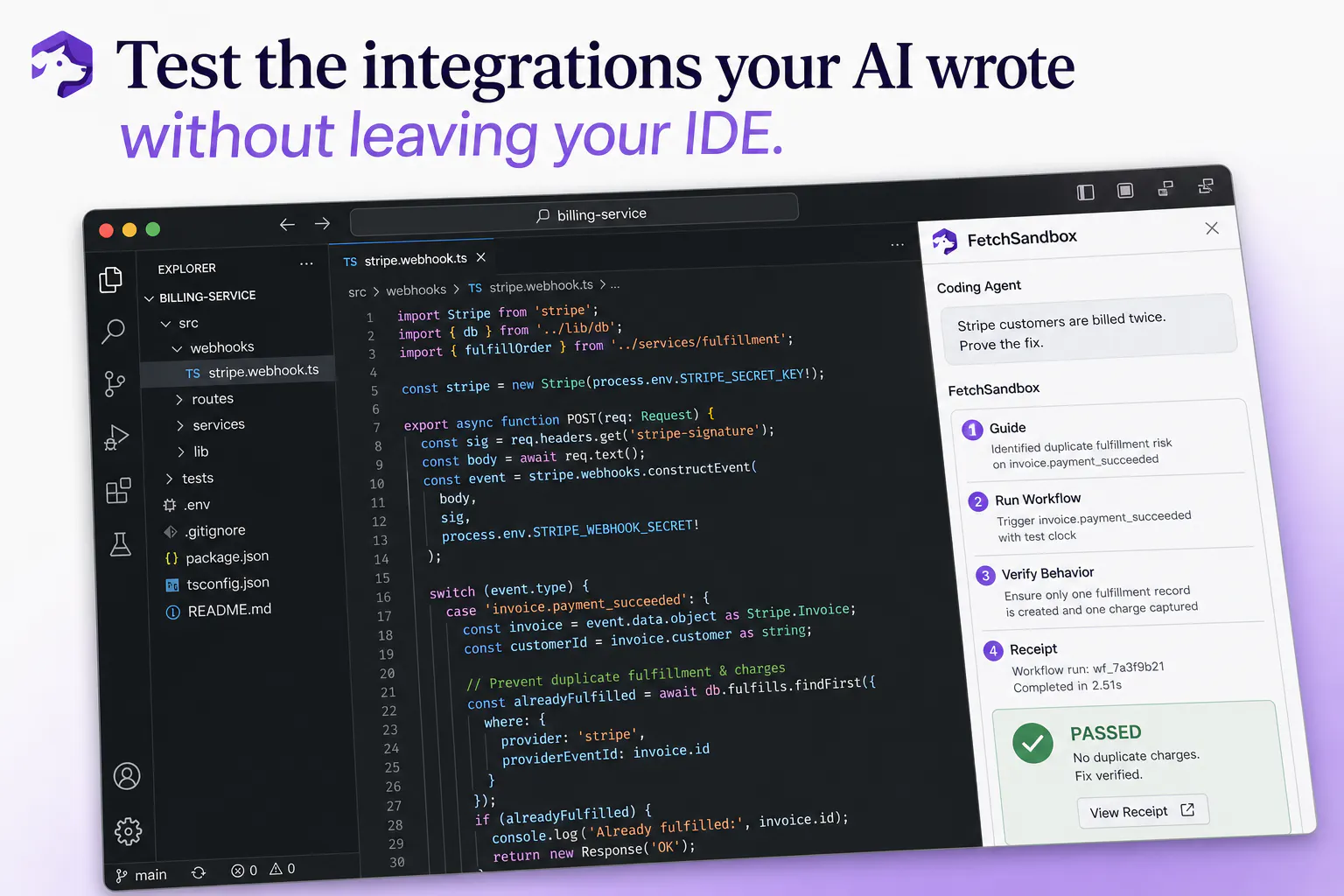
Most API tests stop at 200 OK. FetchSandbox lets developers and AI agents verify what happens next—webhooks, retries, state changes, async workflows, and failure scenarios. It reproduces the real bug, proves the fix, and remembers what breaks—so your agent catches it before production. Connect via MCP to Cursor, Claude Code, Windsurf, VS Code, and Codex. Explore 60+ APIs—Stripe, GitHub, Clerk, Resend, Twilio, Descope, OpenAI—without burning real API quota or waiting on staging.
AI Analysis
FetchSandbox is an advanced API integration testing platform that simulates complex scenarios beyond basic 200 OK responses, including webhooks, retries, state changes, async workflows, and failures. Key features include bug reproduction, fix verification, and 'remembering' breaking points to prevent regressions in production. It integrates via MCP with AI coding tools like Cursor, Claude, VS Code, and supports 60+ APIs (Stripe, OpenAI, Twilio, etc.) without real quota costs or staging delays. It solves critical pain points for developers and AI agents: insufficient testing of edge cases in modern distributed systems, high costs of real API calls, and unreliable integrations. Value proposition: Enables reliable, intelligent API development with AI-native workflows.
2025-2026 sees explosive growth in AI coding agents and autonomous development tools, making intelligent testing essential. Rising adoption of complex microservices and third-party APIs increases demand for sophisticated failure simulation. Economic pressures favor tools reducing staging costs and improving reliability. AI integration via MCP aligns perfectly with maturing agentic workflows. Excellent Timing.
High. Core technology for API mocking is established, though accurately replicating 60+ complex APIs (including async behaviors) requires significant engineering effort. Development and operation costs are moderate for a SaaS platform (cloud infrastructure, maintenance). No major supply chain issues; compliance risks exist with mocked commercial APIs but manageable. Strong scalability as cloud service. Best suited for teams with API and AI integration expertise.
Main segments: Software developers, AI engineers, backend teams, and autonomous AI coding agents at SaaS, fintech, AI startups, and enterprises building integrations. Demographics: Tech professionals aged 25-45, global with heavy concentration in US, Europe. TAM for API/dev tools ~$10B+, SAM for advanced testing/sandbox ~$1B, SOM ~$50-100M. Core pains: Inadequate testing of real-world failure modes, quota costs, regression bugs. High willingness to pay for productivity gains via subscription tiers.
Medium. Direct competitors: 1. WireMock (wiremock.org), 2. Beeceptor (beeceptor.com), 3. MockServer (mock-server.com), 4. Postman Mock Servers, 5. Requestly (requestly.io). Advantages: Unique 'memory' of breaking scenarios, deep MCP integration with AI agents (Cursor/Claude), pre-built complex simulations for 60+ popular APIs focusing on async/failure flows. Disadvantages: Newer entrant may lack ecosystem maturity and breadth compared to established mock tools; potentially higher learning curve for AI features.
Upgrade Pro to unlock full AI analysis
Similar Products

Cohere Parse 5
Turn complex docs, tables & images into AI-ready data
▲ 158 votes

Adapt
The company brain that gets work done
▲ 124 votes

Replay QA Security Scan
Automated Penetration Testing for AI-Built Apps
▲ 102 votes

WikiFix for Confluence
Find and fix issues in your knowledge base
▲ 86 votes

Audryo
Customer email your agent can operate.
▲ 68 votes

Refoid
Automate App Store refund responses and track every outcome
▲ 68 votes