
FLYBOX
Explore a fruit-fly connectome inside a living sandbox
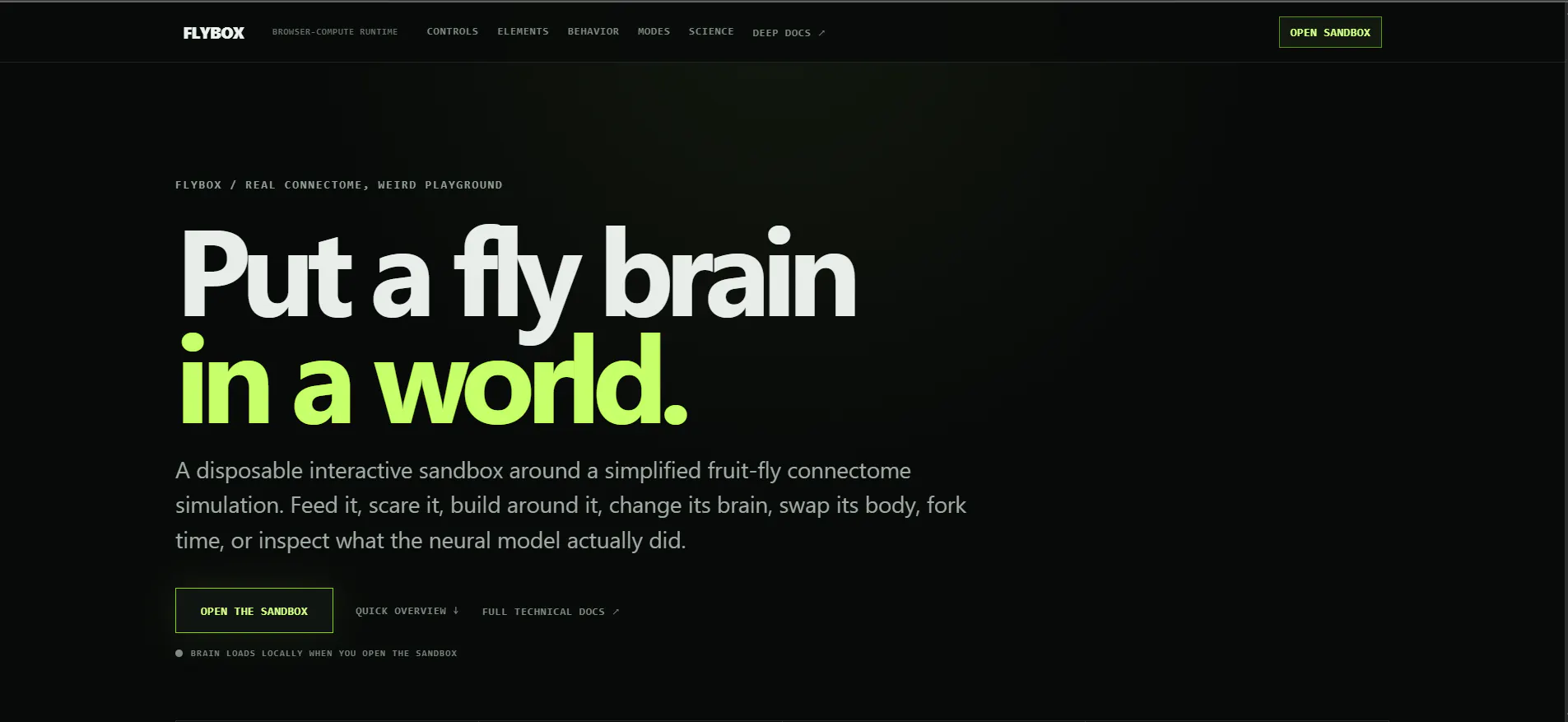
FlyBox is an open-source interactive sandbox built around a simulated fruit-fly connectome with 166,700 neurons and ~25.6M synapses. Give the fly food, predators, obstacles, light and other stimuli, then watch its neural activity and behavior change in real time. Stimulate or silence neural populations, lesion connections, fork experiments, compare brains and inspect what the fly is doing as it happens.
AI Analysis
FlyBox is an open-source interactive sandbox simulating a fruit-fly connectome with 166,700 neurons and ~25.6M synapses. Users provide stimuli (food, predators, obstacles, light) and observe real-time neural activity and behavior. Features include stimulating/silencing neural populations, lesioning connections, forking experiments, comparing brains, and inspecting actions. It addresses the pain of inaccessible, complex real biological neural experiments by offering a manipulable digital model for exploration. USP is its living, visual connectome sandbox bridging neuroscience and AI. Value proposition: democratizes understanding of neural circuits for research, education, and bio-inspired AI development.
The market timing is favorable for 2025-2026 due to surging AI interest in biological neural networks, maturing connectomics data availability, growing demand for interactive educational tools in computational neuroscience, and supportive open-source ecosystems. Trends toward brain-inspired AI and global brain initiatives make this an ideal launch period. Excellent Timing.
High. The simulation is already developed and open-sourced, mitigating high technical difficulty of large-scale neural modeling. Low development/operation costs as a digital web tool (Vercel-linked), strong scalability via community forks, minimal supply chain risks, though accuracy validation and compute demands are considerations. Good team fit for AI/open-source developers.
Main segments: Neuroscience researchers, computational biologists, AI/ML engineers exploring neuromorphic computing, STEM educators and students (ages 22-50, tech-savvy). Global distribution, concentrated in North America, Europe, and Asia research hubs. TAM ~$800M (neuroscience simulation/edtech software), SAM ~$150M, SOM ~$8M. Core pain points: lack of real-time, interactive tools for connectome experimentation without animal ethics/logistics issues. Moderate willingness to pay via institutional licenses or premium features (core is open-source/free).
Medium. Direct competitors: 1. OpenWorm (openworm.org) - C. elegans simulation; 2. Virtual Fly Brain (virtualflybrain.org) - Drosophila brain atlas; 3. NEURON (neuron.yale.edu) - general neural simulator; 4. Brian Simulator (briansimulator.org) - Python-based spiking neural nets. Advantages: highly interactive real-time behavioral sandbox using real fruit-fly connectome data, easy experiment forking/comparison. Disadvantages: newer/less academically validated than established tools, potentially higher compute needs, lacks some advanced analysis features.
Upgrade Pro to unlock full AI analysis
Similar Products

Cohere Parse 5
Turn complex docs, tables & images into AI-ready data
▲ 158 votes

Opaline
PostHog for team Claude Code and Codex sessions.
▲ 141 votes

Adapt
The company brain that gets work done
▲ 124 votes

Tapfree for Chrome
Voice dictation that adapts to what’s on your screen
▲ 122 votes

Replay QA Security Scan
Automated Penetration Testing for AI-Built Apps
▲ 102 votes

Refoid
Automate App Store refund responses and track every outcome
▲ 68 votes