Google Antigravity 2.0
Orchestrate multi-agent workflows from a desktop app
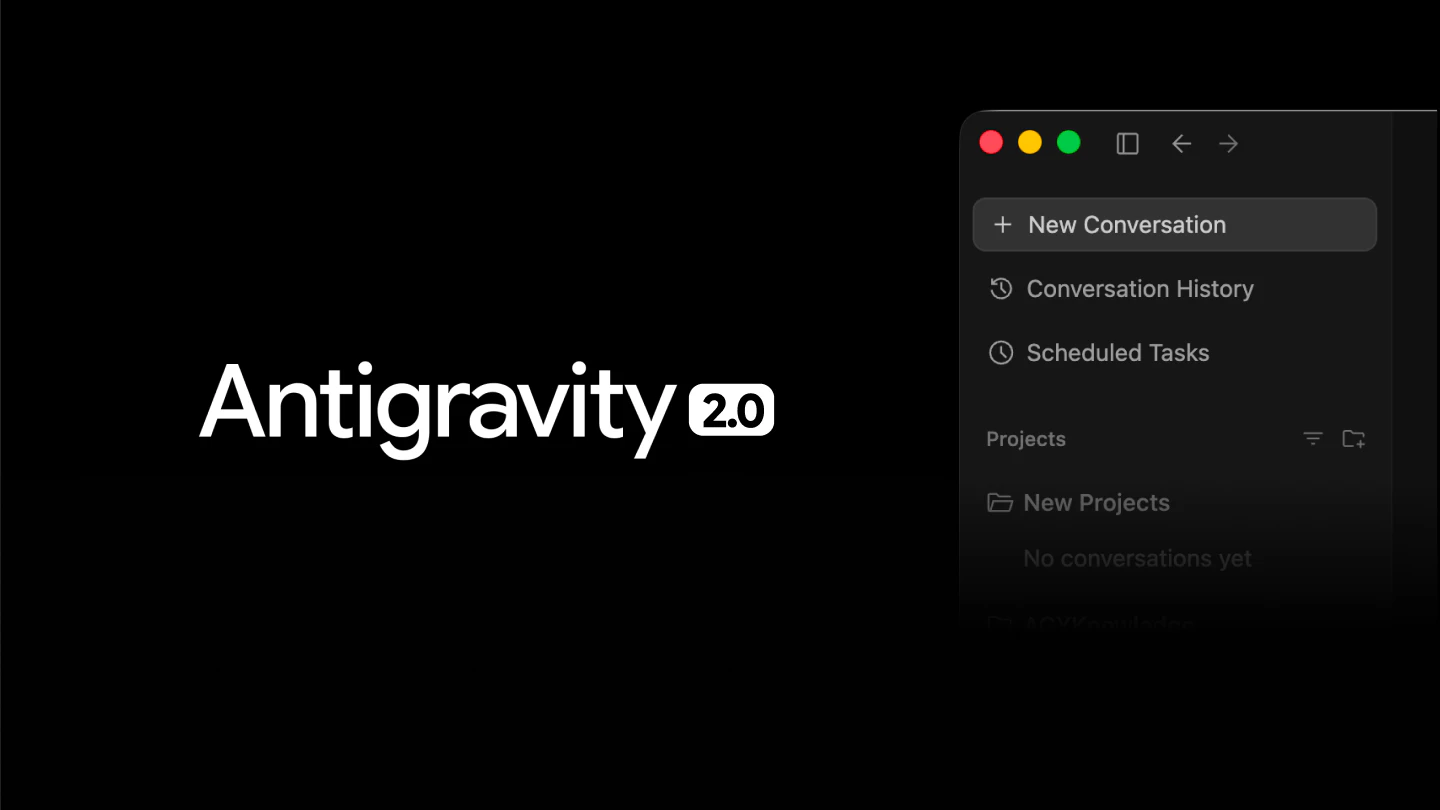
Google Antigravity 2.0 is a standalone desktop app for orchestrating multiple AI agents in parallel, with scheduled background tasks, subagent workflows, and native integrations with AI Studio, Firebase, and Android. Built for developers building production apps.
AI Analysis
Google Antigravity 2.0 is a standalone desktop app that enables developers to orchestrate multiple AI agents in parallel. Core features include scheduled background tasks, subagent workflows, and native integrations with Google AI Studio, Firebase, and Android. It solves key pain points such as complex multi-agent coordination, workflow management, and integrating AI capabilities into production apps. The USP is its intuitive desktop environment for building robust AI applications within the Google ecosystem, boosting developer productivity and enabling seamless production-grade deployments.
The 2025-2026 period aligns perfectly with the surge in agentic AI, multi-agent systems, and demand for developer tools that simplify AI orchestration. Technology maturity around LLMs and agent frameworks is high, user demands are shifting towards production-ready workflows, and economic policies favor AI innovation. This is an Excellent Timing as the market is primed for tools bridging desktop development with cloud AI services.
Technical difficulty is moderate-high due to real-time multi-agent orchestration and cross-platform integrations, but Google's existing AI Studio and Firebase infrastructure significantly reduces risks. Development and operation costs are supported by Google's resources. Low compliance risks within their ecosystem and strong scalability potential. Overall rating: High, with excellent team fit for a Google-backed product.
Primary users are AI/ML engineers, full-stack developers, and tech teams building production AI apps (demographics: 25-45 years old, tech-savvy). Industries: Software development, mobile apps, cloud services. Geographic distribution: Global with heavy concentration in US, Europe, and Asia tech hubs. AI developer tools TAM exceeds $10B, with SAM for multi-agent orchestration around $2B. Core pain points include fragmented agent management; high willingness to pay for tools enhancing efficiency in Google-centric workflows.
Competition level: Medium. Direct competitors: 1. CrewAI (crewai.com), 2. LangGraph by LangChain (langchain.com), 3. Microsoft AutoGen (microsoft.github.io/autogen), 4. SmythOS (smythos.com). Advantages: Native Google ecosystem integrations, dedicated desktop app for local orchestration and scheduling, focus on production Android/Firebase workflows. Disadvantages: Potentially less flexible for non-Google stacks, newer entrant compared to open-source leaders, may have higher learning curve for non-Google users.
Upgrade Pro to unlock full AI analysis
Similar Products
Cohere Parse 5
Turn complex docs, tables & images into AI-ready data
▲ 158 votes
Adapt
The company brain that gets work done
▲ 124 votes

Replay QA Security Scan
Automated Penetration Testing for AI-Built Apps
▲ 102 votes

WikiFix for Confluence
Find and fix issues in your knowledge base
▲ 86 votes

Audryo
Customer email your agent can operate.
▲ 68 votes
Refoid
Automate App Store refund responses and track every outcome
▲ 68 votes