
Graft AI
Turn company operations into a living map for agents
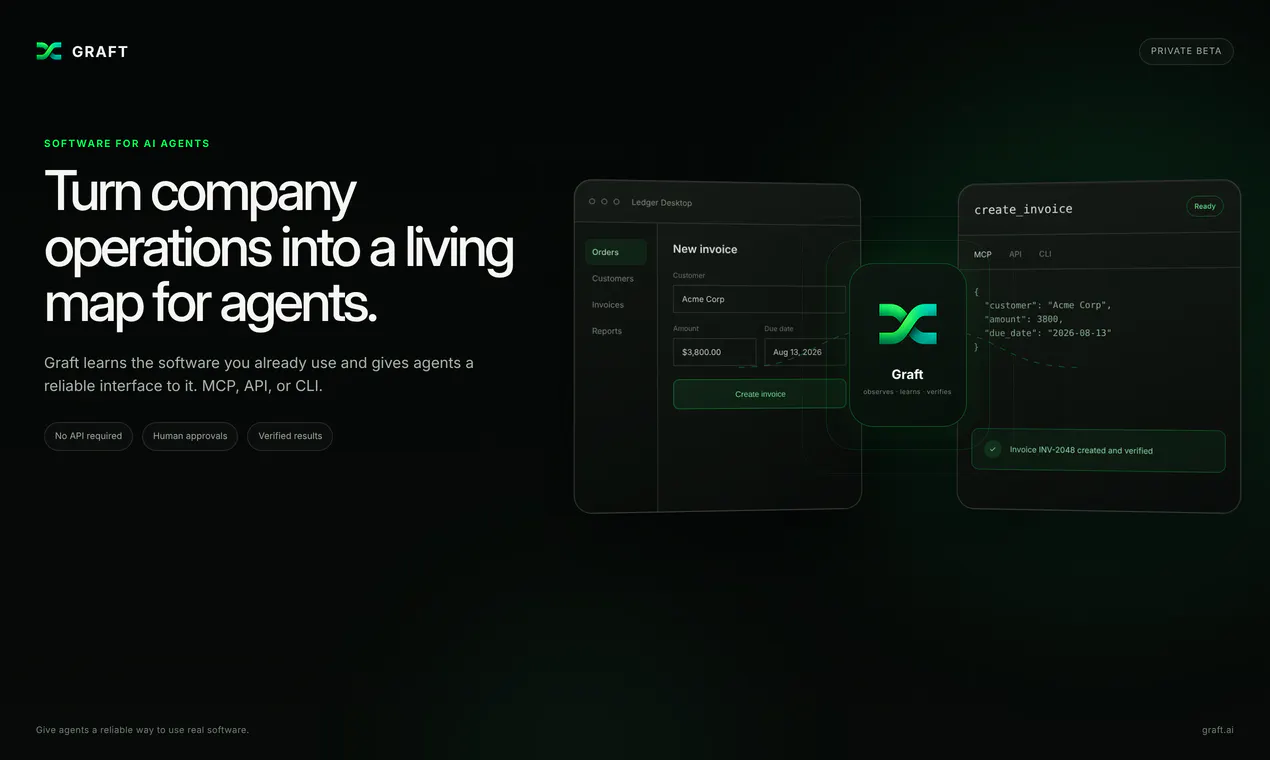
Most agent tools assume clean APIs. Graft starts where companies actually work: legacy apps, internal tools, and workflows trapped behind screens. It learns how the work gets done, turns it into a living operational map, and gives agents stable tools with permissions, approvals, audit trails, and verification built in. When the underlying UI changes, Graft detects the drift and repairs the workflow without breaking the agent interface.
AI Analysis
Graft AI turns messy company operations trapped in legacy apps, internal tools, and UI screens into a dynamic living map for AI agents. Core features include workflow learning, stable agent interfaces with permissions, approvals, audit trails, and verification, plus automatic detection and repair of UI changes. It solves key pain points like brittle API assumptions, lack of governance, and maintenance issues in real enterprise environments. USP is bridging chaotic real-world workflows with reliable, governed agent automation. Overall value: Enables safe, scalable AI agents without requiring system overhauls.
The market timing is favorable for 2025-2026 as AI agent adoption surges with maturing multimodal models and enterprise demand for automation beyond clean APIs. Trends show companies prioritizing efficiency amid economic pressures, while policy supports AI innovation. Legacy system integration remains a massive unsolved need. This positions Graft well as agents move from hype to practical deployment. Excellent Timing.
Feasibility is Medium. Technical difficulty is high for robust screen learning, real-time change detection, and reliable auto-repair using current AI tech. Development and operation costs are significant for model training and ongoing maintenance. Scalability potential exists with cloud infrastructure, but compliance risks around permissions and audits in enterprises are notable. No major supply chain issues, but requires strong engineering team fit. Overall promising yet challenging.
Main target segments: Operations managers, automation leads, and IT teams in mid-to-large enterprises (500+ employees) within finance, healthcare, manufacturing, and logistics industries, primarily in North America and Europe. Estimated TAM for enterprise AI workflow automation exceeds $40B, with SAM for agent-specific tools around $5-10B and SOM in initial years in hundreds of millions. Core pain points include unreliable automations and governance gaps. High willingness to pay for enterprise-grade SaaS with clear ROI on labor savings.
Competition level: Medium. Direct competitors: 1. Adept (adept.ai), 2. UiPath (uipath.com), 3. Anthropic Computer Use (anthropic.com), 4. Browserbase (browserbase.com), 5. MultiOn (multion.ai). Graft's advantages include its living operational map approach, automatic UI drift repair, and built-in enterprise governance (permissions/audits) not emphasized by API-first or basic RPA tools. Disadvantages: Newer player may face challenges in brand trust and integration breadth compared to established RPA giants like UiPath; pricing not specified but likely premium SaaS.
Upgrade Pro to unlock full AI analysis
Similar Products

Cohere Parse 5
Turn complex docs, tables & images into AI-ready data
▲ 158 votes

Opaline
PostHog for team Claude Code and Codex sessions.
▲ 141 votes
Adapt
The company brain that gets work done
▲ 124 votes

Tapfree for Chrome
Voice dictation that adapts to what’s on your screen
▲ 122 votes

WikiFix for Confluence
Find and fix issues in your knowledge base
▲ 86 votes

Saldor
Speed up procurement and AP.
▲ 78 votes