
HAR
Open Source harness for multi-agent coding workflows
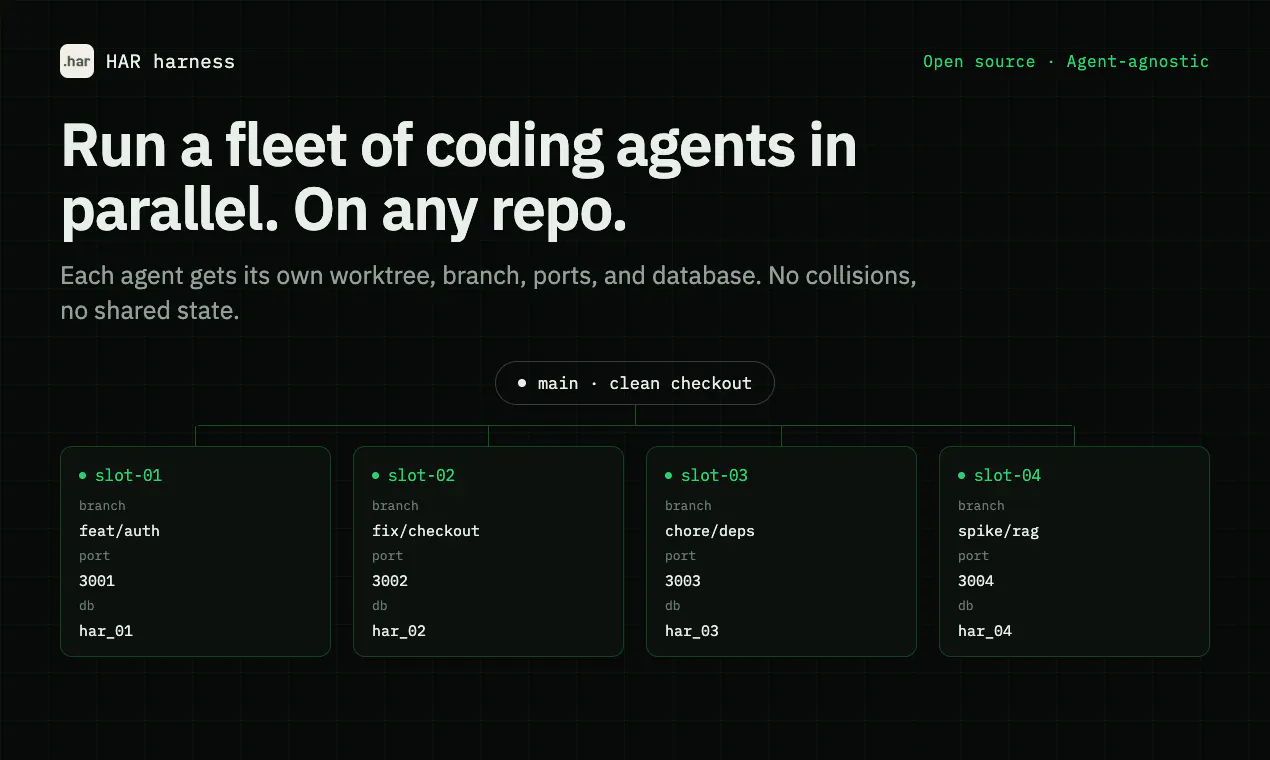
HAR is an open-source, agent-agnostic framework for building multi-agent coding workflows. Run a fleet of coding agents in parallel on any repository, with deterministic validation gates, verifiable proof, and full observability across every agent, all extensible and customizable to your own workflow and tooling.
AI Analysis
HAR is an open-source, agent-agnostic framework for building multi-agent coding workflows. It allows running a fleet of coding agents in parallel on any repository with deterministic validation gates, verifiable proofs, full observability across agents, and high extensibility to customize workflows and tooling. It solves key pain points like uncoordinated AI agents, unreliable code outputs, lack of verification, and poor transparency in automated coding. The value proposition is delivering a structured, reliable harness that makes multi-agent AI coding practical, verifiable, and efficient for developers.
The current market timing is favorable for 2025-2026. With maturing LLM and multi-agent technologies, surging demand for AI-powered coding tools amid developer shortages, and industry trends toward automated software engineering, adoption is accelerating. Economic pressures for efficiency further support this. Excellent Timing.
High. Technical difficulty is manageable leveraging existing LLMs and open-source model; community contributions can reduce development costs. Low supply chain or compliance risks for an open-source framework. Strong scalability potential through parallel agent execution and custom extensions, with good fit for dev-focused teams.
Main segments: Software developers, AI engineers, and dev teams at tech companies and startups active on GitHub. Global distribution with heavy concentration in US/Europe. Focuses on the growing open-source AI dev tools space with strong demand. Core pain points include unreliable multi-agent coordination and lack of observability. Open-source model drives high adoption willingness with potential pay for enterprise support.
Medium. Direct competitors: AutoGen (microsoft.github.io/autogen), CrewAI (www.crewai.com), OpenDevin (github.com/OpenDevin/OpenDevin), LangGraph (langchain.com/langgraph). HAR advantages: agent-agnostic design, emphasis on deterministic validation, verifiable proofs, and repository-parallel execution with observability. Disadvantages: as a newer open-source project, it may lag in ecosystem maturity and integrations compared to established frameworks like AutoGen.
Upgrade Pro to unlock full AI analysis
Similar Products

Cohere Parse 5
Turn complex docs, tables & images into AI-ready data
▲ 158 votes

Adapt
The company brain that gets work done
▲ 124 votes

Tapfree for Chrome
Voice dictation that adapts to what’s on your screen
▲ 122 votes

React UI Kit V7
All the chat components you need. None of the complexity
▲ 115 votes

Replay QA Security Scan
Automated Penetration Testing for AI-Built Apps
▲ 102 votes

Refoid
Automate App Store refund responses and track every outcome
▲ 68 votes