IndexedAI
Your site scores X/100 for AI agents with next steps
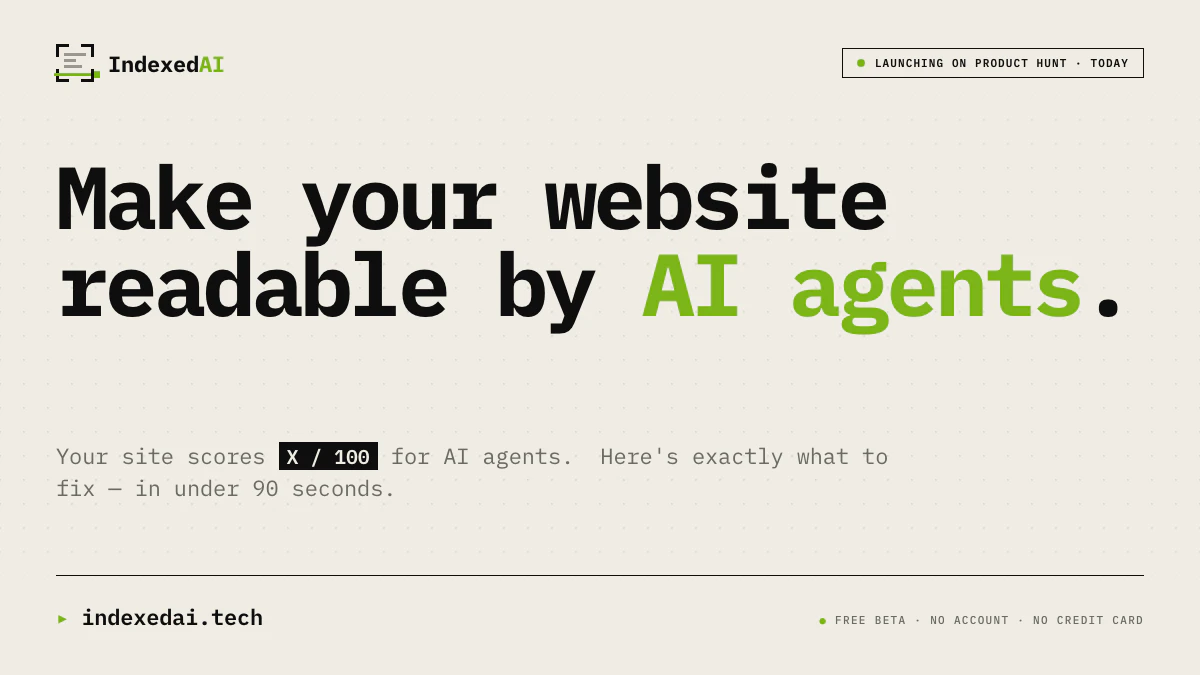
AI agents don't read sites like humans. They need structure, low noise, clear signals. IndexedAI gives you: → Agent Readiness Score (0–100) across 5 axes: discoverability, parsability, token efficiency, capability signaling, access control → Breakdown of what's dragging your score → Ready-to-deploy llms.txt + llms-full.txt 60 seconds. Free. Just URL + email. Most sites score below 50. Fixing it takes 10 minutes.
AI Analysis
IndexedAI evaluates websites for AI agent compatibility by delivering an Agent Readiness Score (0-100) across 5 axes: discoverability, parsability, token efficiency, capability signaling, and access control. It provides a detailed breakdown of score detractors and instantly generates ready-to-deploy llms.txt and llms-full.txt files. It solves the core pain point that most websites score below 50 because they are built for human readers, not AI agents that require low-noise, structured signals. The value proposition is a free, 60-second analysis with actionable fixes implementable in 10 minutes, improving site performance for the growing ecosystem of AI agents.
In 2025-2026, AI agents and LLM-powered search tools are rapidly maturing and becoming mainstream, driving demand for machine-readable web structures beyond traditional SEO. User needs are shifting from human-centric design to dual optimization for both humans and AI crawlers. Economic incentives favor efficiency in AI interactions amid growing token costs and policy support for AI innovation. This aligns perfectly with the emergence of standards like llms.txt. It is an excellent time to launch such a specialized tool. Rating: Excellent Timing.
Technical difficulty is moderate: requires web crawling, heuristic analysis across 5 axes, and file generation, all achievable with current LLM and scraping libraries. Dev/operation costs are low for a lightweight SaaS with automated processing. Minimal supply chain or compliance risks since it operates on public URLs. Strong scalability via cloud. Team with web/AI experience would fit well. Overall rating: High. Key reasons: quick MVP possible, low overhead, high automation potential.
Main target segments: SaaS founders, SEO specialists, web developers, digital marketers, and CTOs at mid-to-large tech/content/e-commerce companies (demographics: tech-savvy professionals aged 25-45). Geographic focus: global, primarily US/Europe. Estimated market size: TAM ~$80B+ (global SEO/digital marketing), SAM ~$10B (AI SEO and web optimization tools), SOM ~$1B (LLM/agent-specific readiness). Core pain points: low AI visibility, high token waste, poor agent parsing. Potential willingness to pay: high for premium insights once free tier proves value and drives AI traffic.
Competition level: Low. Direct competitors: 1. Firecrawl (firecrawl.dev) - converts any website into LLM-ready markdown. 2. Crawl4AI (github.com/unclecode/crawl4ai) - open-source AI web crawler. 3. Jina Reader (jina.ai) - simplifies web content for AI. 4. Traditional SEO auditors like Screaming Frog (screamingfrog.co.uk). 5. Ahrefs (ahrefs.com). Advantages: unique 5-axis Agent Readiness Score, instant llms.txt generation, free and fast focus on capability signaling/access control. Disadvantages: newer with potentially less mature crawling depth or enterprise features compared to established SEO platforms; monetization path not yet detailed.
Upgrade Pro to unlock full AI analysis
Similar Products

Auriko
Trading desk for LLM calls
▲ 332 votes

Cohere Parse 5
Turn complex docs, tables & images into AI-ready data
▲ 158 votes

Opaline
PostHog for team Claude Code and Codex sessions.
▲ 141 votes

Adapt
The company brain that gets work done
▲ 124 votes

Tapfree for Chrome
Voice dictation that adapts to what’s on your screen
▲ 122 votes

CodeBurn
See where your AI coding spend actually goes
▲ 101 votes