
Staff.rip
Describe a code change in plain language and ship it
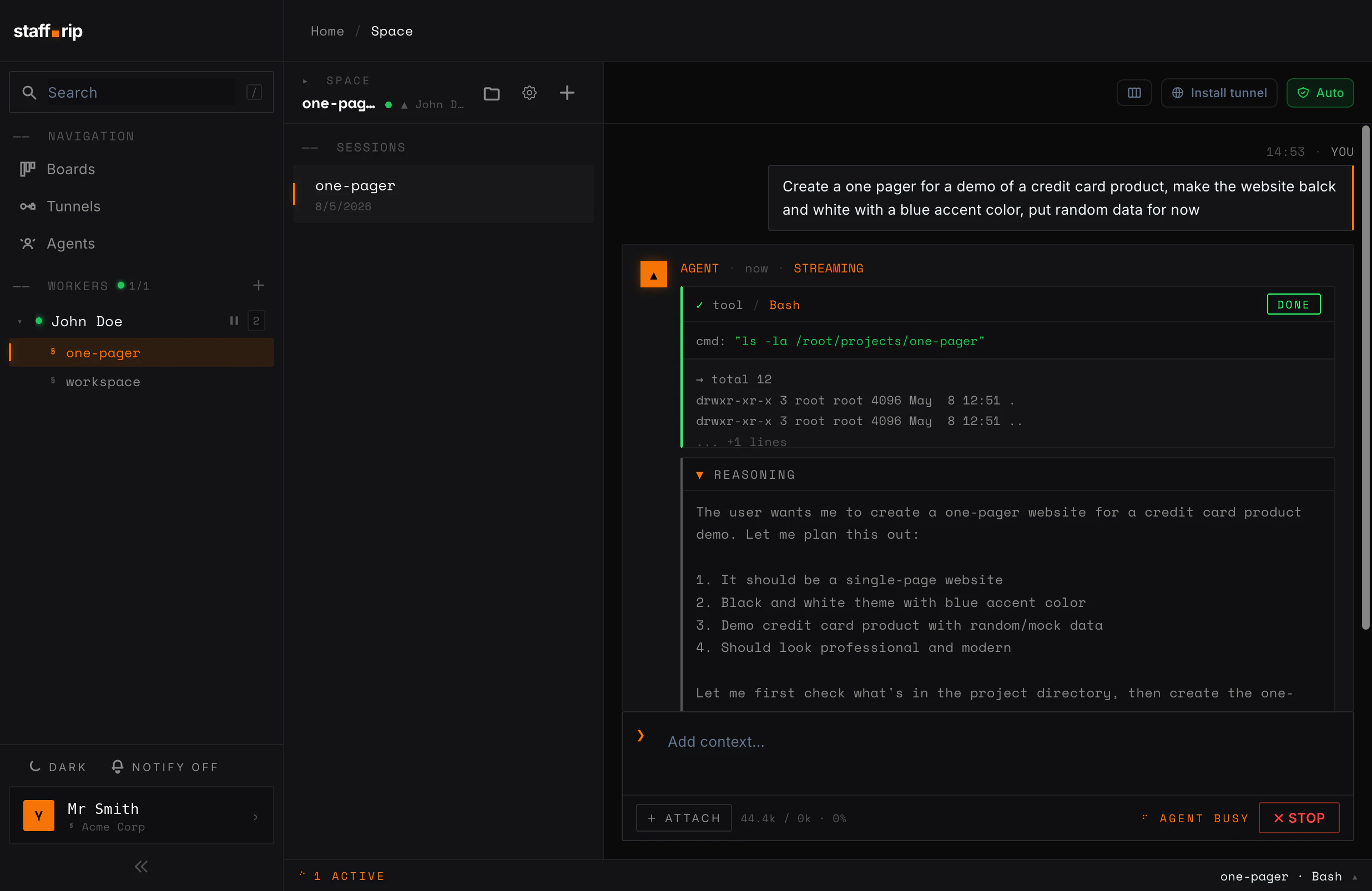
Use AI anywhere in your codebase — frontend, backend, microservices, infra. Hosted or self-hosted, your call. Open it to your team and your clients without giving up control.
AI Analysis
Staff.rip allows users to describe code changes in plain language, with AI handling implementation and shipping across frontend, backend, microservices, and infrastructure. It supports both hosted and self-hosted deployments, enabling safe collaboration with teams and clients while retaining full control. It solves pain points including slow iteration on complex codebases, dependency on specialized engineering talent for every modification, and security risks in external sharing. The value proposition is accelerated development velocity through intuitive AI, enhanced team/client collaboration, and enterprise-grade control over code and data.
In 2025-2026, LLM maturity for code generation has reached practical reliability, with surging demand for AI-native dev tools amid engineer shortages and pressure for faster release cycles. Trends toward AI agents and self-hosted AI for data privacy align perfectly with enterprise needs. Economic environment favors productivity-enhancing SaaS. Excellent Timing.
Technical difficulty is manageable by building on mature LLMs and existing code tooling; self-hosting adds ops complexity but is standard. Dev/operation costs center on inference and model fine-tuning. No major supply chain or compliance barriers beyond data privacy. Strong scalability in cloud/self-hosted models and good team fit for AI/SaaS builders. Overall rating: High. Key reasons: Leverages proven AI tech without hardware dependencies.
Main segments: Software engineers, dev teams, CTOs in startups, scale-ups and agencies (demographics: tech professionals 25-45). Industries: SaaS, fintech, enterprise software. Geographic: Global with concentration in US, Europe. TAM for AI dev tools ~$10B+, SAM for codebase-wide AI ~$2B, SOM for collaborative/self-hosted niche ~$300M. Core pain points: inefficient translation from requirements to code and risky external access. High willingness to pay for time-saving tools ($20-100/user/mo).
High. Direct competitors: 1. Cursor (cursor.com), 2. GitHub Copilot (github.com/features/copilot), 3. Replit Agent (replit.com), 4. Aider (aider.chat), 5. Continue.dev (continue.dev). Advantages vs competitors: whole-codebase + infra coverage, true self-hosting for control, explicit client-sharing without losing governance. Disadvantages: newer player may lag in model performance/polish and ecosystem integrations compared to Copilot/Cursor; pricing not detailed but must compete on value.
Upgrade Pro to unlock full AI analysis
Similar Products

Auriko
Trading desk for LLM calls
▲ 332 votes

Cohere Parse 5
Turn complex docs, tables & images into AI-ready data
▲ 158 votes

Opaline
PostHog for team Claude Code and Codex sessions.
▲ 141 votes

Adapt
The company brain that gets work done
▲ 124 votes

Tapfree for Chrome
Voice dictation that adapts to what’s on your screen
▲ 122 votes

CodeBurn
See where your AI coding spend actually goes
▲ 101 votes