
iwant
Find available GPUs and host open models in one command
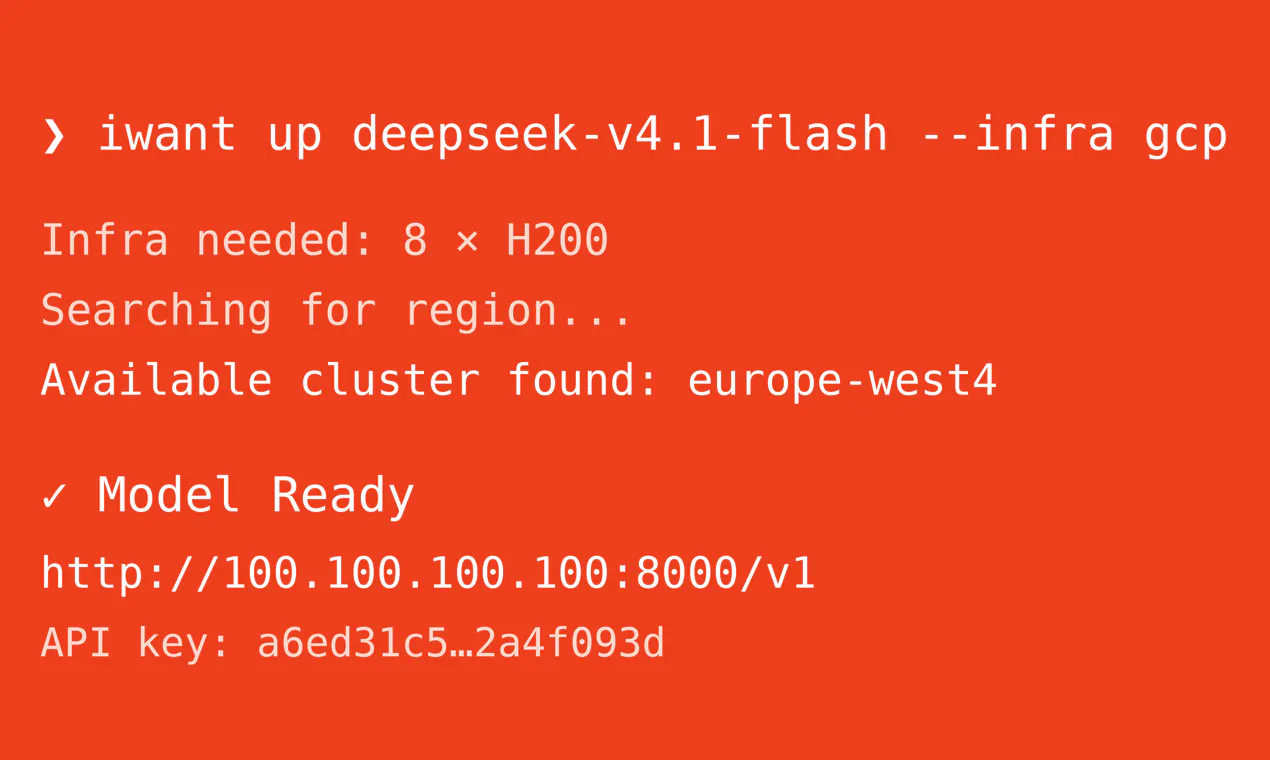
Host your own DeepSeek, Kimi, Minimax, MiMo, Step with with one command. iwant hunts across GCP regions for available GPUs, then handles provisioning, model downloads, and vLLM setup. One command gives you an OpenAI-compatible endpoint, an API key, and SSH access.
AI Analysis
iwant is an open-source tool that simplifies hosting local LLMs like DeepSeek, Kimi, Minimax, MiMo, and Step. With one command, it scans GCP regions for available GPUs, provisions instances, downloads models, sets up vLLM, and provides an OpenAI-compatible endpoint, API key, and SSH access. It solves the pain of manual GPU hunting, complex cloud setup, and model deployment for developers and AI enthusiasts. Core value: instant, cost-effective local LLM hosting without infrastructure headaches.
The timing is favorable as 2025-2026 sees explosive open-source LLM growth, GPU scarcity, and rising demand for private/local inference amid privacy concerns and API cost volatility. Cloud GPU availability remains challenging, making automated provisioning tools highly relevant. Rating: Excellent Timing.
Technically feasible using existing GCP APIs, Terraform/Ansible-like provisioning, and vLLM. Main challenges are GCP quota management, variable GPU pricing/availability, and robust error handling across regions. Operational costs depend on GPU usage; open-source nature aids community contributions. Scalability is good but requires monitoring for production use. Overall rating: High feasibility with moderate operational complexity.
Primary users: AI/ML developers, researchers, indie hackers, and small teams wanting affordable local LLM inference (demographics: tech-savvy, 25-45 years old, global with heavy US/Europe/Asia concentration). Industries: AI startups, research labs, enterprises needing private models. TAM is part of the multi-billion LLM tooling market; SOM likely several million USD annually among open-source cloud automation users. Pain points include high API costs, data privacy, and setup friction. Willingness to pay: moderate (prefer free/open-source but value time-saving premium features).
Competition Level: Medium. Direct alternatives: 1) vLLM + manual GCP scripts (github.com/vllm-project/vllm); 2) RunPod / Vast.ai serverless GPU platforms (runpod.io, vast.ai); 3) Ollama + cloud wrappers; 4) Hugging Face Inference Endpoints; 5) Local tools like LM Studio or PrivateGPT. Advantages: one-command automation, GCP focus with multi-region hunting, built-in OpenAI compatibility. Disadvantages: GCP-only (no multi-cloud), early-stage open-source project (potential stability issues), no managed hosting tier. Strong differentiation in simplicity for GCP users but faces pressure from broader GPU marketplaces.
Upgrade Pro to unlock full AI analysis
Similar Products

Cohere Parse 5
Turn complex docs, tables & images into AI-ready data
▲ 158 votes

Adapt
The company brain that gets work done
▲ 124 votes

Replay QA Security Scan
Automated Penetration Testing for AI-Built Apps
▲ 102 votes

WikiFix for Confluence
Find and fix issues in your knowledge base
▲ 86 votes

Audryo
Customer email your agent can operate.
▲ 68 votes

Refoid
Automate App Store refund responses and track every outcome
▲ 68 votes