
judged.systems
The judgment API platform for support systems.
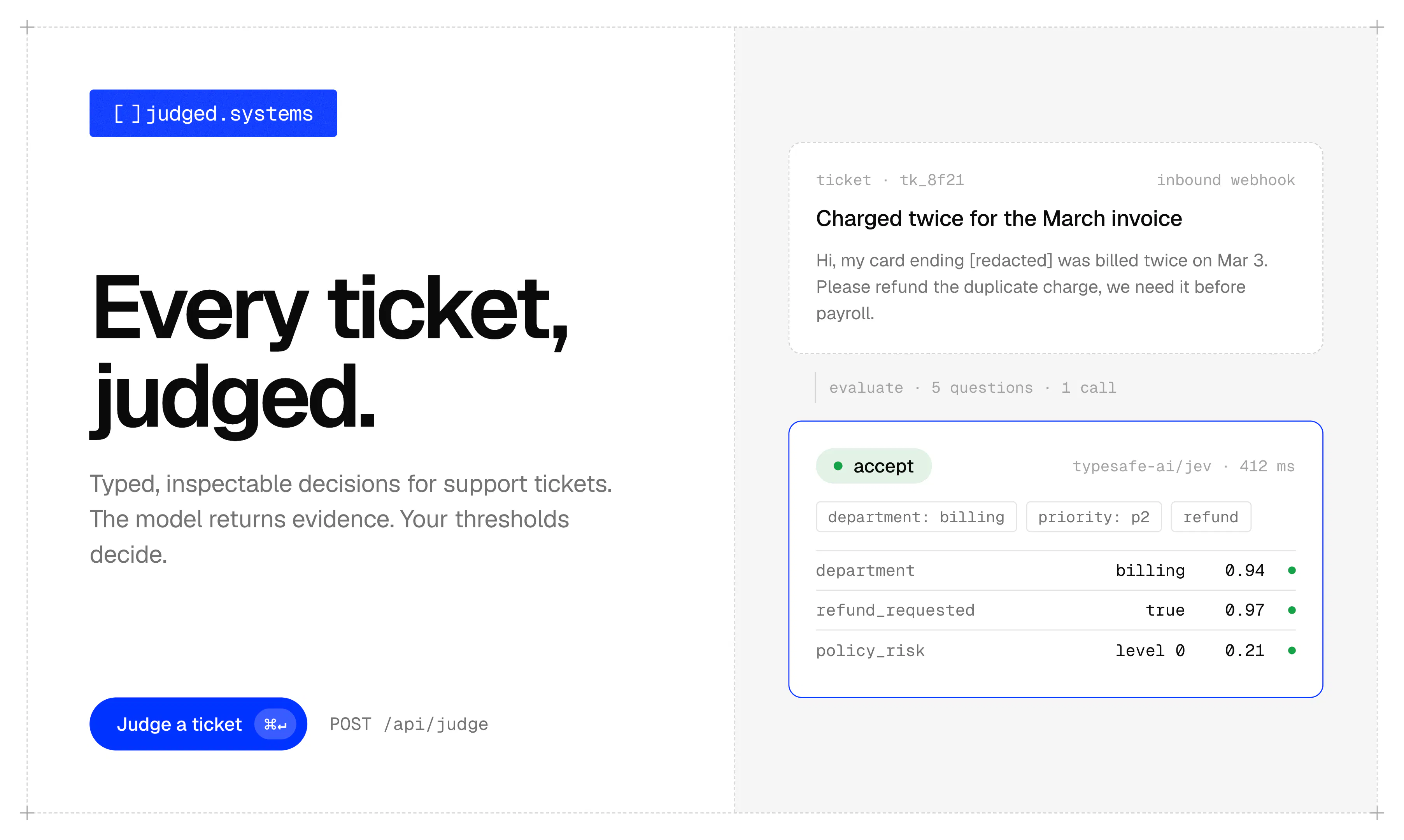
Support systems call judged.systems when a ticket needs a judgment. The helpdesk stays the system of record. You send the ticket. A pack defines the questions: queue, urgency, refund request, policy risk. Back comes a choice and its probabilities, a score on a rubric, or the probability a statement is true. Your thresholds return accept or review. A failed call stays in review. The ticket is redacted first. The evaluation is stored as it happened. A label on a miss leaves it untouched.
AI Analysis
judged.systems is a judgment API platform for customer support systems. Support teams send tickets along with a 'pack' defining evaluation criteria such as queue, urgency, refund requests, or policy risks. It returns choices with probabilities, rubric scores, or statement truth probabilities. Thresholds determine accept or review outcomes, with failed calls defaulting to review. Key features include automatic ticket redaction for privacy, immutable storage of evaluations, and maintaining the helpdesk as the system of record. It solves pain points of time-consuming, inconsistent manual judgments in high-volume environments. USP is its specialized, auditable AI judgments that integrate without replacing existing systems. Value proposition: efficient, reliable automation with control and compliance.
In 2025-2026, market timing is favorable due to maturing LLM technology for nuanced decisions, growing demand for AI augmentation in customer support to handle rising ticket volumes and labor costs, and enterprise focus on auditable AI tools amid regulatory emphasis on transparency. It aligns with trends toward specialized APIs that enhance rather than replace existing helpdesks. Excellent Timing.
Feasibility is High. Technical difficulty is moderate as it builds on mature LLM APIs with added logic for redaction, packs, and thresholds. Development and operation costs are manageable but include AI inference fees that scale with usage. Privacy compliance is addressed via built-in redaction; scalability is strong via cloud infrastructure. Low supply chain risk as a pure software API.
Main target segments: Developers and operators of helpdesk/support systems in SaaS, e-commerce, and service industries; mid-to-large enterprises with high ticket volumes. Geographic focus: primarily North America and Europe. Core pain points: manual review bottlenecks, judgment inconsistency, and lack of audit trails. Estimated market is part of the growing AI customer service sector with strong demand. Potential willingness to pay is high for tools reducing operational overhead via usage-based API pricing.
Medium. Direct competitors: 1. Forethought (forethought.ai), 2. Zendesk AI (zendesk.com), 3. Intercom (intercom.com), 4. Sierra (sierra.ai). Advantages: more specialized judgment API with explicit probabilities, redaction, and non-replacement integration; strong auditability. Disadvantages: narrower scope than full-suite AI support platforms; requires custom integration; less established brand.
Upgrade Pro to unlock full AI analysis
Similar Products

Cohere Parse 5
Turn complex docs, tables & images into AI-ready data
▲ 158 votes

Adapt
The company brain that gets work done
▲ 124 votes

Replay QA Security Scan
Automated Penetration Testing for AI-Built Apps
▲ 102 votes

WikiFix for Confluence
Find and fix issues in your knowledge base
▲ 86 votes

Audryo
Customer email your agent can operate.
▲ 68 votes

Refoid
Automate App Store refund responses and track every outcome
▲ 68 votes