
Kaiku
The task tracker your AI agents already know how to use
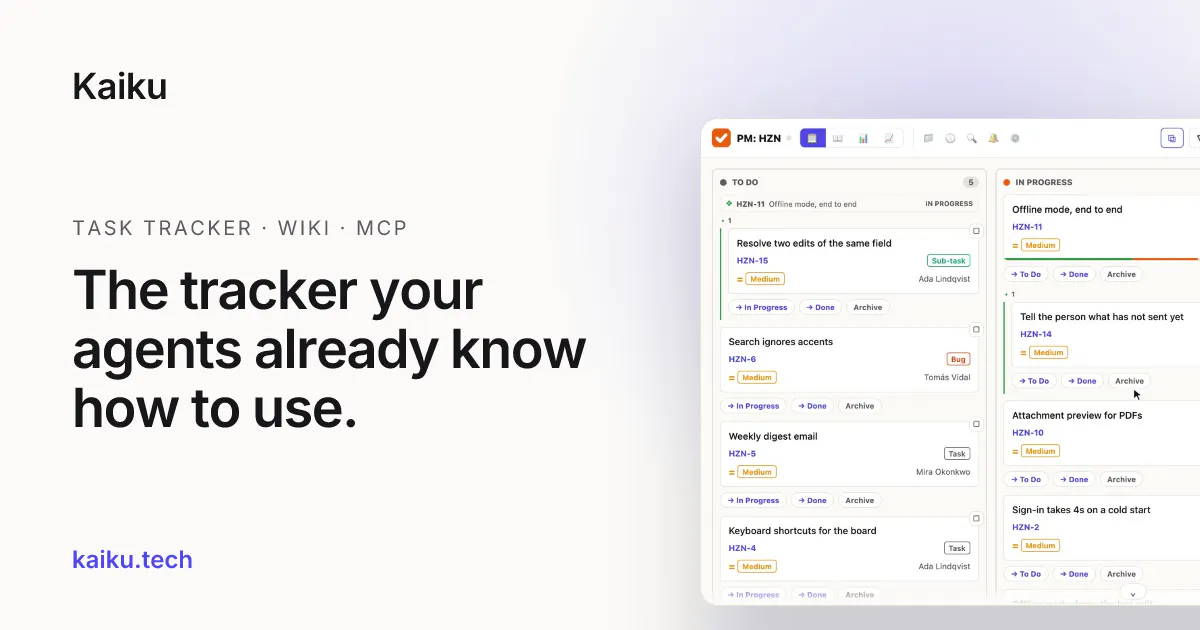
A task tracker and wiki built for teams whose work is increasingly done by AI agents. It speaks the API of the tracker most companies already run, so the MCP servers your agents use work unchanged. Built-in MCP server for Claude Code and Cursor, agents you call in a comment that propose but never decide, and every agent run's cost recorded on the issue it worked on.
AI Analysis
Kaiku is a task tracker and wiki built for teams increasingly relying on AI agents. Core features include API compatibility with existing company trackers (so MCP servers remain unchanged), a built-in MCP server for Claude Code and Cursor, agents that propose changes in comments but never decide, and automatic recording of each agent's run cost on the relevant issue. It addresses key pain points like managing hybrid human-AI workflows, maintaining transparency in AI contributions, tracking costs, and integrating AI without disrupting current tools. The value proposition is an AI-native task management system that agents already know how to use, boosting productivity and visibility in AI-augmented teams.
The market timing is favorable for 2025-2026 as AI agents (especially with models like Claude and tools like Cursor) are seeing rapid adoption in developer workflows. Technology maturity in AI coding assistants is high, user demands are shifting toward seamless human-AI collaboration and cost transparency tools. Economic pressures favor productivity gains from AI, with supportive policies for tech innovation. This is an Excellent Timing as the industry is at an inflection point for agent-native tools.
Overall feasibility is High. Technical difficulty is moderate as it builds on existing APIs and AI integrations (MCP servers), but requires robust compatibility and cost-tracking systems. Development and operation costs are typical for a SaaS developer tool with cloud hosting. Low supply chain risks; compliance risks include data privacy for team wikis. Strong scalability potential via cloud infrastructure and focused scope on AI-agent workflows. Team fit is ideal for those experienced in AI/dev tools.
Main target users: Software engineering and AI development teams in tech companies and startups, demographics 25-45 years old, tech-savvy professionals. Industries: Software development, AI/ML. Geographic: Primarily US and Europe with global remote teams. Estimated market size: TAM for AI dev tools ~$15B by 2026, SAM for AI task management ~$800M, SOM ~$50M initially. Core pain points: Lack of visibility and control in AI agent tasks, cost overruns, integration friction. High willingness to pay for specialized tools that save engineering time (likely $10-50/user/month).
Competition level: Medium. Direct competitors: 1. Linear (linear.app), 2. Jira (atlassian.com), 3. GitHub Issues (github.com/features/issues), 4. Cursor (cursor.com) built-in tools, 5. Aider (aider.chat). Advantages: Unique AI-agent focus with seamless MCP compatibility, cost tracking per issue, proposal-only agents. Disadvantages: Newer product with potentially fewer general features and integrations than established tools like Jira/Linear; limited brand recognition. Strong differentiation in the emerging AI agent management niche reduces direct pressure.
Upgrade Pro to unlock full AI analysis
Similar Products

Cohere Parse 5
Turn complex docs, tables & images into AI-ready data
▲ 158 votes

Opaline
PostHog for team Claude Code and Codex sessions.
▲ 141 votes

Adapt
The company brain that gets work done
▲ 124 votes

Tapfree for Chrome
Voice dictation that adapts to what’s on your screen
▲ 122 votes

Replay QA Security Scan
Automated Penetration Testing for AI-Built Apps
▲ 102 votes

Refoid
Automate App Store refund responses and track every outcome
▲ 68 votes