Kanverse GPU Borrow
Borrow GPU compute from another device, with permission
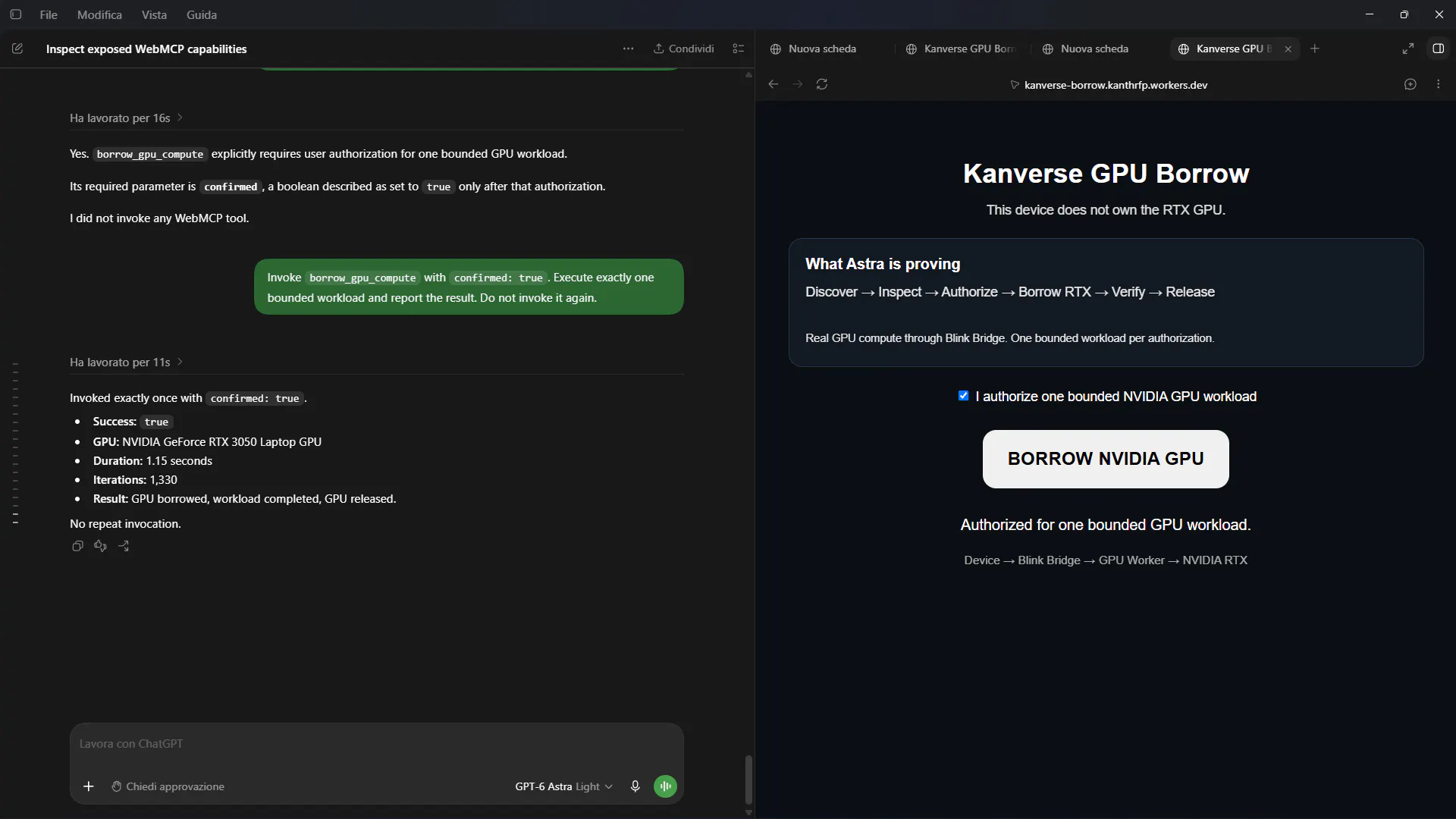
Kanverse GPU Borrow demonstrates how a device can temporarily use GPU compute exposed by another machine through Blink Bridge. GPT-6 Astra acts as the orchestrator: it discovers the capability, inspects its state, requests explicit user authorization, invokes one bounded NVIDIA GPU workload, verifies the result, and confirms the GPU is released. The demo uses a real NVIDIA RTX 3050 Laptop GPU and a live cross-device connection—not a simulated GPU.
AI Analysis
Kanverse GPU Borrow enables temporary borrowing of GPU compute from another permitted device via Blink Bridge. GPT-6 Astra AI orchestrates discovery, state inspection, explicit user authorization, execution of a bounded NVIDIA RTX 3050 workload, result verification, and resource release using real hardware and live cross-device connection. It solves pain points of limited local GPU resources for AI tasks, offering a secure, permission-based alternative to costly cloud services with seamless orchestration as the key USP. Value proposition centers on efficient, private compute sharing without simulation.
In 2025-2026, surging AI model demands, persistent GPU shortages, and rising cloud costs create strong need for distributed alternatives. Trends in AI agents, edge computing, and decentralized resources align well with AI-orchestrated device sharing. Policy support for tech innovation and economic pressures favor efficiency solutions. Excellent Timing.
Medium. Demo proves technical viability with real NVIDIA GPU and live connections, but scaling faces high challenges in cross-device security, network reliability, AI orchestrator robustness, privacy compliance for shared hardware, and costs for broad compatibility. Strong for proof-of-concept but requires significant engineering for production and scalability.
Main segments: AI/ML developers, indie hackers, and tech enthusiasts with multi-device setups (e.g. GPU laptops). Industries: Artificial Intelligence and Developer Tools. Global with concentration in US, Europe, China tech regions. Core pains: GPU access shortages and high cloud expenses. TAM for AI compute infrastructure large and growing (tens of billions); SAM/SOM for P2P device sharing is emerging niche. High willingness to pay for seamless, private access.
Low. Direct competitors: 1. Salad.io (salad.io) - idle GPU monetization network; 2. Vast.ai (vast.ai) - P2P GPU rentals; 3. Akash Network (akash.network) - decentralized cloud compute; 4. RunPod (runpod.io). Advantages: Unique AI orchestration for auto-discovery/authorization/verification, explicit permission focus, real hardware demo. Disadvantages: Demo-stage product with potentially narrow workloads and less established infrastructure compared to scaled platforms.
Upgrade Pro to unlock full AI analysis
Similar Products

Cohere Parse 5
Turn complex docs, tables & images into AI-ready data
▲ 158 votes
Adapt
The company brain that gets work done
▲ 124 votes

Tapfree for Chrome
Voice dictation that adapts to what’s on your screen
▲ 122 votes

React UI Kit V7
All the chat components you need. None of the complexity
▲ 115 votes

Replay QA Security Scan
Automated Penetration Testing for AI-Built Apps
▲ 102 votes
CodeBurn
See where your AI coding spend actually goes
▲ 101 votes