
Kastra
Runtime authorization for Claude, Cursor, Codex and OpenClaw
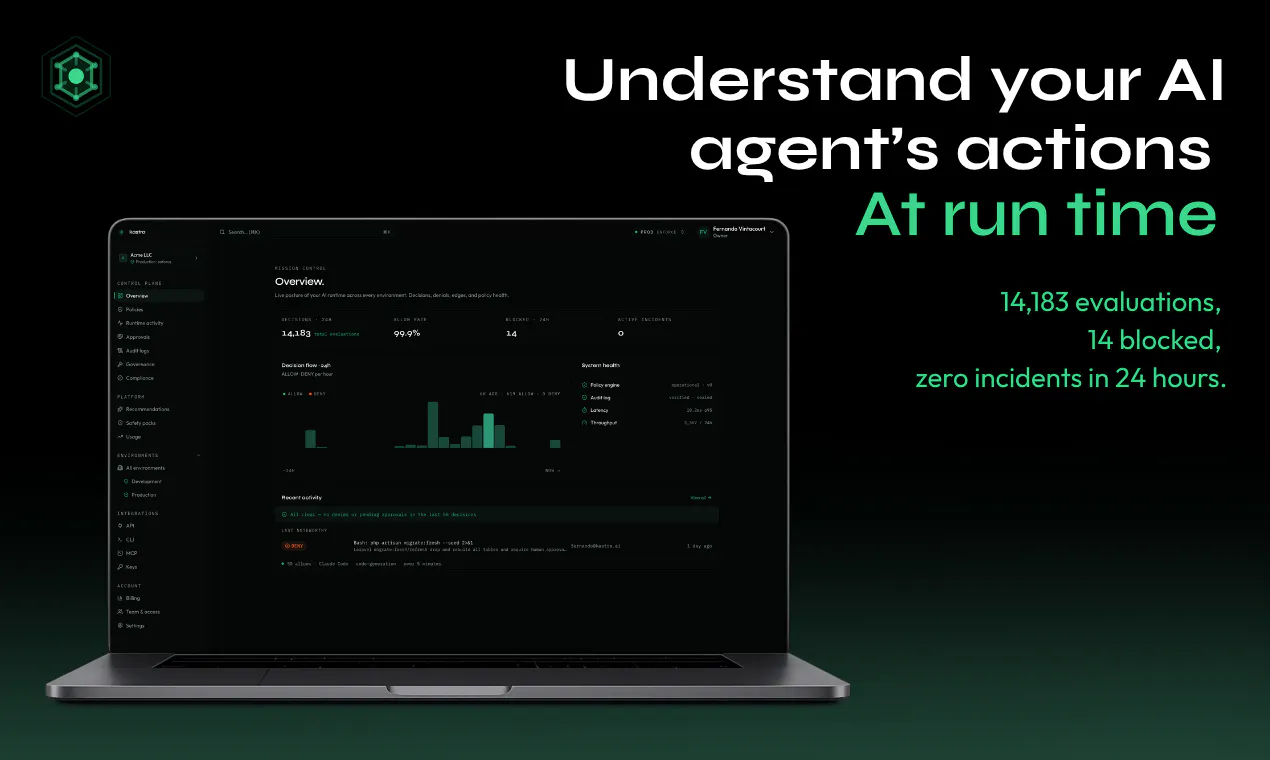
Kastra is the runtime authorization layer for AI agents. It decides what agents can and cannot do before actions execute, enforcing policies with sub-1 ms latency across tools, prompts, inputs, and outputs. Use one control plane to govern agents and policies across Claude Code, Cursor, Codex, OpenClaw, the Anthropic SDK, the OpenAI SDK, and more. Prevent unauthorized tool use, prompt injection, and exposure of sensitive data before they become incidents. Trust the rules, not the agents.
AI Analysis
Kastra is the runtime authorization layer for AI agents. It enforces policies on tools, prompts, inputs, and outputs before actions execute, with sub-1ms latency. It supports a unified control plane across Claude Code, Cursor, Codex, OpenClaw, Anthropic SDK, OpenAI SDK, and more. Key features prevent unauthorized tool use, prompt injection, and sensitive data exposure. It solves critical security incidents caused by unpredictable AI agent behaviors by shifting trust to enforceable rules rather than the agents themselves. The value proposition is secure governance for AI development workflows.
In 2025-2026, explosive growth of agentic AI tools like Claude and Cursor drives urgent demand for security layers as incidents of prompt injection and data leaks rise. Low-latency interception tech is mature, user needs for governance have intensified, and global AI regulations emphasize safety. This aligns perfectly with enterprise adoption trends. Excellent Timing.
Technically demanding to maintain sub-ms latency and compatibility across rapidly evolving SDKs and tools, but feasible via proxy/hook architectures. Moderate development and operation costs with ongoing integration needs. Compliance risks around data privacy are present but standard for security tools. Strong scalability as a cloud control plane. Overall High.
Main segments: AI developers, software engineering teams, and security officers in tech enterprises using agentic coding tools. Primarily North America and Europe tech hubs. AI agent security market shows strong demand with expanding TAM. Core pain points: uncontrolled agent actions leading to breaches and compliance issues. High willingness to pay for preventive, low-latency governance solutions via subscriptions.
Medium. Direct competitors: 1. Lakera (lakera.ai), 2. Patronus AI (patronus.ai), 3. Guardrails AI (guardrailsai.com), 4. Protect AI (protectai.com), 5. NVIDIA NeMo Guardrails (nvidia.com). Advantages: specialized ultra-low latency runtime auth for specific dev tools like Cursor/Claude with unified control plane. Disadvantages: newer entrant with potentially narrower scope and less established enterprise trust compared to broader AI safety platforms.
Upgrade Pro to unlock full AI analysis
Similar Products

Cohere Parse 5
Turn complex docs, tables & images into AI-ready data
▲ 158 votes

Adapt
The company brain that gets work done
▲ 124 votes

Replay QA Security Scan
Automated Penetration Testing for AI-Built Apps
▲ 102 votes

WikiFix for Confluence
Find and fix issues in your knowledge base
▲ 86 votes

Audryo
Customer email your agent can operate.
▲ 68 votes
Refoid
Automate App Store refund responses and track every outcome
▲ 68 votes