
Keen Code
A context-efficient CLI coding agent built by agents
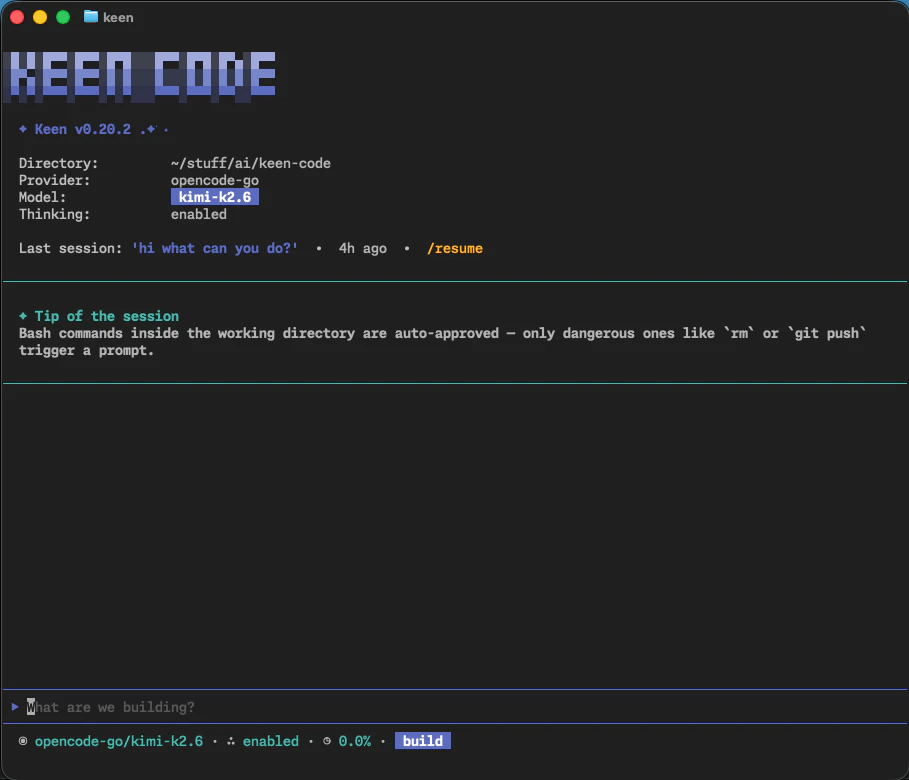
Keen Code is an open-source, context-aware and efficient CLI coding agent written in Go. Three aspects stand it out from other similar products: - It was built from scratch by coding agents, with the full prompt/design trail preserved and shared in the repo. - It uses turn memory to keep multi-turn sessions lean which saves context significantly. - It maps MCP servers to lazy-loaded Skills instead of stuffing large schemas into context upfront. This again saves context in mult-MCP setting.
AI Analysis
Keen Code is an open-source, context-aware CLI coding agent written in Go. Core features include turn memory for lean multi-turn sessions and lazy-loaded Skills from mapped MCP servers, avoiding upfront large schema injection. It stands out as it was built entirely by coding agents from scratch, with the full prompt and design trail shared openly in the GitHub repo. It solves key pain points of context bloat, high token costs, and inefficiency in existing AI coding agents during extended or multi-tool interactions. The value proposition is a transparent, highly efficient, and cost-saving AI developer tool that prioritizes practicality for complex coding workflows.
In 2025-2026, market timing is favorable with surging adoption of AI coding agents amid maturing LLMs. Context window and token cost challenges persist, driving demand for efficiency innovations. Developer workflows are rapidly integrating AI, supported by open-source trends. This aligns perfectly with industry needs for optimized, practical tools. Excellent Timing.
High. Technical implementation in Go using existing LLMs is proven (product already built). Moderate development costs as open-source with community potential. Minimal supply chain or compliance risks for a CLI dev tool. Strong scalability via context optimizations and high team fit for AI-focused developers. Community contributions from transparent repo enhance long-term feasibility.
Main segments: Software developers, AI engineers, and open-source contributors (ages 25-45, tech-savvy). Industries: Software development and IT services. Geographic: Global with concentration in US, Europe, and Asia tech hubs. TAM for AI developer tools exceeds $10B by 2026; SAM for CLI coding agents ~$500M; SOM niche efficiency tools ~$50M. Core pains: Context inefficiency raising costs and limiting sessions. High willingness to pay for productivity gains via API credits or premium tiers.
Medium. Direct competitors: 1. Aider (aider.chat), 2. OpenDevin (github.com/OpenDevin/OpenDevin), 3. Continue (continue.dev), 4. Sweep AI (sweep.dev). Advantages: Superior context efficiency via turn memory and lazy-loading, unique 'built-by-agents' transparency with shared prompts. Disadvantages: Newer with potentially smaller community/ecosystem than Aider or Continue; lacks deep IDE integrations; relies on external LLMs without proprietary model advantages.
Upgrade Pro to unlock full AI analysis
Similar Products

Cohere Parse 5
Turn complex docs, tables & images into AI-ready data
▲ 158 votes

Adapt
The company brain that gets work done
▲ 124 votes

Replay QA Security Scan
Automated Penetration Testing for AI-Built Apps
▲ 102 votes

WikiFix for Confluence
Find and fix issues in your knowledge base
▲ 86 votes

Audryo
Customer email your agent can operate.
▲ 68 votes

Refoid
Automate App Store refund responses and track every outcome
▲ 68 votes