
Kogvio
Understand anything online without leaving the page.
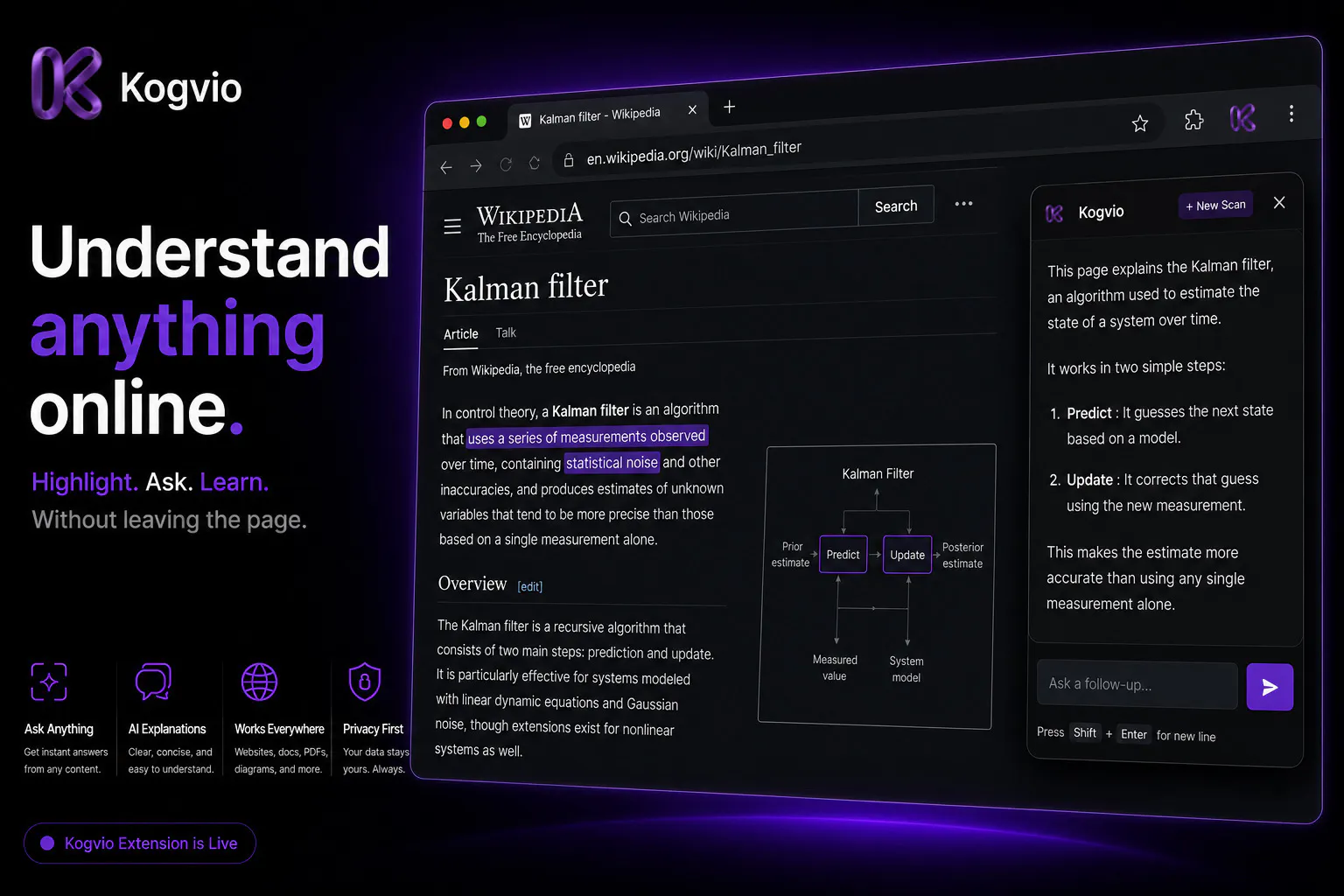
Every time I didn't understand something online, I had the same workflow: Copy. Open ChatGPT. Paste. Come back. It completely broke my focus. So I built Kogvio. Highlight anything on a webpage or PDF, ask questions instantly in context, and continue learning without leaving the page. Whether it's documentation, research papers, medical textbooks, or technical diagrams, Kogvio helps you understand—not just search.
AI Analysis
Kogvio is a browser extension that enables users to highlight text or elements on any webpage or PDF, then ask AI questions in full context without copying, switching tabs, or opening separate apps like ChatGPT. It directly solves the pain of broken focus and workflow disruption during online learning or research. Core features include instant in-page Q&A, support for technical diagrams, research papers, medical textbooks, and documentation. The unique selling point is seamless contextual understanding that keeps users immersed. Overall value proposition: transform passive browsing into interactive, efficient knowledge acquisition for deeper comprehension.
In 2025-2026, timing is strong due to mature LLM capabilities enabling reliable contextual AI, surging demand for distraction-free productivity tools amid remote work and digital education growth, and browser AI integration trends. User frustration with tab-switching workflows is well-documented, and economic conditions favor efficiency-enhancing SaaS. No significant policy barriers for such tools. Excellent Timing.
High technical feasibility using established browser extension APIs (Chrome/Firefox) and third-party LLM services for context injection. Moderate development and operation costs centered on API usage fees and maintenance. Low supply chain risk; main challenges are data privacy compliance (e.g. GDPR for page content) and scalability of inference costs. Good scalability potential via cloud. Fits a solo or small technical team with AI/extension experience, as evidenced by the founder building it to solve personal pain. High.
Main segments: tech-savvy students, researchers, developers, medical professionals, and knowledge workers (ages 18-45) in education, R&D, healthcare, and software industries. Geographically global with heavy adoption in North America, Europe, and East Asia. Estimated market size: TAM for AI productivity/learning tools exceeds $15B, SAM for browser-based AI assistants ~$1-2B, SOM for contextual page tools ~$200M+. Core pain points: context loss and focus breaks during research. High willingness to pay for premium unlimited access via subscriptions.
Medium. Direct competitors: 1. Monica (monica.im) - AI web sidebar assistant. 2. Merlin AI (merlin.foyer.work) - browser AI copilot. 3. PDF.ai (pdf.ai) - AI chat for documents. 4. Humata (humata.ai) - AI for research papers/PDFs. 5. Glasp (glasp.co) - AI-powered social highlighter. Advantages vs competitors: tighter in-page integration without sidebar intrusion, strong emphasis on diagrams and instant highlight-to-ask for any webpage. Disadvantages: newer with potentially smaller feature set, reliance on external LLMs may lead to variable performance, less brand recognition than established players.
Upgrade Pro to unlock full AI analysis
Similar Products

Cohere Parse 5
Turn complex docs, tables & images into AI-ready data
▲ 158 votes

Adapt
The company brain that gets work done
▲ 124 votes

Replay QA Security Scan
Automated Penetration Testing for AI-Built Apps
▲ 102 votes

WikiFix for Confluence
Find and fix issues in your knowledge base
▲ 86 votes

Audryo
Customer email your agent can operate.
▲ 68 votes

Refoid
Automate App Store refund responses and track every outcome
▲ 68 votes