
Kuku: open source
Your open-source, local second brain for every AI
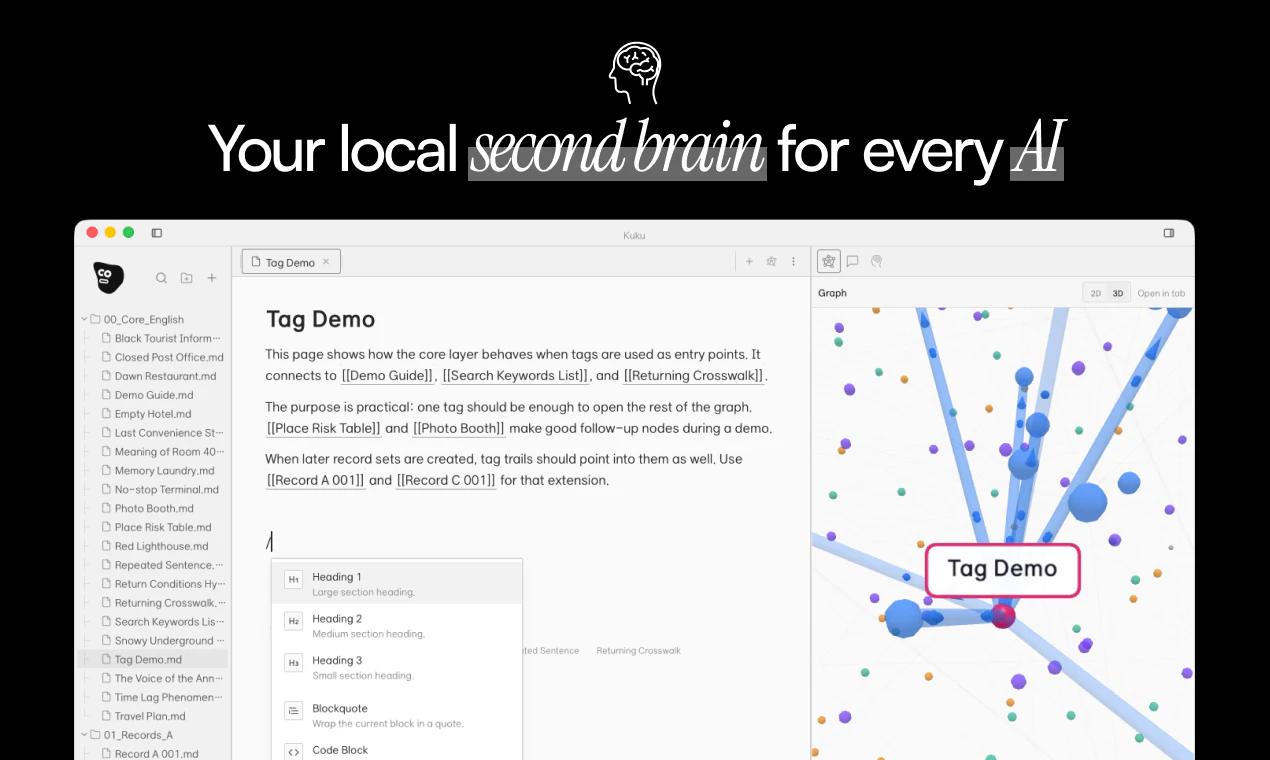
Kuku is back as an open-source, local-first second brain for the AI era. It keeps your knowledge in plain Markdown files, then turns your vault into reusable context: wikilinks, backlinks, graph, search, and AI-assisted edits with reviewable diffs. Unlike closed note apps or one-off AI chats, Kuku is built to make your memory portable across tools, models, and self-hosted setups.
AI Analysis
Kuku is an open-source, local-first second brain for the AI era. It stores knowledge in plain Markdown files with features like wikilinks, backlinks, knowledge graph, search, and AI-assisted edits featuring reviewable diffs. Unique selling points include full data ownership, portability across AI tools/models, and avoidance of lock-in from closed apps. It solves key user pain points such as fragmented knowledge, ephemeral AI chats without reusable context, and lack of control in proprietary note systems. The value proposition is a persistent, user-controlled memory layer that enhances productivity while remaining fully interoperable and self-hosted.
In 2025-2026, timing is strong with maturing local/open-source LLMs, rising privacy demands, backlash against cloud vendor lock-in, and user shift toward persistent AI knowledge tools over transient chats. Economic pressures on SaaS costs and policy emphasis on data sovereignty further support local-first solutions. Excellent Timing.
Technical difficulty is manageable using existing Markdown ecosystems, open-source graph libraries, and local AI integrations. Low operational costs due to local-first design (minimal servers). Limited supply chain or compliance risks for an open-source desktop tool. High scalability via community contributions. Overall High with strong potential for self-hosted setups.
Primary users: developers, researchers, writers, and AI enthusiasts (ages 25-45) in tech/creative industries; global with concentration in US, Europe, China tech hubs. TAM for PKM tools approx. $10B+, SAM for AI-integrated local notes $1-2B, SOM for open-source segment several hundred million. Pain points: data silos, non-reusable AI outputs, loss of control. High willingness to pay for advanced features, support, or related hosted services despite core being free/open-source.
Medium. Direct competitors: 1. Obsidian (obsidian.md), 2. Logseq (logseq.com), 3. Roam Research (roamresearch.com), 4. Anytype (anytype.io), 5. Capacities (capacities.io). Advantages vs competitors: strict open-source/local Markdown focus, unique reviewable AI diffs for safe edits, superior portability across models. Disadvantages: likely smaller plugin ecosystem than Obsidian, less marketing polish than SaaS tools, requires user technical comfort for self-hosting.
Upgrade Pro to unlock full AI analysis
Similar Products

Widgo
AI Sales rep for your website visitors
▲ 360 votes

Load Nova
Dispatchers AI Co-Pilot and Dashboard that care about speed
▲ 131 votes

Adapt
The company brain that gets work done
▲ 124 votes

Onpilot
An AI workforce customized to your business
▲ 105 votes

Saldor
Speed up procurement and AP.
▲ 78 votes

Prowler Cloud
Where your AI agent becomes a cloud security defender
▲ 64 votes