
LLMTest
Use the right LLMs in your apps. Setup fallbacks. Be happy.
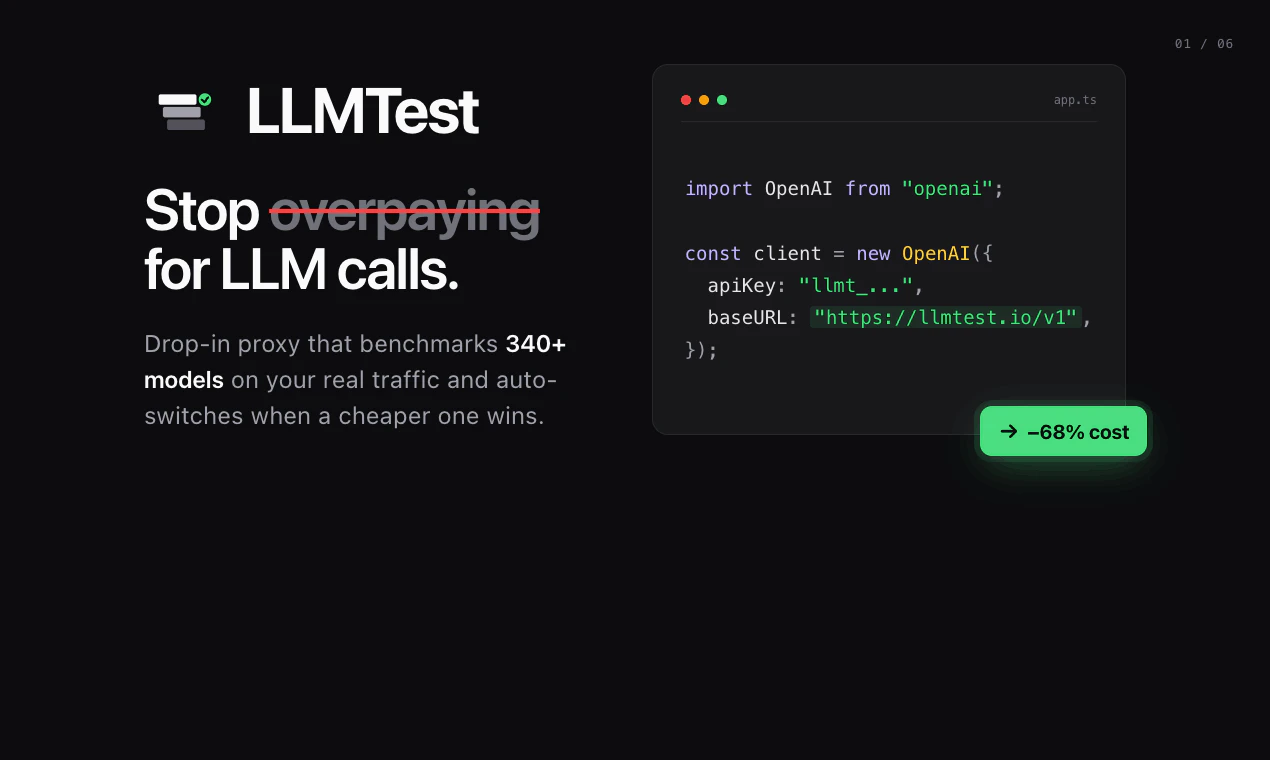
"OpenRouter + Intelligence" LLMTest helps devs and vibe coders automatically: ✅ Pick better models for AI-powered features (faster, cheaper, better, sometimes all 3 combined) ↪️ Automatically add fallbacks when LLM providers fail (API is overloaded or JSON format isn't respected) All through one single API and MCP functions so you can just tell Claude or Codex to optimize everything.
AI Analysis
LLMTest is a developer-focused tool described as 'OpenRouter + Intelligence' that automatically selects optimal LLMs for apps based on speed, cost, and performance. It sets up intelligent fallbacks for provider outages or formatting failures. Delivered via a single unified API and MCP functions, it allows AI models like Claude or Codex to optimize implementations. It solves key pain points including manual model selection, unreliable LLM APIs, inconsistent outputs, and integration complexity. The value proposition is simplified, reliable, and optimized AI feature deployment, enabling faster development and happier developers.
The market timing is favorable entering 2025-2026 amid explosive growth in AI application development, proliferation of diverse LLM providers, rising costs, and reliability concerns in production. Technology maturity in LLM routing is advancing, user demand is shifting toward abstraction tools that reduce complexity, and economic pressures favor cost-optimization solutions. Supportive AI innovation policies further boost the environment. This makes it an excellent time for intelligent LLM management tools. Rating: Excellent Timing.
Building the intelligent routing layer requires real-time benchmarking, performance data aggregation, and robust fallback mechanisms, presenting moderate technical difficulty. Development and operation costs are manageable for a SaaS API product. Scalability is strong with cloud infrastructure, though compliance risks around AI data handling and API dependencies exist. Suitable for teams with AI/ML expertise. Overall feasibility is high with good scalability potential. Rating: High
Primary target users are software developers, AI engineers, 'vibe coders', and teams building AI-powered features. Industries include tech startups, SaaS companies, and digital product developers. Geographic distribution is global with heavy concentration in US, Europe, and Asia tech hubs. The TAM for AI developer tools exceeds $20B, with SAM for LLM routing/optimization around $2-5B. Core pain points are inefficient model selection and production reliability. Users show strong willingness to pay for tools that reduce costs and engineering overhead, often via usage-based API pricing.
Competition level is Medium. Direct competitors: 1. OpenRouter (openrouter.ai), 2. LiteLLM (litellm.ai), 3. Portkey (portkey.ai), 4. Helicone (helicone.ai), 5. LangChain/LangSmith (langchain.com). This product's advantages include intelligent automatic model picking beyond basic routing, built-in fallbacks with MCP functions for AI self-optimization. Disadvantages: newer entrant with potentially fewer integrations than established players like OpenRouter or LiteLLM; limited public details on pricing, benchmarks, or proven scalability compared to competitors.
Upgrade Pro to unlock full AI analysis
Similar Products

Cohere Parse 5
Turn complex docs, tables & images into AI-ready data
▲ 158 votes

Adapt
The company brain that gets work done
▲ 124 votes

Replay QA Security Scan
Automated Penetration Testing for AI-Built Apps
▲ 102 votes

WikiFix for Confluence
Find and fix issues in your knowledge base
▲ 86 votes

Audryo
Customer email your agent can operate.
▲ 68 votes

Refoid
Automate App Store refund responses and track every outcome
▲ 68 votes