
LongCat-2.0
1.6T MoE trained entirely on AI ASICs
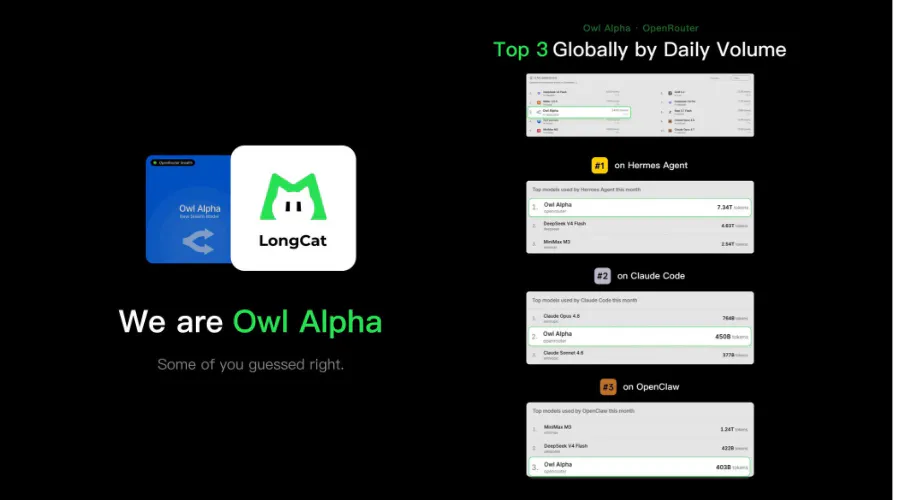
LongCat-2.0 is an MIT-licensed 1.6T-parameter MoE model with ~48B active parameters, 1M context, LongCat Sparse Attention, and post-training for coding and agentic workflows. It was trained on AI ASIC superpods and integrates with Claude Code, OpenClaw, and Hermes.
AI Analysis
LongCat-2.0 is an MIT-licensed open-source 1.6T-parameter MoE model with ~48B active parameters. Key features include a 1M token context window, proprietary LongCat Sparse Attention, and specialized post-training for coding and agentic workflows. Trained entirely on AI ASIC superpods, it integrates with Claude Code, OpenClaw, and Hermes. It solves pain points around reliance on closed-source APIs, limited context lengths in existing models, and the need for efficient, customizable AI for complex developer tasks. The value proposition is delivering a highly scalable, cost-effective, open alternative that empowers developers to build advanced coding tools and autonomous agents without proprietary restrictions.
The 2025-2026 period is highly favorable as the AI sector emphasizes efficient open-source models amid rising costs of proprietary APIs, maturing long-context and agentic AI applications, and growing demand for specialized coding tools. ASIC hardware for training is becoming more accessible, and policy support for open AI ecosystems is increasing globally. This aligns perfectly with user shifts toward customizable, transparent models. Excellent Timing.
High. The model has already been successfully trained on AI ASIC superpods, proving technical viability despite the complexity of 1.6T-scale MoE. Open MIT licensing minimizes distribution and legal risks with low operational costs for sharing weights. Challenges include high compute needs for inference, but the 48B active parameters improve efficiency and scalability. Strong team fit implied by completion on specialized hardware; good potential for community-driven improvements.
Primary segments: AI/ML engineers, software developers building coding assistants and AI agents, open-source enthusiasts, and tech startups/researchers. Industries include software development, AI R&D; geographic focus on US, Europe, and Asia tech hubs. TAM for open-source LLMs exceeds $10B within the broader $100B+ generative AI market by 2026. Core pain points are expensive API dependency, insufficient context for complex tasks, and customization limits. High willingness to pay for enterprise support, fine-tuning services, or optimized inference hosting.
Medium. Direct competitors: 1. Mixtral 8x22B (mistral.ai), 2. Llama 3.1 405B (meta.com/llama), 3. DeepSeek-V2 (deepseek.com), 4. Qwen2 (qwen.ai). Advantages vs competitors: significantly larger total parameter scale with efficient MoE activation, specialized post-training for coding/agentic use cases, unique sparse attention enabling true 1M context, and ASIC-trained optimization for potential cost/performance edge. Disadvantages: less mature ecosystem and community support than Llama or Mistral, potentially higher deployment complexity for average users, and fewer public benchmarks.
Upgrade Pro to unlock full AI analysis
Similar Products

Cohere Parse 5
Turn complex docs, tables & images into AI-ready data
▲ 158 votes

Opaline
PostHog for team Claude Code and Codex sessions.
▲ 141 votes

Adapt
The company brain that gets work done
▲ 124 votes

Tapfree for Chrome
Voice dictation that adapts to what’s on your screen
▲ 122 votes
CodeBurn
See where your AI coding spend actually goes
▲ 101 votes

WikiFix for Confluence
Find and fix issues in your knowledge base
▲ 86 votes