
M1 by Montage
Agentic UI that scales on demand
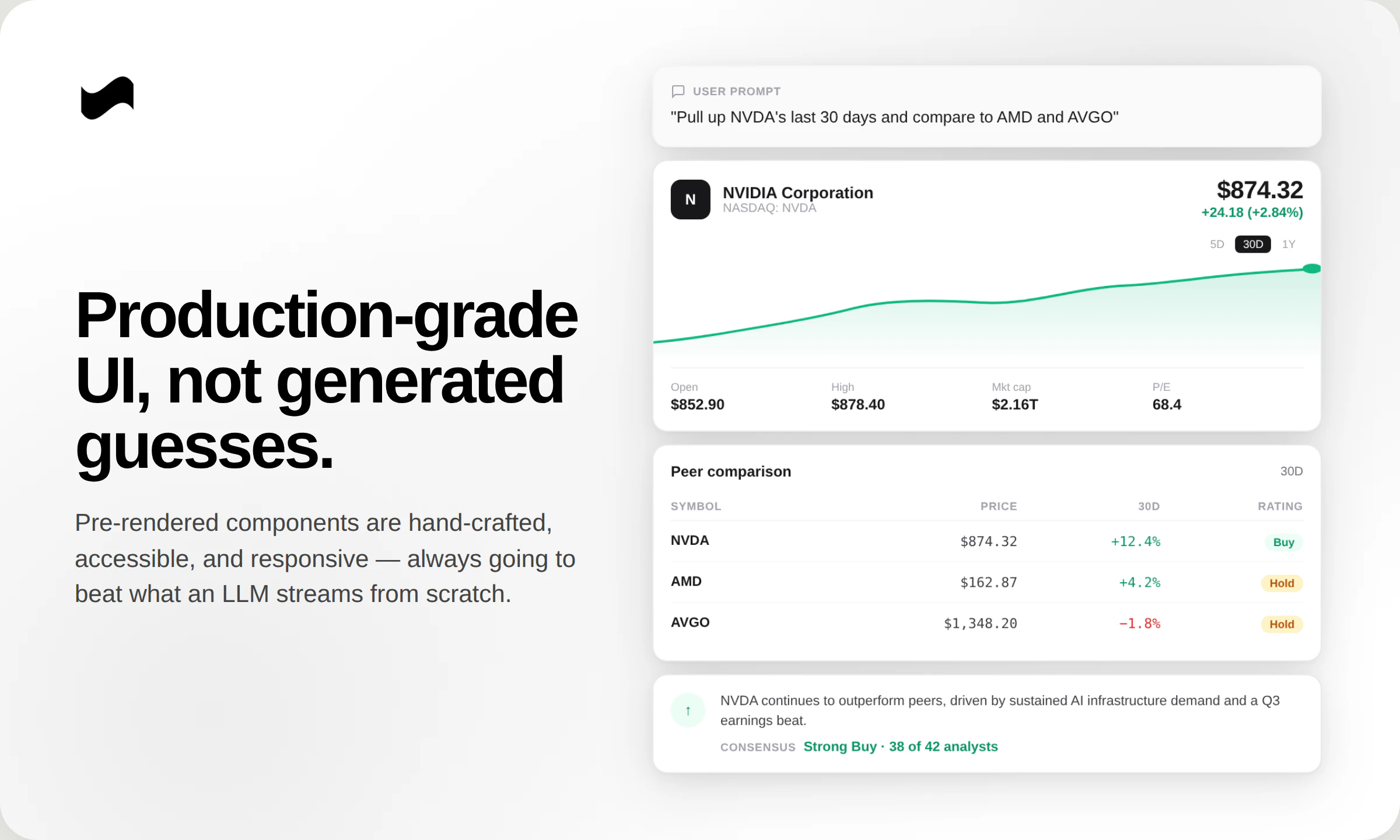
AI agents render UI slowly, expensively, inconsistently and inference bills balloon from it. Montage fixes it: emit a tiny intent schema, we compile production components server-side: 10x faster, 50-100x fewer tokens, model and framework agnostic. Now one M1 API call generates rich interactive visuals, hosts them as live UIs with persistent state, and styles to your brand. Don't let your agents reinvent UI every turn - ship them on Montage!
AI Analysis
M1 by Montage solves the problem of AI agents rendering UI slowly, expensively, inconsistently, and with ballooning inference costs. Instead of agents generating full UI each turn, users emit a tiny intent schema that Montage compiles into production-grade components server-side. This delivers 10x faster performance, 50-100x fewer tokens, and is compatible with any model or framework. One API call generates rich interactive visuals, hosts them as live UIs with persistent state, and applies custom brand styling. The value proposition is enabling developers to ship consistent, scalable, cost-efficient agentic interfaces without reinventing the UI wheel every interaction.
2025-2026 sees explosive growth in AI agents and autonomous systems, with rising concerns over inference costs and the need for seamless UX. Server-side rendering and component compilation technologies are mature, while demand for agent-framework agnostic tools is surging amid economic pressure to optimize AI spend. This makes it an ideal window before the market consolidates around a few standards. Rating: Excellent Timing.
Technically feasible leveraging existing server-side rendering, schema compilation, and cloud hosting tech. Moderate development costs for the compiler and stateful hosting infrastructure; operational costs lowered by drastic token reduction. Minimal supply chain risk; compliance mainly around data privacy for hosted UIs. Strong scalability via cloud. Team with web/AI expertise would fit well. Overall rating: High.
Primary users: AI/ML engineers, full-stack developers, and product teams building AI agents or copilots. Industries: SaaS, developer tools, enterprise AI applications. Geographic: Global with heavy concentration in US, Europe, and East Asia tech hubs. TAM for AI infrastructure and dev tools exceeds $15B by 2026; SAM for agent UI solutions estimated several hundred million; SOM for early adopters in the tens of millions. Pain points center on cost, consistency, and latency of AI UIs. High willingness to pay for direct inference savings and faster shipping.
Medium. Direct competitors: Vercel v0 (v0.dev), Chainlit (chainlit.io), Streamlit (streamlit.io), Gradio (gradio.app). Advantages vs competitors: dramatically lower token usage and latency via intent schema approach, built-in stateful UI hosting, model/framework agnostic design, and agent-specific optimization. Disadvantages: newer entrant with potentially smaller ecosystem and fewer pre-built components compared to mature tools like Streamlit or v0's design focus.
Upgrade Pro to unlock full AI analysis
Similar Products

Cohere Parse 5
Turn complex docs, tables & images into AI-ready data
▲ 158 votes

Adapt
The company brain that gets work done
▲ 124 votes

Replay QA Security Scan
Automated Penetration Testing for AI-Built Apps
▲ 102 votes

WikiFix for Confluence
Find and fix issues in your knowledge base
▲ 86 votes

Audryo
Customer email your agent can operate.
▲ 68 votes

Refoid
Automate App Store refund responses and track every outcome
▲ 68 votes