
Mastra Factory
From issue to production, run by agents.
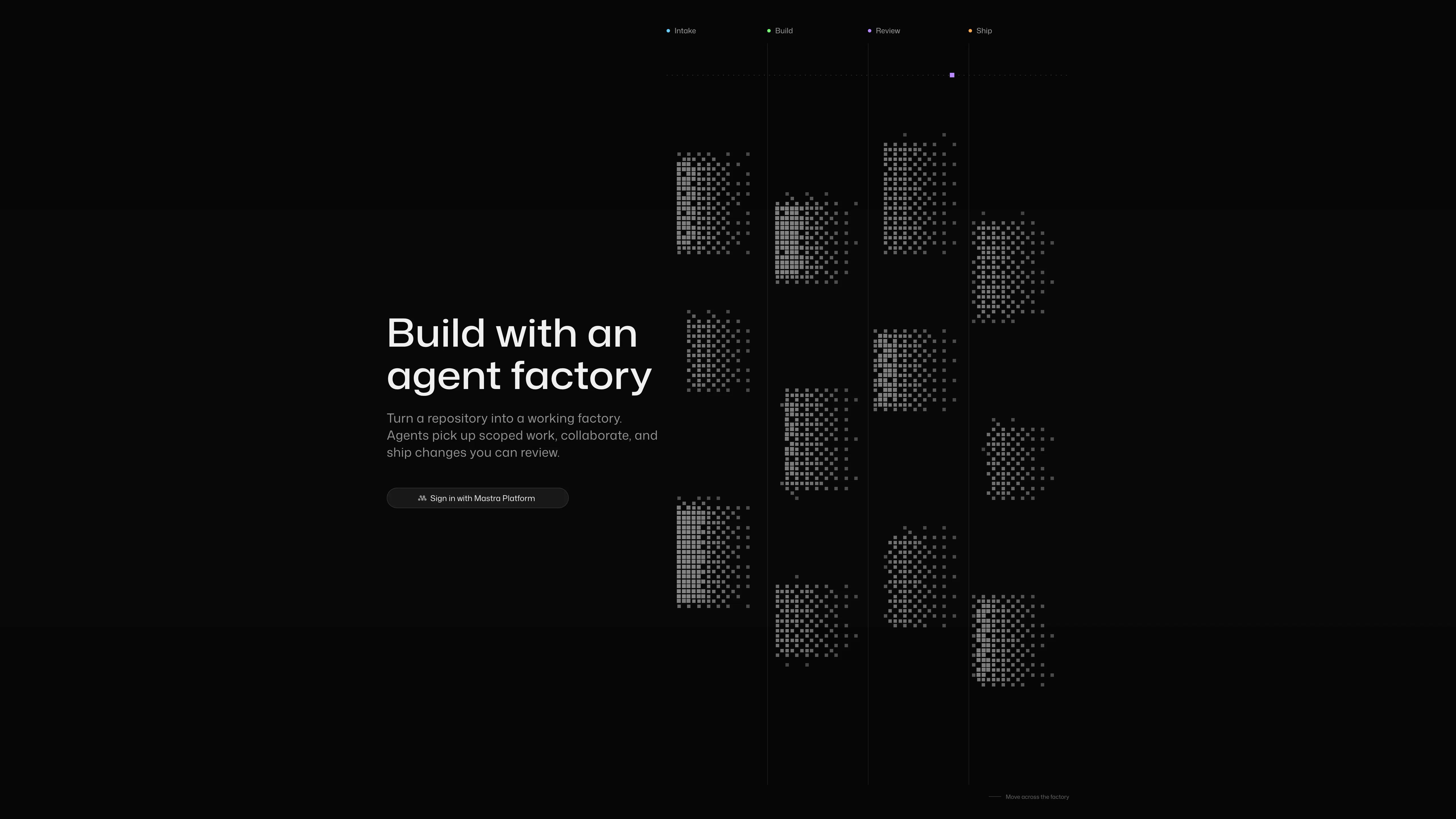
Mastra Factory is an open source, agent-powered software delivery environment. It combines persistent coding agents, repository workspaces, issue intake, planning, implementation, and pull request review in a web application you control.
AI Analysis
Mastra Factory is an open-source, agent-powered software delivery environment that automates the full cycle from issue intake to production. Core features include persistent coding agents, repository workspaces, planning, implementation, and pull request reviews, all within a self-hosted web application. It solves key pain points such as slow manual development processes, context loss in coding, and inefficient review cycles. Unique selling points are its open-source nature and user-controlled deployment, offering customization and data privacy. The value proposition is accelerating software delivery with reliable AI agents while maintaining full ownership and integration with existing GitHub workflows.
In 2025-2026, AI agent technology is reaching maturity with advanced LLMs capable of complex coding tasks, aligning with rising demand for automated DevOps amid developer shortages and efficiency pressures. Economic environments favor tools that reduce costs, and open-source policies support adoption. This is an excellent window before full market saturation. Excellent Timing.
Technical difficulty is medium-high as reliable multi-agent coordination for real-world coding remains challenging despite maturing LLMs. Development and operation costs are moderate for open-source (community-driven), with low supply chain risks but potential compliance issues in enterprise data handling. Strong scalability via self-hosting. Overall Medium feasibility due to execution risks in agent accuracy. Rating: Medium.
Main target segments: Software developers, engineering managers, and DevOps teams in tech startups, mid-sized firms, and enterprises focused on AI adoption; primarily in North America and Europe with global open-source users. Estimated TAM for AI-powered dev tools is $15B+, SAM for agent-based delivery platforms ~$3B, SOM for open-source self-hosted solutions ~$800M. Core pain points include lengthy release cycles and review bottlenecks. High willingness to pay for enterprise support or premium features despite open-source base.
Competition level: Medium. Direct competitors: 1. OpenDevin (github.com/OpenDevin/OpenDevin), 2. GitHub Copilot Workspace (github.com/features/copilot), 3. Aider (aider.chat), 4. Devin by Cognition Labs (cognition.ai), 5. SWE-agent (github.com/princeton-nlp/SWE-agent). Advantages: Fully integrated web-based self-hosted environment with persistent agents and end-to-end issue-to-PR flow; strong open-source customization. Disadvantages: Potentially less mature/polished than commercial tools, limited enterprise features/support compared to paid solutions, and faces challenges in agent reliability versus more established players.
Upgrade Pro to unlock full AI analysis
Similar Products

Cohere Parse 5
Turn complex docs, tables & images into AI-ready data
▲ 158 votes

Adapt
The company brain that gets work done
▲ 124 votes

Replay QA Security Scan
Automated Penetration Testing for AI-Built Apps
▲ 102 votes

WikiFix for Confluence
Find and fix issues in your knowledge base
▲ 86 votes

Audryo
Customer email your agent can operate.
▲ 68 votes

Refoid
Automate App Store refund responses and track every outcome
▲ 68 votes