
MemoryCustodian
Repo-native memory for coding agents
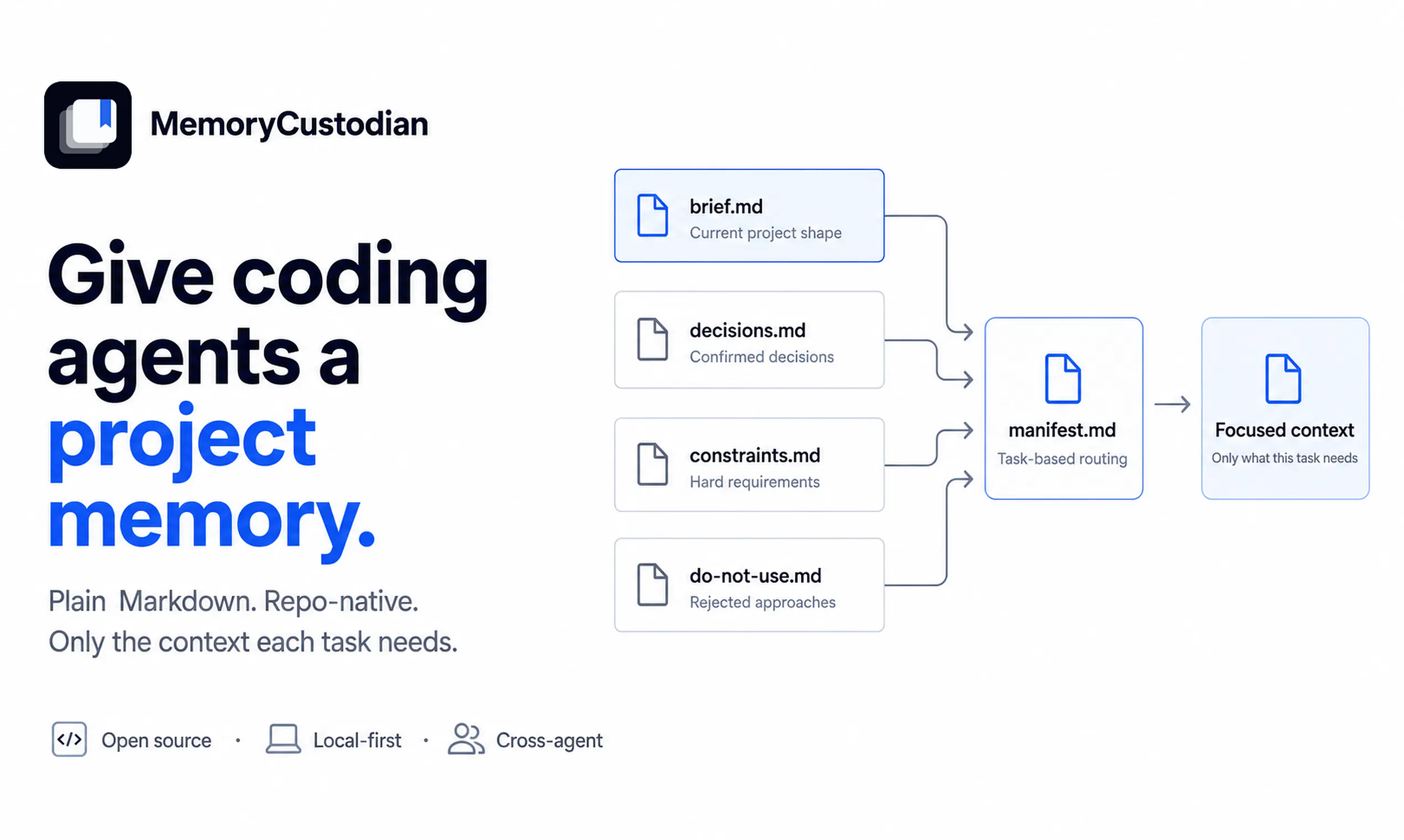
MemoryCustodian gives Codex, Claude Code, Gemini, and other coding agents durable project memory—without a hosted service or bloating every prompt. Decisions, constraints, rejected approaches, and project context live as plain Markdown in your repo, where they can be reviewed, versioned, shared, and deleted like code. A manifest loads only the memory relevant to each task. Open source, local-first, and cross-agent.
AI Analysis
MemoryCustodian provides durable project memory for coding agents like Codex, Claude, and Gemini by storing decisions, constraints, rejected approaches, and context as plain Markdown files directly in the repo. A manifest selectively loads only relevant memory for each task, avoiding prompt bloat. As an open-source, local-first, cross-agent solution, it requires no hosted service. It solves key pain points of transient agent memory, context loss between sessions, and inefficient large prompts. The value proposition is treating memory like code—versioned, reviewable, shareable, and deletable—improving agent reliability, collaboration, and developer control.
In 2025-2026, the explosion of AI coding agents and autonomous development tools creates strong demand for persistent, manageable memory solutions. Advancing LLM capabilities (e.g. Claude, Gemini) highlight context window limitations, while trends favor local-first, privacy-focused tools amid growing data sovereignty concerns. Economic push for developer productivity and open-source momentum make this highly opportune. Excellent Timing.
Technical difficulty is low as the solution centers on simple Markdown file management, Git integration, and a lightweight manifest loader, likely implemented via CLI or library. Development and operation costs are minimal due to its local-first, open-source nature with no servers required. Low supply chain or compliance risks. High scalability through community contributions and repo-based design. Overall High feasibility supported by straightforward execution and strong alignment with existing dev workflows.
Main target users: Individual developers, AI engineers, and software engineering teams adopting LLM coding agents. Industries: Software development and tech startups. Geographic distribution: Global with concentration in US, Europe, and East Asia. Estimated market size: Developer tools TAM approximately $15B, AI-enhanced dev tools SAM around $2-3B (growing 30-40% annually), SOM for agent memory niche $200-500M. Core pain points include context loss in long projects and prompt inefficiency. Potential willingness to pay is high for productivity gains, though open-source model suggests adoption via self-hosting or sponsorships.
Low. Direct competitors: 1. Mem0 (mem0.ai) - persistent AI memory layer; 2. Zep (getzep.com) - long-term memory for LLM apps; 3. LangChain/LangGraph memory (langchain.com) - agent memory modules; 4. AutoGen (microsoft.github.io/autogen) - multi-agent memory features. Advantages: fully repo-native and Git-versioned (transparent, no black-box DB), no hosted dependency, cross-agent compatibility, and memory is human-readable/deletable like code. Disadvantages: potentially simpler retrieval than vector-based semantic search in competitors; relies on accurate manifests. Strong differentiation via local-first approach reduces competition pressure.
Upgrade Pro to unlock full AI analysis
Similar Products

Cohere Parse 5
Turn complex docs, tables & images into AI-ready data
▲ 158 votes

Adapt
The company brain that gets work done
▲ 124 votes

Tapfree for Chrome
Voice dictation that adapts to what’s on your screen
▲ 122 votes

React UI Kit V7
All the chat components you need. None of the complexity
▲ 115 votes

Replay QA Security Scan
Automated Penetration Testing for AI-Built Apps
▲ 102 votes

CodeBurn
See where your AI coding spend actually goes
▲ 101 votes