
oMLX
Mac LLM server that cuts agent wait times from 90s to 5s
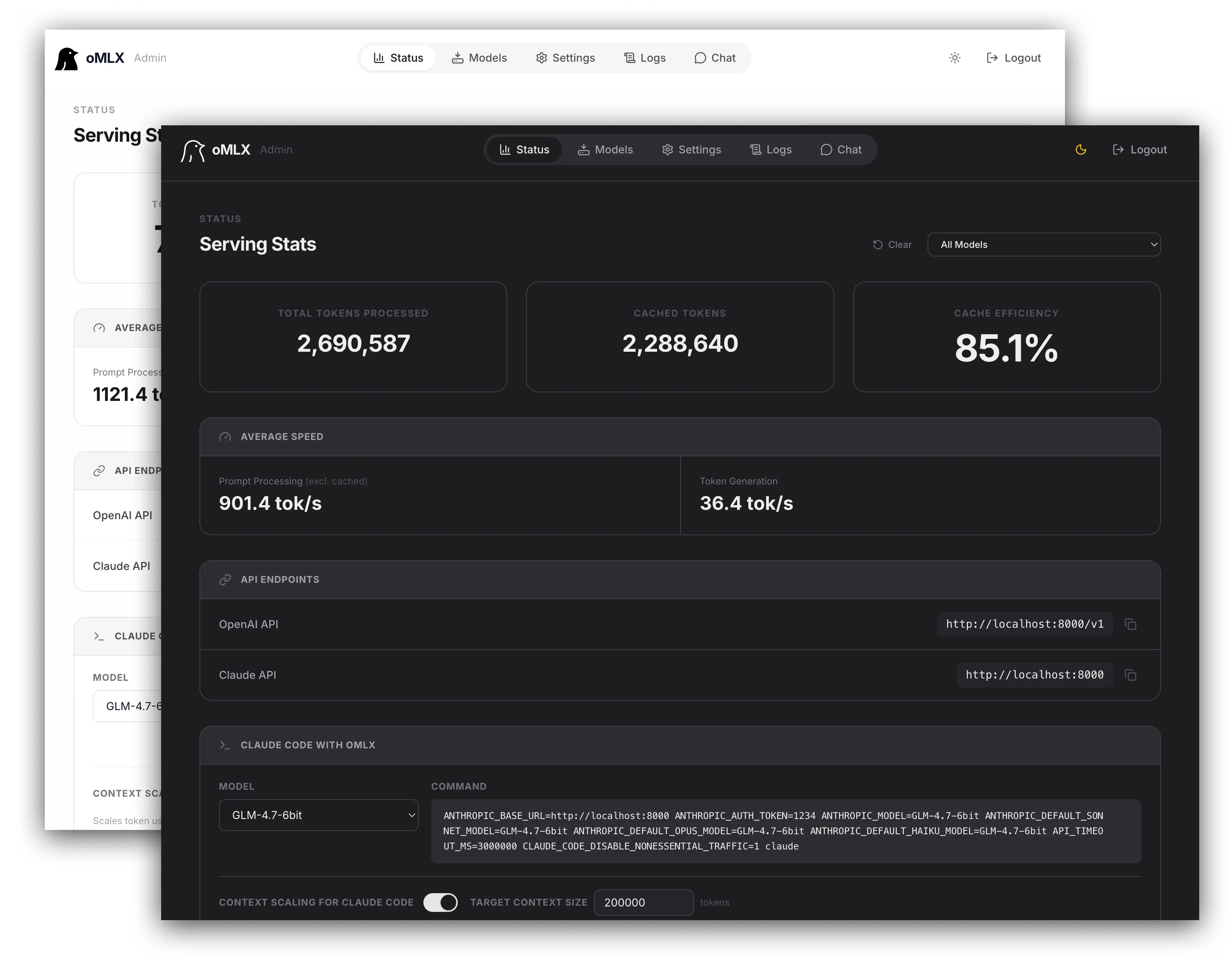
oMLX turns your Mac into a full LLM inference server, run from the menu bar. It serves text, vision, OCR, embedding and reranker models with continuous batching, plus a RAM+SSD tiered KV cache that survives restarts, so Claude Code and Cursor respond in about 5s instead of 90s. OpenAI and Anthropic compatible APIs drop straight in. Native Swift, not Electron. Apache 2.0, open source.
AI Analysis
oMLX transforms Apple Silicon Macs into a lightweight LLM inference server runnable from the menu bar. It supports text, vision, OCR, embedding, and reranker models with continuous batching for efficiency. A standout feature is its tiered RAM+SSD KV cache that persists across restarts, slashing AI agent latency from 90s to 5s in tools like Cursor and Claude Code. It provides OpenAI/Anthropic-compatible APIs for easy integration. Built as native Swift (not Electron), fully open source under Apache 2.0. It solves key pain points of slow local inference, high latency in dev workflows, and cumbersome setups, delivering fast, private, restart-resilient AI serving for developers.
In 2025-2026, explosive growth in AI agents, local/on-device AI for privacy and reduced costs, and maturing Apple MLX framework align perfectly. Rising demand for low-latency dev tools (e.g. Cursor) amid AI-native software engineering makes this ideal. Economic push for efficient computing and Apple Silicon adoption further support it. Excellent Timing.
Technical difficulty is low-to-medium leveraging mature MLX framework on Apple Silicon; native Swift implementation keeps it lightweight. Low development/operation costs as open-source project. Minimal supply chain or compliance risks. High scalability within Mac ecosystem with strong potential for community contributions. Overall High feasibility with proven tech and existing implementation.
Primary users: Mac-based software developers, AI engineers, and indie hackers using AI coding agents (ages 25-45, tech-savvy). Industries: Software dev, AI/ML research. Geographic: Heavily US/Europe with growing Asia adoption. TAM for AI developer tools ~$15B+, SAM for local LLM servers ~$2B, SOM for Mac-optimized ~$300M. Core pains: Slow inference latency hurting productivity. High willingness to pay for premium features/support despite core being free/open-source.
Medium. Direct competitors: 1. Ollama (ollama.com), 2. LM Studio (lmstudio.ai), 3. LocalAI (localai.io), 4. llama.cpp tools, 5. MLX examples on GitHub. Advantages: Superior Mac-native speed via MLX, unique persistent tiered KV cache, menu-bar simplicity, and dramatic agent latency reduction; OpenAI/Anthropic API compatibility. Disadvantages: Mac-only (vs cross-platform competitors), lacks some enterprise features or broad model support of Ollama. Strong differentiation in performance for Apple ecosystem users.
Upgrade Pro to unlock full AI analysis
Similar Products

Cohere Parse 5
Turn complex docs, tables & images into AI-ready data
▲ 158 votes

Adapt
The company brain that gets work done
▲ 124 votes

Replay QA Security Scan
Automated Penetration Testing for AI-Built Apps
▲ 102 votes

WikiFix for Confluence
Find and fix issues in your knowledge base
▲ 86 votes

Audryo
Customer email your agent can operate.
▲ 68 votes

Refoid
Automate App Store refund responses and track every outcome
▲ 68 votes