OpenPilot
Open-source desktop AI agent for any model you choose
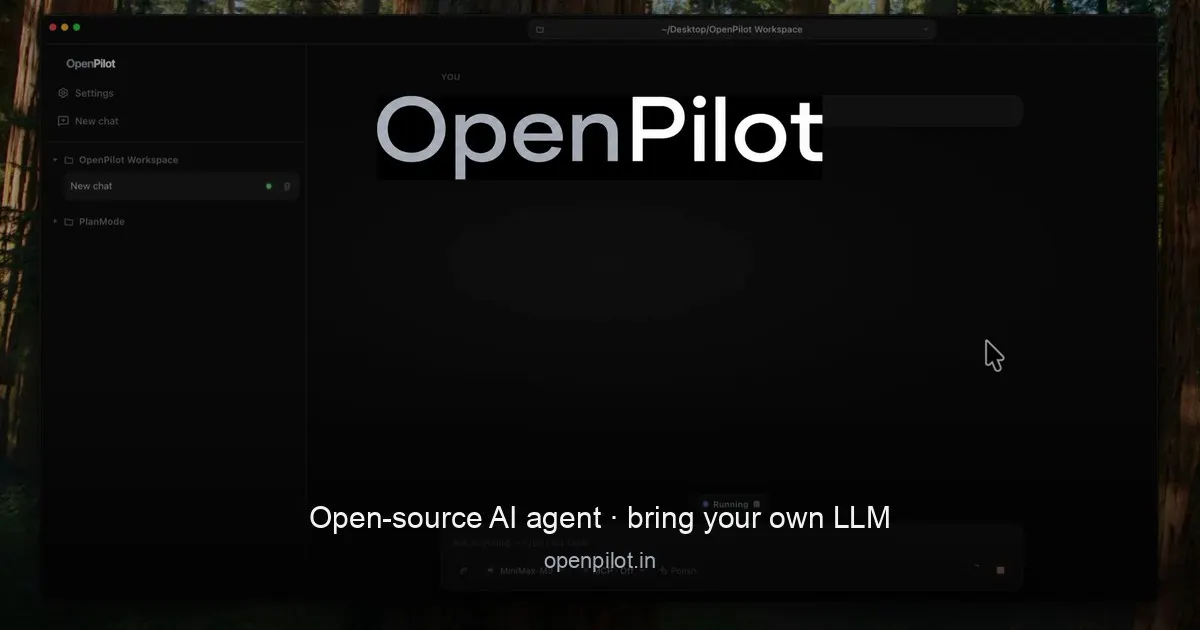
OpenPilot is a free, MIT-licensed desktop AI agent. Connect any OpenAI-compatible model (OpenAI, OpenRouter, Ollama, LM Studio), pick a folder, and it reads and edits files and runs commands there. You approve sensitive actions. Windows now, macOS early beta.
AI Analysis
OpenPilot is a free, MIT-licensed open-source desktop AI agent that connects to any OpenAI-compatible model including OpenAI, OpenRouter, Ollama, and LM Studio. Users select a local folder where the agent reads files, makes edits, and executes terminal commands, with mandatory user approval for all sensitive actions to ensure safety and control. It primarily solves developer pain points around time-consuming manual coding, file management, and repetitive tasks by enabling autonomous AI assistance directly on the desktop while preserving user oversight. Core USPs include full model flexibility (local or cloud), open-source transparency, and privacy focus without vendor lock-in. Currently available on Windows with macOS in early beta, its value proposition is delivering powerful AI productivity for developers and power users without cost barriers.
2025-2026 sees rapid maturation of local LLMs (Ollama, LM Studio) and surging demand for AI agents that prioritize privacy, control, and open-source principles amid growing concerns over cloud AI data security and costs. Developer workflows are increasingly AI-augmented, with economic tailwinds for productivity tools. This aligns perfectly with the rise of desktop AI integration. Excellent Timing.
Technical implementation is moderately difficult, relying on established LLM APIs and OS file/command interfaces, but sandboxing for safe command execution presents security challenges. As an open-source project, development and operation costs are low with strong community support potential. Minimal supply chain risks; compliance is straightforward for a desktop tool. High scalability via model flexibility. Overall rating: High, supported by existing Windows release and beta.
Primary users: Software developers, AI enthusiasts, indie hackers, and technical power users (ages 20-40) familiar with LLMs. Industries: Software engineering, tech startups, open-source communities. Geographic: Global with concentration in US, Europe, and Asia tech hubs. TAM for AI developer tools exceeds $15B, SAM for desktop/open-source agents ~$2B, SOM ~$300M. Core pain points include inefficient context-switching in coding and lack of trusted local automation. High willingness to pay for enhanced models or features despite core product being free.
Competition Level: Medium. Direct competitors: 1. Aider (aider.chat) - CLI-based AI coding assistant. 2. OpenDevin (github.com/OpenDevin/OpenDevin) - Open-source AI software engineering platform. 3. Continue.dev (continue.dev) - Open-source autopilot for VS Code. 4. Cursor (cursor.com) - AI-first code editor with agent features. 5. Roo Code (formerly Cline). Advantages: Fully free/MIT open-source, highly model-agnostic (strong local LLM support), explicit approval workflow for safety. Disadvantages: Early platform support (Windows-focused), potentially less integrated IDE experience than Cursor and fewer advanced autonomous capabilities than dedicated agents.
Upgrade Pro to unlock full AI analysis
Similar Products

Cohere Parse 5
Turn complex docs, tables & images into AI-ready data
▲ 158 votes

Adapt
The company brain that gets work done
▲ 124 votes

Replay QA Security Scan
Automated Penetration Testing for AI-Built Apps
▲ 102 votes

WikiFix for Confluence
Find and fix issues in your knowledge base
▲ 86 votes

Audryo
Customer email your agent can operate.
▲ 68 votes

Refoid
Automate App Store refund responses and track every outcome
▲ 68 votes