
OpenShip
Open source PaaS on your server or in the cloud. No lock in.
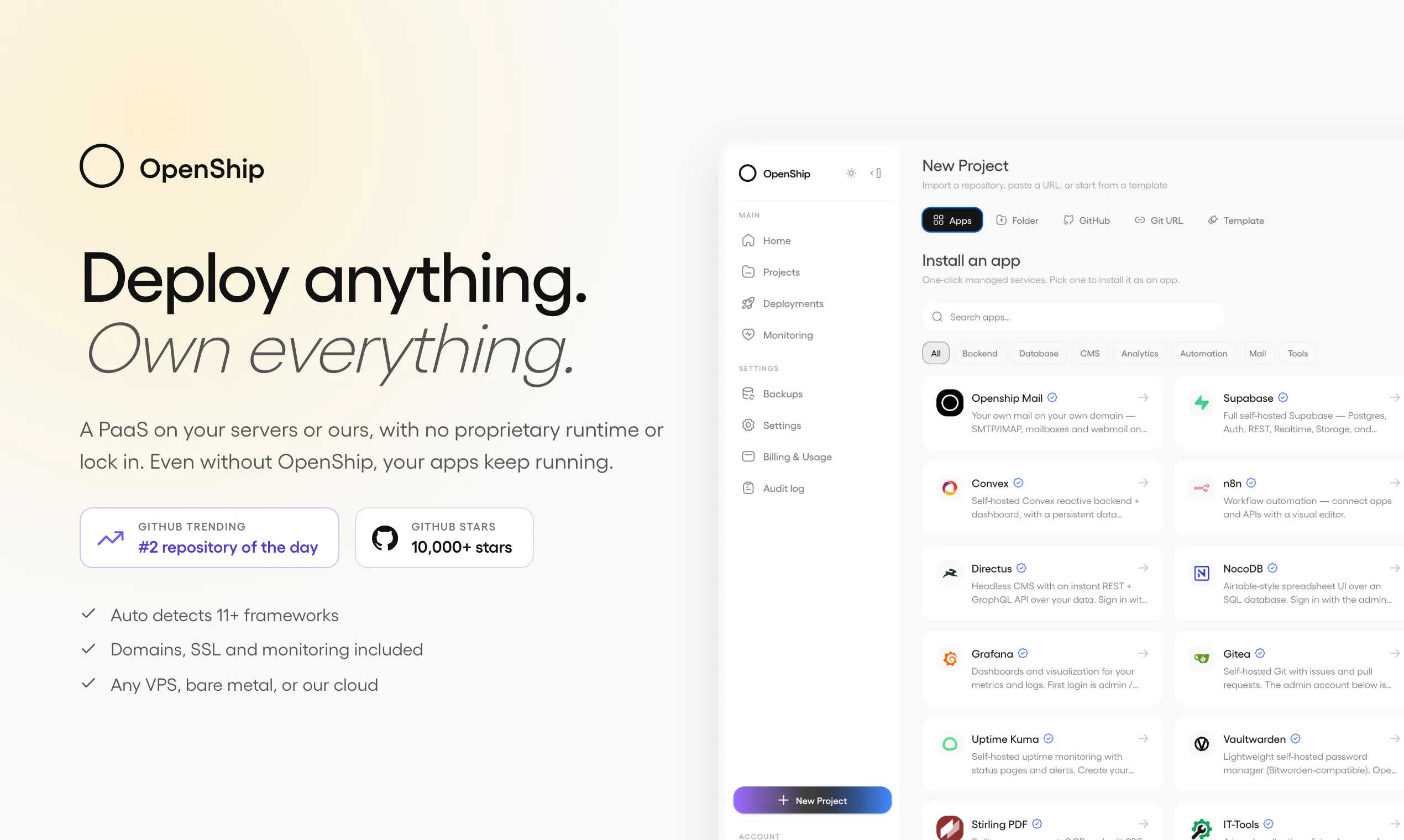
OpenShip is an open source PaaS that runs on our cloud or your infrastructure. Push your code and OpenShip handles builds, deployments, domains, SSL, monitoring, backups, secrets, and the services your apps depend on. Start fully managed on OpenShip Cloud or self host on your own cloud or on prem. Move between them without changing how you deploy. No proprietary runtime. No vendor lock in. Remove OpenShip and your apps keep running. Deploy anything. Own everything.
AI Analysis
OpenShip is an open source PaaS that runs on your own infrastructure or their managed cloud. Core features include code push for automated builds and deployments, plus management of domains, SSL, monitoring, backups, secrets, and app dependencies. Unique selling points are no vendor lock-in, seamless migration between self-hosted and cloud without changes, and apps that continue running even after removing OpenShip. It solves key user pain points like proprietary runtimes, deployment complexity, infrastructure management burdens, and vendor dependency. Overall value proposition: deploy anything while owning everything with full flexibility and control.
For 2025-2026, timing is favorable as rising cloud costs, data sovereignty demands, and AI application growth drive needs for flexible, open-source deployment tools. Container and orchestration tech is mature, user demand for no lock-in solutions is increasing amid economic pressures and open-source adoption trends. Excellent Timing.
Overall feasibility is Medium. Technical difficulty is moderate using mature Docker/Kubernetes foundations, but integrating seamless portability, monitoring, backups across environments adds complexity. Development and operation costs for managed cloud are high with scalability and security considerations. Low compliance risks due to open source model; strong scalability potential with community support. Main challenges are operational overhead for full feature parity.
Main target segments: developers, DevOps engineers, startups and SMB tech companies. Industries focus on software/web/AI app development. Global geographic distribution, strongest in North America/Europe. PaaS market TAM is multi-billion dollars with open-source segment in hundreds of millions. Core pain points: vendor lock-in, high costs, deployment complexity. High willingness to pay for managed tier while self-host option is free.
Medium. Direct competitors: 1. Coolify (coolify.io), 2. CapRover (caprover.com), 3. Dokku (dokku.com), 4. Railway (railway.app). Advantages vs competitors: true no lock-in with portable deployments across self-host/cloud and apps persisting post-removal. Disadvantages: potentially newer with less established community/ecosystem compared to veterans; must compete on feature maturity and managed service pricing.
Upgrade Pro to unlock full AI analysis
Similar Products

Opaline
PostHog for team Claude Code and Codex sessions.
▲ 141 votes

Adapt
The company brain that gets work done
▲ 124 votes

React UI Kit V7
All the chat components you need. None of the complexity
▲ 115 votes

Replay QA Security Scan
Automated Penetration Testing for AI-Built Apps
▲ 102 votes

Saldor
Speed up procurement and AP.
▲ 78 votes

Refoid
Automate App Store refund responses and track every outcome
▲ 68 votes