
Papr Graph
Upgrade to graph-native vector embeddings
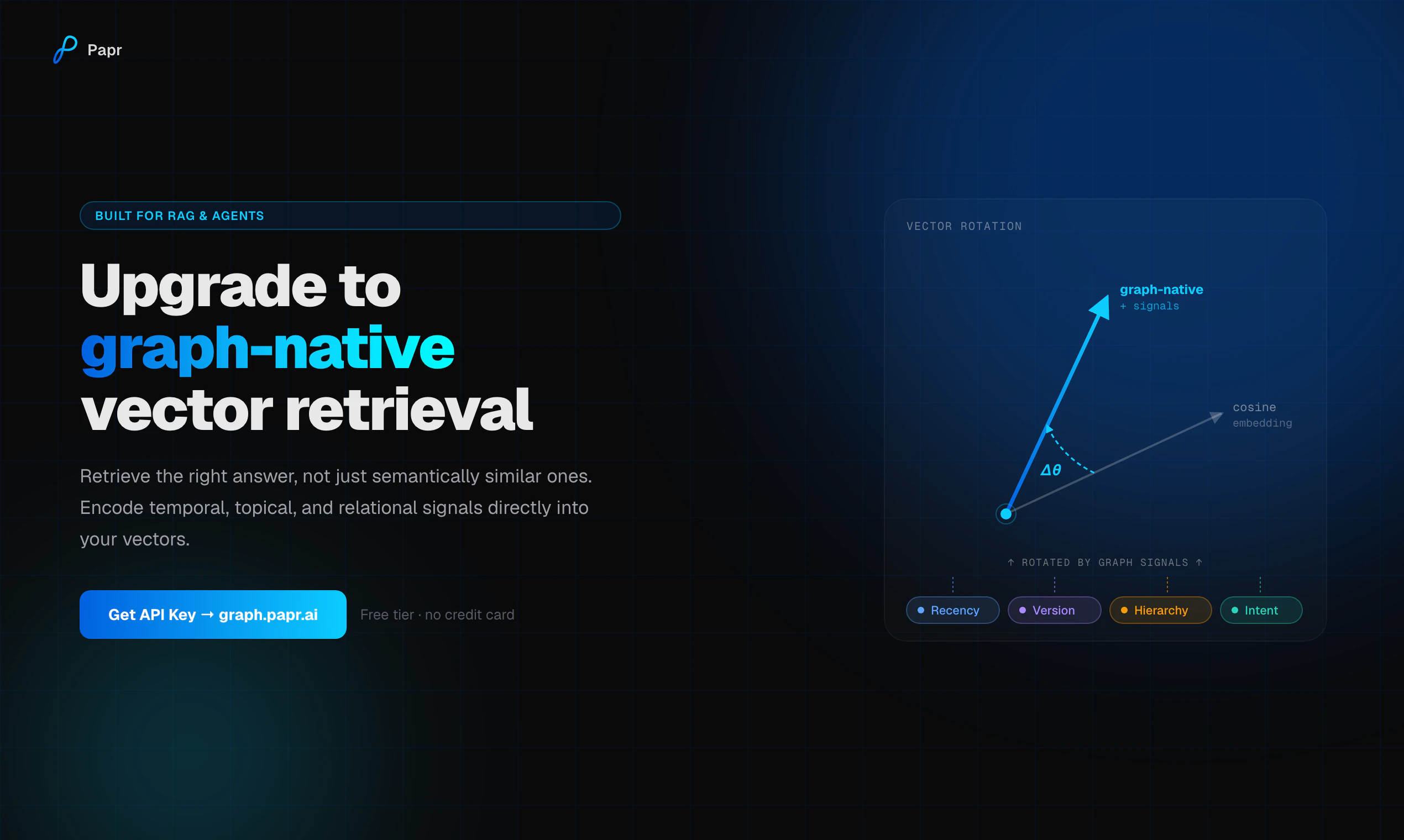
Papr Graph transforms semantic embeddings into graph-native embeddings with one API call. It encodes temporal, topical, and other dimensions within any embedding, helping agents retrieve answers based on correctness, not just semantic closeness.
AI Analysis
Papr Graph transforms standard semantic embeddings into graph-native embeddings using a single API call. It encodes temporal, topical, and other contextual dimensions directly into embeddings. This enables AI agents to retrieve information based on correctness and structured relevance rather than semantic similarity alone. It solves the critical pain point of vector retrieval systems returning plausible but factually incorrect results, reducing hallucinations in RAG and agentic AI workflows. The value proposition is enhanced accuracy and reliability for AI applications with seamless integration.
The market timing is favorable due to the 2025-2026 explosion of AI agents, advanced RAG pipelines, and focus on reducing LLM hallucinations. Graph techniques for knowledge representation are reaching maturity alongside rising demand for hybrid vector-graph solutions. Economic investment in AI infrastructure remains strong despite regulatory scrutiny. This is an Excellent Timing as developers actively seek tools to move beyond basic semantic search.
Technically feasible leveraging existing embedding models and graph algorithms; the one-API-call approach simplifies adoption. Development and operation costs are moderate for a cloud API service. Low supply chain and compliance risks for a pure software tool. Strong scalability potential via cloud infrastructure. Overall rating: High, assuming the team has AI/ML expertise.
Primary users are AI/ML engineers, developers building autonomous agents, and teams implementing RAG systems (demographics: tech professionals aged 25-45). Industries: AI startups, enterprise software, research labs. Geographic focus: US, Europe, China. AI developer tools TAM exceeds $15B with strong growth; SAM for embedding/RAG tech is several billion. Core pain: inaccurate retrievals harming AI reliability. High willingness to pay for performance-enhancing APIs.
Medium. Direct competitors: 1. Microsoft GraphRAG (github.com/microsoft/graphrag), 2. Neo4j Vector Search (neo4j.com), 3. Weaviate (weaviate.io), 4. LlamaIndex PropertyGraph (llamaindex.ai). Advantages: simple one-call transformation for any embedding, explicit focus on correctness over similarity. Disadvantages: newer entrant with potentially less ecosystem integration and brand trust compared to established vector/graph databases.
Upgrade Pro to unlock full AI analysis
Similar Products
Cohere Parse 5
Turn complex docs, tables & images into AI-ready data
▲ 158 votes

Adapt
The company brain that gets work done
▲ 124 votes

Replay QA Security Scan
Automated Penetration Testing for AI-Built Apps
▲ 102 votes

WikiFix for Confluence
Find and fix issues in your knowledge base
▲ 86 votes

Audryo
Customer email your agent can operate.
▲ 68 votes
Refoid
Automate App Store refund responses and track every outcome
▲ 68 votes