
Parsewise API
API for agentic multi-document processing
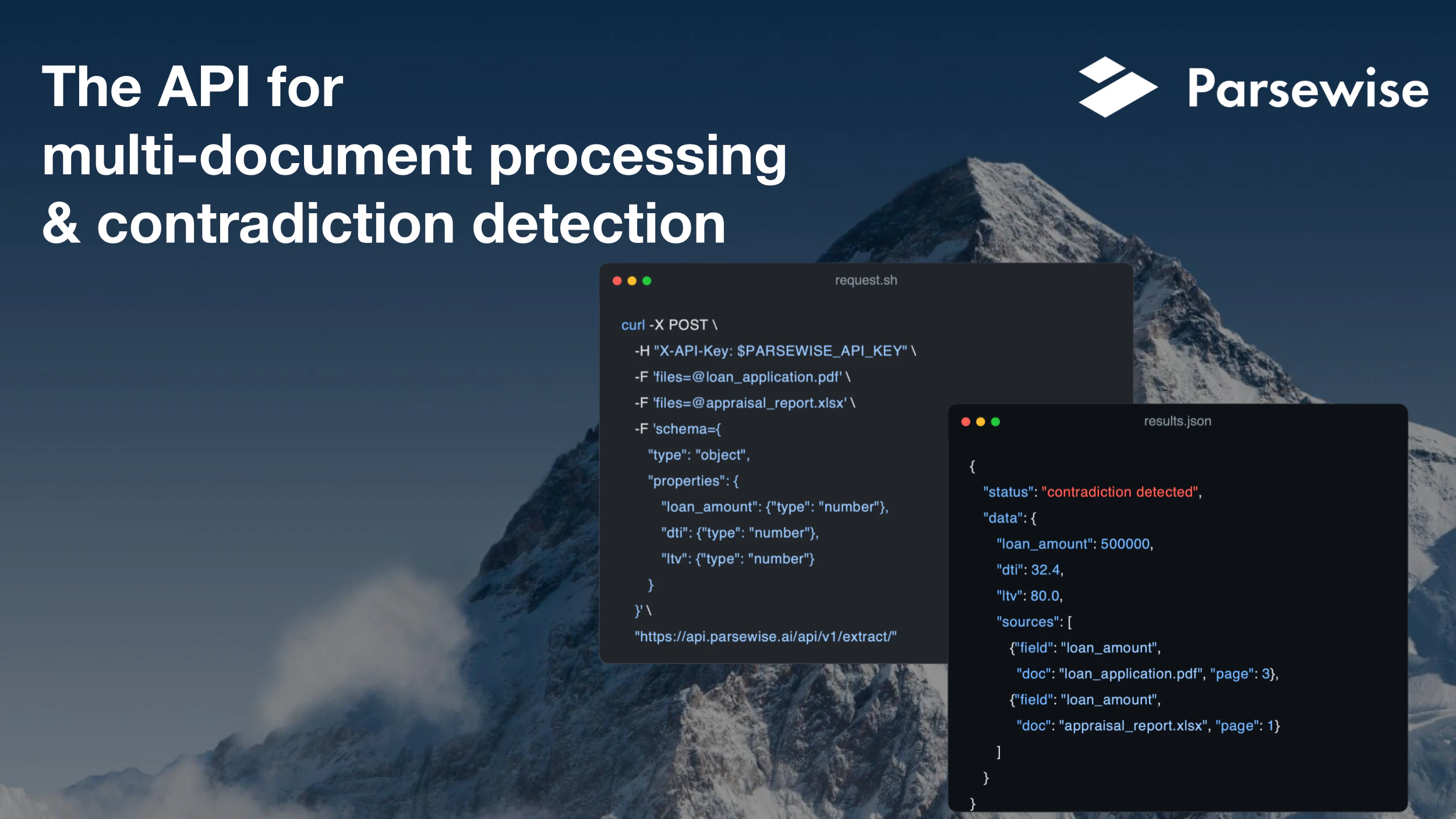
One API call replaces the entire document processing pipeline. You send multiple documents and a desired output schema; you get back resolved values, flagged contradictions, and full lineage down to the source words, pages, and documents, with bounding boxes you can embed directly into your own UI for human validation. No parsing, classification, stitching, or custom verification interface to build or maintain.
AI Analysis
Parsewise API simplifies agentic multi-document processing into one API call. Users submit multiple documents and an output schema, receiving resolved structured values, flagged contradictions, full provenance lineage to source words/pages/documents, and bounding boxes for direct UI embedding and human validation. It eliminates building/maintaining parsing, classification, stitching, or custom verification interfaces. Solves pain points like error-prone pipelines, lack of traceability in AI outputs, and high dev overhead for document-heavy apps. Value proposition: fast, reliable, auditable document intelligence for accelerated development in complex workflows.
In 2025-2026, AI agentic systems and multimodal LLMs are reaching maturity amid surging demand for verifiable automation to combat hallucinations. Enterprise focus on productivity tools, regulatory needs for auditability, and economic push for efficiency make this ideal. Document AI adoption is accelerating with remote work and data growth. Excellent Timing.
High technical feasibility using existing LLMs, vision models for bounding boxes, and agent orchestration. Moderate development costs but potential high operational LLM inference expenses. Strong scalability via cloud infrastructure. Compliance risks for data privacy in sensitive documents; low supply chain issues. Good team fit for AI engineers. High.
Primary segments: Developers, AI/product teams at B2B SaaS companies; industries include legal tech, fintech, insurance, healthcare, and enterprise KM. Global with concentration in US/Europe. TAM for document AI ~$10B+ growing rapidly; SAM for API platforms ~$2-3B. Core pains: brittle pipelines, unverifiable AI extractions. High willingness to pay for usage-based API that saves engineering time.
Medium. Direct competitors: 1. LlamaParse (llamaindex.ai/llamaparse), 2. Unstructured.io (unstructured.io), 3. Nanonets (nanonets.com), 4. Rossum (rossum.ai), 5. Azure AI Document Intelligence (azure.microsoft.com/products/ai-services/ai-document-intelligence). Advantages: single-call agentic pipeline with contradiction flagging, detailed lineage and embeddable bounding boxes for superior transparency vs basic parsers. Disadvantages: newer entrant with less brand trust and ecosystem integrations than incumbents; potentially higher per-call costs.
Upgrade Pro to unlock full AI analysis
Similar Products

Cohere Parse 5
Turn complex docs, tables & images into AI-ready data
▲ 158 votes

Adapt
The company brain that gets work done
▲ 124 votes

Replay QA Security Scan
Automated Penetration Testing for AI-Built Apps
▲ 102 votes

WikiFix for Confluence
Find and fix issues in your knowledge base
▲ 86 votes

Audryo
Customer email your agent can operate.
▲ 68 votes

Refoid
Automate App Store refund responses and track every outcome
▲ 68 votes