
Pixcode
A self-hosted control room for AI coding agents
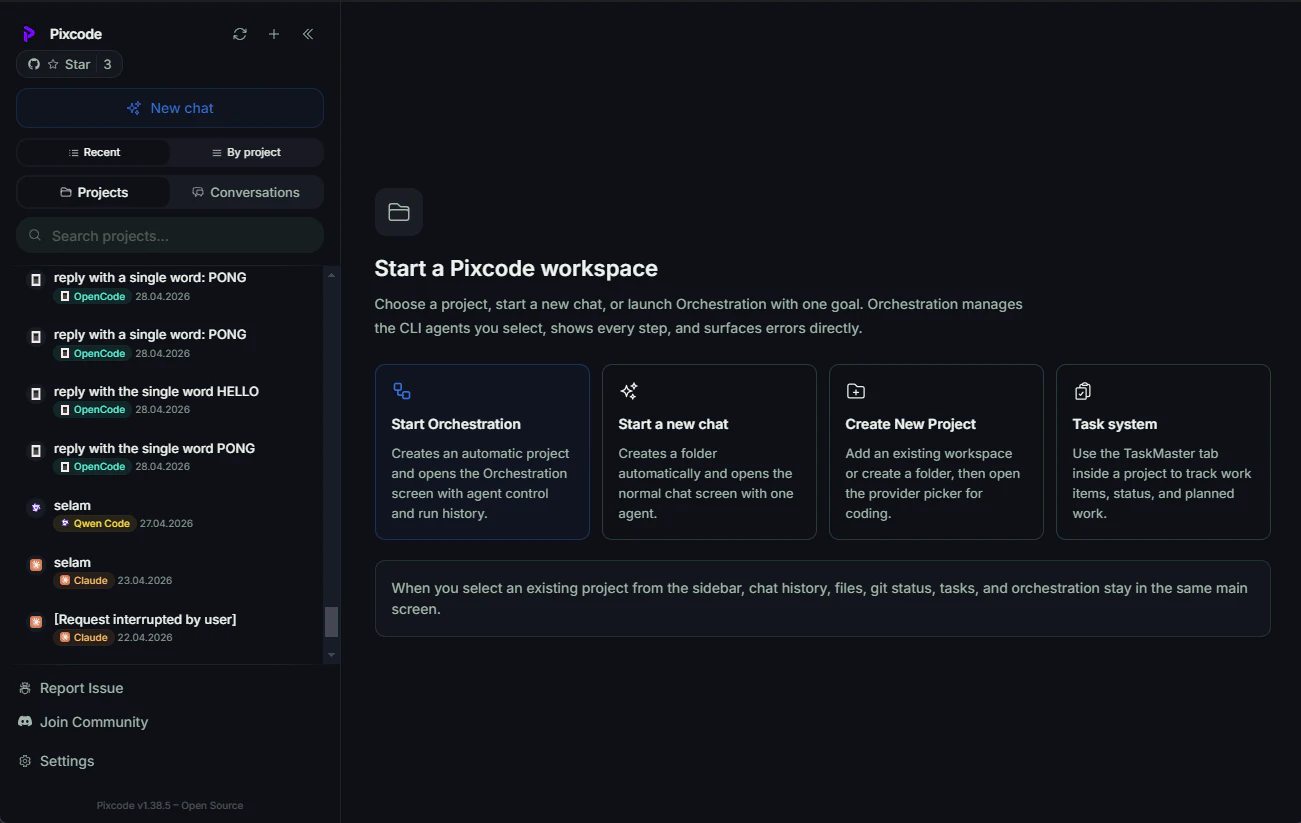
Pixcode is a self-hosted web UI and desktop/server control room for Claude Code, Cursor CLI, OpenAI Codex, Gemini CLI, Qwen Code, and OpenCode with multi-agent orchestration, files, shell, Git, API keys, Telegram, notifications, plugins, MCP, and theme customization.
AI Analysis
Pixcode is a self-hosted web UI and desktop/server control room for AI coding agents like Claude Code, Cursor CLI, OpenAI Codex, Gemini CLI, Qwen Code, and OpenCode. Core features include multi-agent orchestration, file/shell/Git integration, API key management, Telegram notifications, plugins, MCP support, and theme customization. It addresses pain points of fragmented tool management, privacy/security risks with cloud AI services, and lack of centralized control in AI-driven coding workflows. The value proposition is a private, unified, highly customizable control environment that boosts developer productivity and orchestration capabilities for AI coding tasks.
2025-2026 is an Excellent Timing. AI coding agents and multi-agent systems are maturing rapidly with models like Claude 4 and Gemini advancing, while enterprises increasingly demand self-hosted solutions for data privacy, IP protection, and reduced API costs amid growing regulatory scrutiny on AI. User demand for orchestration tools is surging as developers adopt AI agents in daily workflows.
High feasibility. While integrating multiple AI CLIs, orchestration logic, and real-time shell/Git features involves technical complexity, it builds on mature open-source components and existing APIs. Development/operation costs are manageable for a devtools product; self-hosting reduces cloud dependency but requires solid security implementation. Scalability is strong for individual and team use with low supply chain risks.
Main segments: Individual software developers, AI/ML engineers, small-to-medium dev teams, and tech companies prioritizing data control. Industries: Software development, IT services, startups. Geographic focus: North America and Europe (high privacy awareness), with growing adoption in Asia. TAM for AI developer tools exceeds $15B by 2026; SAM for self-hosted/agent orchestration ~$2B; SOM for this control-room niche ~$100-200M. Core pains: Tool fragmentation and security. High willingness to pay for productivity gains via one-time licenses or support subscriptions.
Medium. Direct competitors: 1. OpenDevin (github.com/OpenDevin/OpenDevin), 2. Continue (continue.dev), 3. Aider (aider.chat), 4. Cursor (cursor.com), 5. Open Interpreter (openinterpreter.com). Advantages: Broad multi-backend support (Claude/Cursor/Gemini/etc.), self-hosted emphasis with rich integrations (Telegram, plugins, MCP, theme customization) for a true 'control room'. Disadvantages: Newer entrant may lack mature ecosystem/community compared to open-source rivals; self-hosting requires more user setup than cloud-first tools like Cursor.
Upgrade Pro to unlock full AI analysis
Similar Products

Cohere Parse 5
Turn complex docs, tables & images into AI-ready data
▲ 158 votes

Opaline
PostHog for team Claude Code and Codex sessions.
▲ 141 votes

Adapt
The company brain that gets work done
▲ 124 votes

Tapfree for Chrome
Voice dictation that adapts to what’s on your screen
▲ 122 votes

Replay QA Security Scan
Automated Penetration Testing for AI-Built Apps
▲ 102 votes

Refoid
Automate App Store refund responses and track every outcome
▲ 68 votes