
Porch
ocal project summaries and cost tracking for AI coding
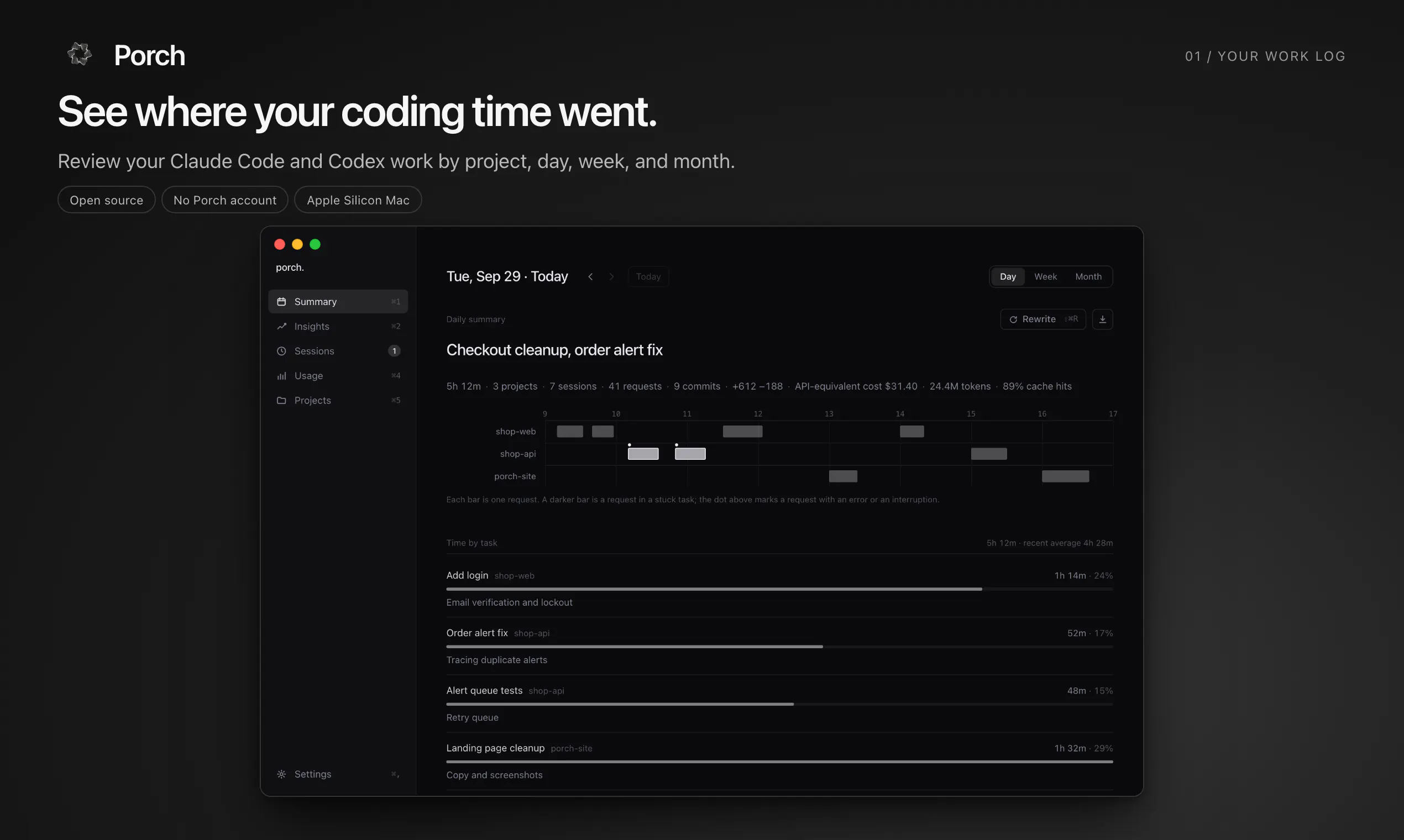
Porch turns your Claude Code and Codex work into daily, weekly, and monthly summaries by project, with estimated task time and blockers. See sessions across terminals and editors, know which need your attention, track tokens and API-equivalent costs, and save summaries as Markdown to Obsidian or any folder. Open source, with no Porch account required. Session status and usage stay on your Mac; summaries use your installed, signed-in Claude Code or Codex.
AI Analysis
Porch is an open-source, local Mac app that converts Claude Code and Codex AI coding sessions into daily, weekly, and monthly project summaries, including estimated task times, blockers, and token/API cost tracking. It provides visibility across terminals and editors, highlights sessions needing attention, and exports summaries as Markdown to Obsidian or folders. It solves key pain points of fragmented AI coding workflows, lack of progress oversight, cost management, and privacy risks from cloud tools. USP: Fully local (no account needed), privacy-focused with data staying on-device. Overall value: Boosts developer productivity and organization in AI-assisted coding without external dependencies.
Favorable in 2025-2026 as AI coding assistants like Claude and Codex see explosive adoption, with developers demanding better productivity, summarization, and cost-control tools. Rising emphasis on AI usage transparency, privacy regulations, and local-first solutions aligns perfectly with Porch's offline, open-source model. Excellent Timing.
High. Technical difficulty is manageable as a local Mac desktop app leveraging existing Claude/Codex installs; no servers or cloud infrastructure needed, keeping dev/operation costs low. Minimal supply chain or compliance risks due to on-device processing. Strong scalability via open-source community contributions. Key risks are initial Mac-only scope and integration maintenance.
Main segments: Individual software developers, AI engineers, and indie hackers using Claude/Codex on Mac, often integrating with Obsidian for notes. Industries: Software development and tech. Geographic: Primarily US, Europe, and global English-speaking developers. Estimated market size: Developer productivity tools TAM is multi-billion with AI subset growing rapidly; SOM for niche local AI trackers in tens of millions. Core pains: disorganized AI outputs and hidden costs. Willingness to pay: Moderate (free OSS model suggests freemium potential).
Low. Direct competitors: WakaTime (wakatime.com), RescueTime (rescuetime.com), ActivityWatch (activitywatch.net), Continue.dev (continue.dev), Aider (aider.chat). Advantages: Unique AI-specific summaries, blockers, token cost tracking, full local/privacy focus, seamless Obsidian export, no account. Disadvantages: Mac-only, narrower scope than general trackers, relies on specific AI tools (Claude/Codex). Strong differentiation in the emerging local AI devtools space.
Upgrade Pro to unlock full AI analysis
Similar Products

Adapt
The company brain that gets work done
▲ 124 votes

Replay QA Security Scan
Automated Penetration Testing for AI-Built Apps
▲ 102 votes

Kosshi
Simple, fast outliner for Mac and iPhone.
▲ 90 votes

WikiFix for Confluence
Find and fix issues in your knowledge base
▲ 86 votes

Audryo
Customer email your agent can operate.
▲ 68 votes

Refoid
Automate App Store refund responses and track every outcome
▲ 68 votes