
Prosed
Go from newsletters & podcasts to published manuscript
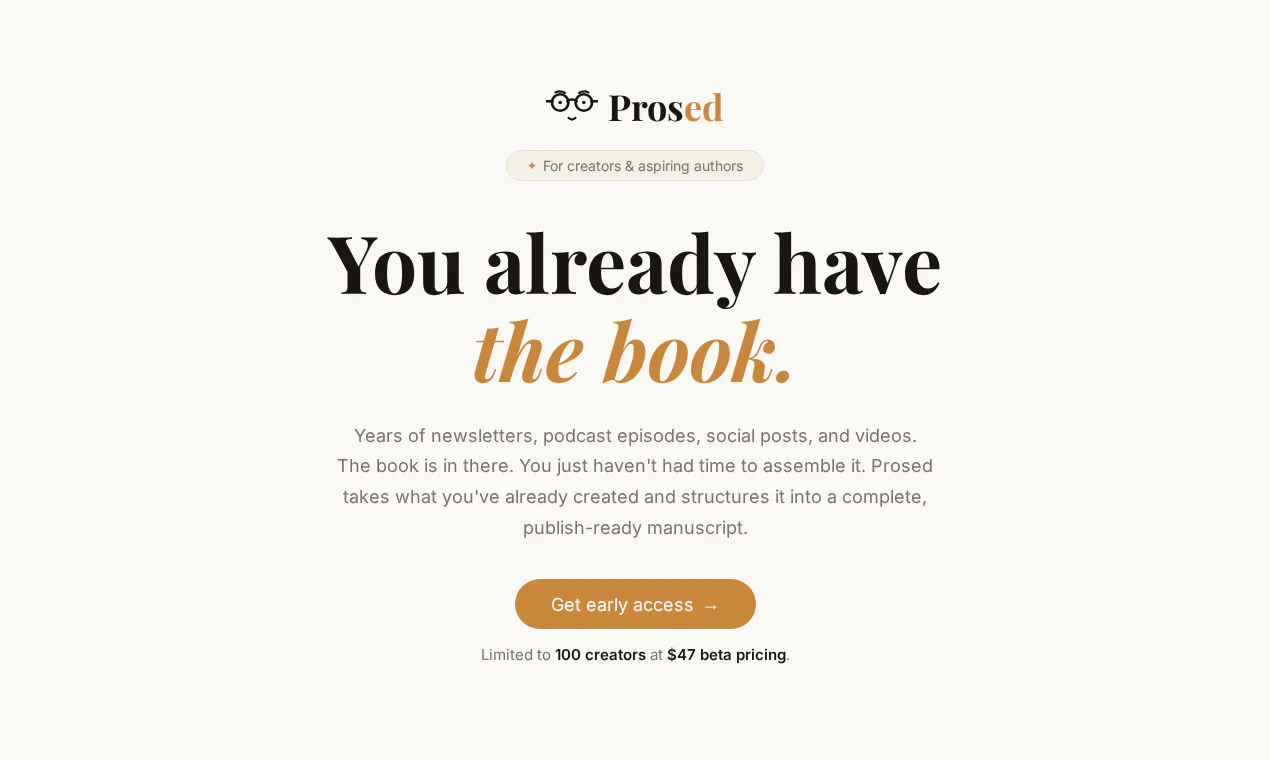
You've spent years creating—newsletters, podcasts, LinkedIn posts, courses. The book is in there. You just haven't had time to assemble it. Prosed's Inkwell pipeline analyzes your voice, structures your scattered content into chapters, and produces a manuscript that actually sounds like you. Not generic AI writing or slop. Your words, your ideas, assembled into something real. Built-in editorial review. Print-ready PDF/DOCX export. Beta: $47 for the first 100 founders.
AI Analysis
Prosed is an AI tool that converts scattered creator content like newsletters, podcasts, LinkedIn posts, and courses into a structured, voice-authentic book manuscript. Core features include voice analysis for genuine tone replication, automatic chapter structuring, built-in editorial review, and print-ready PDF/DOCX exports. It addresses the key pain point of experienced creators who have ample ideas and content but lack the time and organization to assemble them into a publishable book. The unique selling point is producing non-generic, 'slop-free' writing that truly sounds like the user. Overall value proposition: transform years of existing output into a real, professional manuscript quickly, empowering creators to publish without starting from scratch. Beta priced at $47 for early adopters.
The current market timing is favorable for 2025-2026. AI technology has matured sufficiently for nuanced voice mimicry and content synthesis, moving beyond basic generation to more authentic outputs. The creator economy is expanding rapidly with rising demand for legacy-building via books, while fatigue from generic 'AI slop' drives preference for tools like Prosed. Self-publishing continues to grow amid economic shifts favoring personal branding. Excellent Timing.
Overall feasibility is High. Technical difficulty is manageable by leveraging existing LLMs for voice analysis and structuring (via RAG/fine-tuning). Development and operation costs are moderate to high due to AI inference for large content volumes, but scalable via cloud providers. Low supply chain or compliance risks as a pure SaaS digital product. Strong scalability potential once beta feedback is incorporated. Requires a team skilled in AI and editorial processes. Key risks are maintaining consistent 'authentic voice' quality at scale.
Main target users: Content creators, podcasters, newsletter writers (e.g. Substack authors), LinkedIn influencers, and online course creators. Demographics: Professionals and thought leaders aged 30-55, often with established audiences. Industries: Business, self-improvement, non-fiction, education. Geographic focus: Primarily US and Europe. Estimated market: Creator economy TAM exceeds $250B; AI-assisted publishing SAM around $1B with SOM in early thousands of beta users. Core pain points: Time scarcity to organize content into books and maintaining personal voice. High willingness to pay for time-saving, professional results as shown by beta pricing.
Competition level: Medium. Direct competitors: 1. Sudowrite (sudowrite.com), 2. Jasper.ai (jasper.ai), 3. NotebookLM (notebooklm.google), 4. Reedsy (reedsy.com). This product differentiates with its specific 'Inkwell pipeline' for voice analysis from existing scattered content (newsletters/podcasts), focus on non-generic output, and built-in editorial review plus print exports. Advantages: Strong authenticity focus and targeted at multi-format content assembly. Disadvantages: Early beta stage may mean less refined features or proven results compared to established tools; potential high usage costs not yet detailed.
Upgrade Pro to unlock full AI analysis
Similar Products

Cohere Parse 5
Turn complex docs, tables & images into AI-ready data
▲ 158 votes

Opaline
PostHog for team Claude Code and Codex sessions.
▲ 141 votes

Adapt
The company brain that gets work done
▲ 124 votes

Tapfree for Chrome
Voice dictation that adapts to what’s on your screen
▲ 122 votes

CodeBurn
See where your AI coding spend actually goes
▲ 101 votes

WikiFix for Confluence
Find and fix issues in your knowledge base
▲ 86 votes