
Realtime TTS-2
Voice AI that feels as good as it sounds
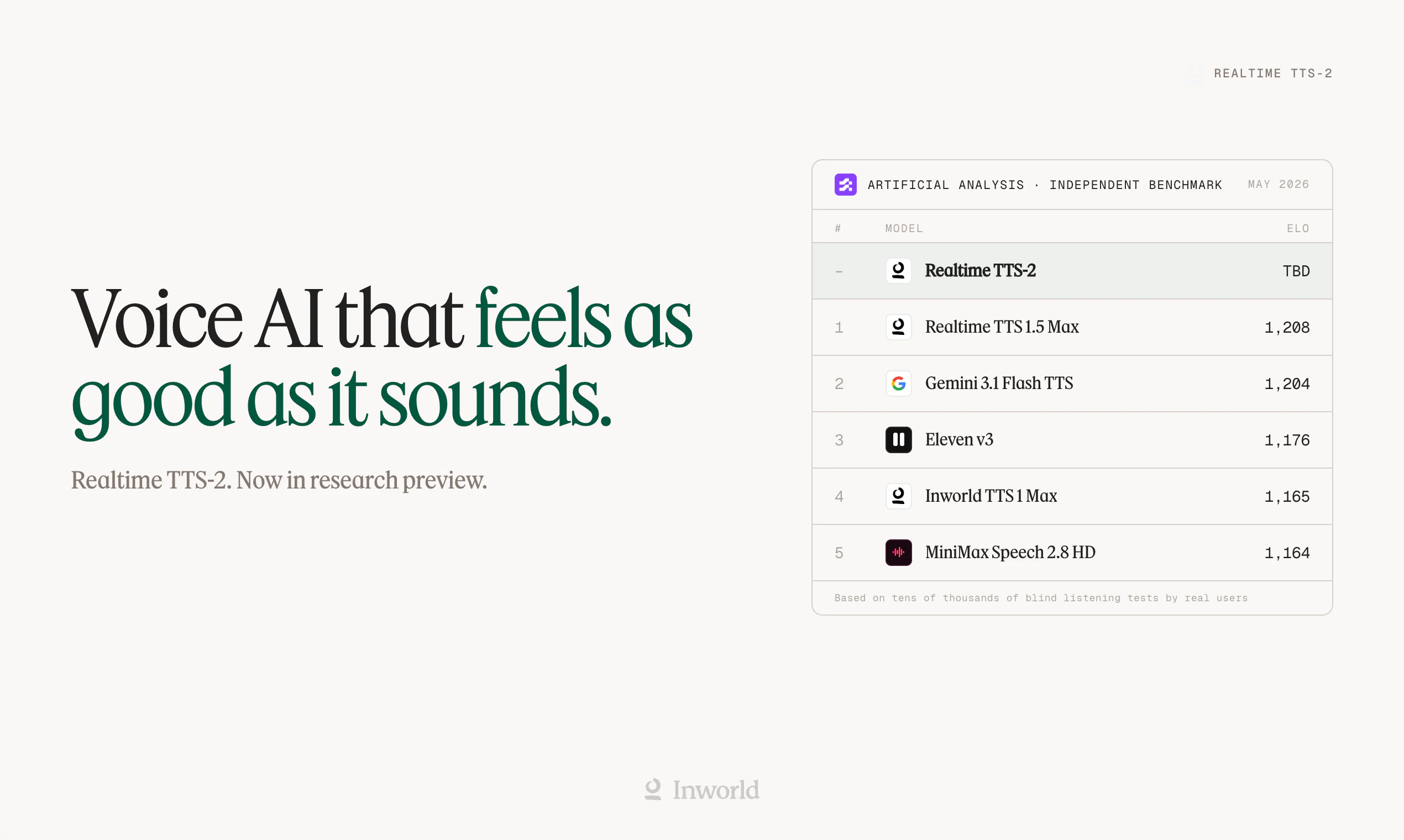
Realtime TTS 1.5 is #1 on Artificial Analysis, voted best in blind tests by thousands of real users. TTS-2 builds on that with six major upgrades: natural language voice direction for tone, emotion, speed, and pitch. Text-based voice design, where you describe a voice in words and generate it. Cross-lingual synthesis across 100+ languages preserving speaker identity. IPA phonetic control for brand names and rare words. And improved alphanumeric pronunciation. Try it free at inworld.ai/tts.
AI Analysis
Realtime TTS-2 is an advanced real-time Text-to-Speech API from Inworld, ranked #1 on Artificial Analysis and best in user blind tests. Building on TTS-1.5, it adds natural language voice direction for tone, emotion, speed and pitch; text-based voice design from word descriptions; cross-lingual synthesis in 100+ languages preserving speaker identity; IPA phonetic control for brands and rare words; and improved alphanumeric pronunciation. It solves pain points of robotic output, inflexible controls, pronunciation errors, and inconsistent multilingual voices. USP is voice AI that feels as good as it sounds, delivering intuitive, highly realistic audio for developers.
In 2025-2026, market timing is highly favorable with surging demand for immersive AI in gaming, virtual agents, metaverse and accessibility tools. TTS tech has matured for real-time low-latency use, while user expectations shift toward emotionally expressive, controllable voices. Supportive AI policies and digital economy growth further boost adoption. This innovation in natural language control aligns perfectly with trends. Excellent Timing.
Building on a proven #1 TTS-1.5 reduces technical difficulty, though advanced model training remains challenging. API-based delivery keeps operational costs scalable with cloud infrastructure. Compliance risks exist around ethical voice use and data privacy but are manageable. Strong scalability for global developers. High overall feasibility for an experienced AI team. Rating: High.
Primary segments: Developers, AI product teams, and companies in gaming, interactive media, edtech, customer service and accessibility apps. Demographics: tech professionals aged 25-45, distributed globally with concentration in North America, Europe and Asia-Pacific. Estimated TAM for AI voice tech exceeds $5B, SAM for realtime TTS APIs around $800M-1B, SOM ~$50M+. Core pains: unnatural prosody, inflexible emotion control and pronunciation issues. High willingness to pay for premium API quality.
Competition level: High. Direct competitors: 1. ElevenLabs (elevenlabs.io), 2. Cartesia (cartesia.ai), 3. OpenAI TTS (platform.openai.com), 4. Play.ht (play.ht), 5. Resemble AI (resemble.ai). Advantages vs competitors: top blind-test rankings, unique natural language direction and text-based voice generation, superior cross-lingual identity preservation and IPA precision. Disadvantages: potentially steeper adoption for new control methods, less ubiquitous brand than OpenAI/Google, pricing not detailed in sources but positioned as premium.
Upgrade Pro to unlock full AI analysis
Similar Products

Cohere Parse 5
Turn complex docs, tables & images into AI-ready data
▲ 158 votes

Opaline
PostHog for team Claude Code and Codex sessions.
▲ 141 votes

Adapt
The company brain that gets work done
▲ 124 votes

Tapfree for Chrome
Voice dictation that adapts to what’s on your screen
▲ 122 votes

Replay QA Security Scan
Automated Penetration Testing for AI-Built Apps
▲ 102 votes

Refoid
Automate App Store refund responses and track every outcome
▲ 68 votes