
Rill Browser
The browser where Claude Code and Codex work beside you
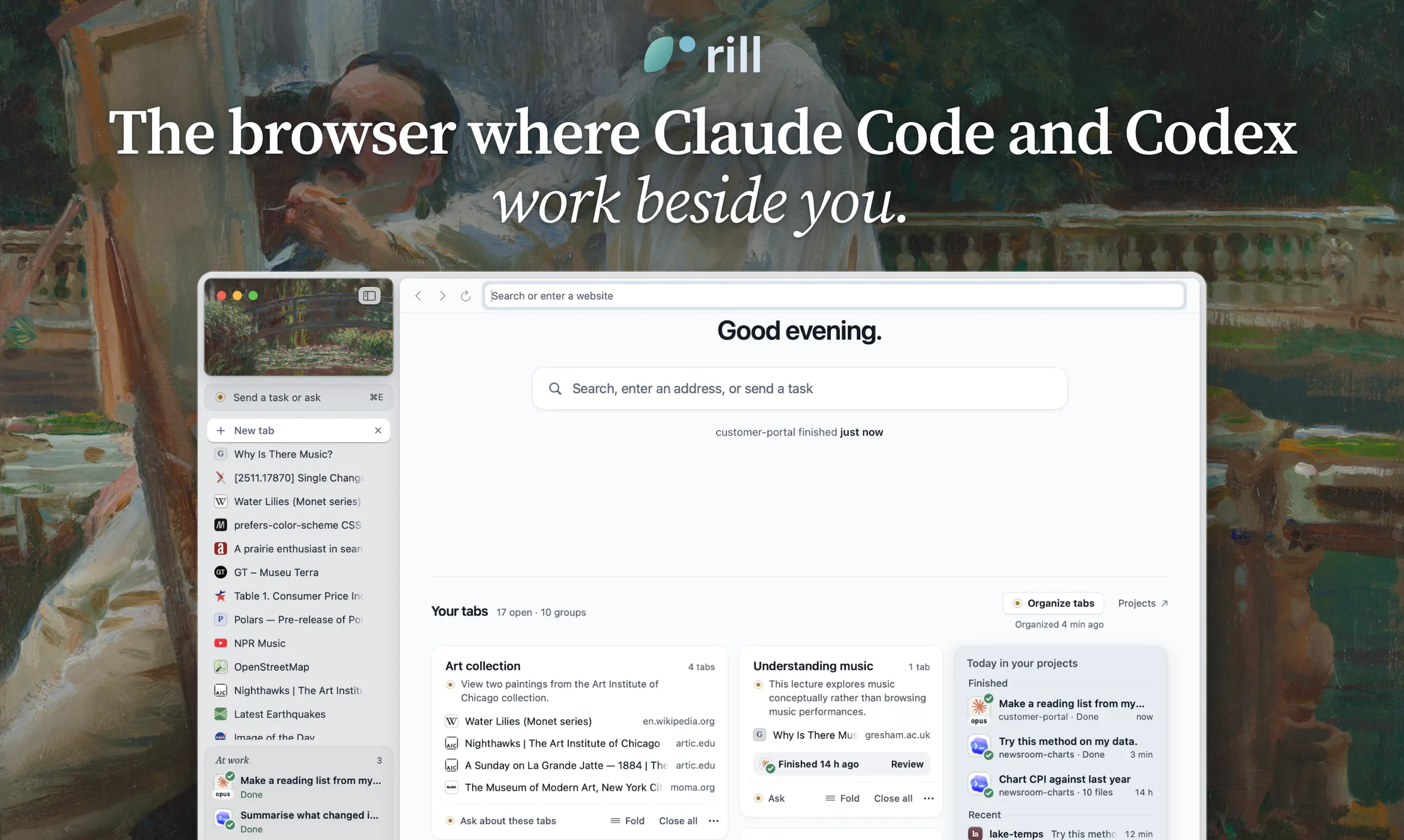
Rill is an AI-native browser built around the Claude Code and Codex you already use. Browse normally, then press ⌘E on any page to turn what you're looking at into a task for your agent. Rill finds the right project, passes along the context, and the agent works while you keep browsing. It also sorts your tabs into themes, turns your history into days you can search, and brings every project your agents are working on into one place. Free, on the plan you already have.
AI Analysis
Rill Browser is an AI-native browser centered on Claude Code and Codex integration. Core features include pressing ⌘E on any webpage to convert content into an AI agent task with automatic context passing, allowing the agent to work while users continue browsing. It organizes tabs into thematic groups, transforms browsing history into searchable daily views, and centralizes all agent projects. It solves key pain points like context switching between browsing and coding tools, tab overload, and fragmented project management for AI-assisted development. The USP is embedding AI coding agents directly into the browser experience for seamless productivity, offered free on users' existing Anthropic plans.
The current market timing is favorable for 2025-2026. With surging adoption of agentic AI, maturing LLM technology like Claude, and developers demanding reduced context-switching in workflows, this aligns perfectly with industry trends toward integrated AI tools. Economic focus on AI productivity and favorable policies for tech innovation support growth. Excellent Timing.
Overall feasibility is Medium. Technical difficulty is high due to developing a full browser (likely Chromium-based) with real-time AI context integration and performance optimization. Development costs are significant for engineering talent, though user-borne API costs reduce operational burden. Low compliance risks for a browser but scalability depends on infrastructure. Suitable for experienced teams but carries execution risks.
Main target users are software developers, AI/ML engineers, and technical professionals aged 25-40 who actively use Claude for coding. Primarily located in North America and Europe, within tech startups, software firms, and freelance development. TAM for AI developer tools exceeds $10B with rapid growth; SAM for integrated AI browsers ~$1B; SOM initially $50-100M. Core pain points include workflow fragmentation and context loss. High willingness to pay for productivity gains, though currently free on existing subscriptions.
Medium. Direct competitors: 1. Arc Browser (arc.net) - productivity-focused browser with some AI features. 2. Brave Browser (brave.com) with built-in AI assistant Leo. 3. Microsoft Edge with Copilot integration. 4. SigmaOS (sigmaos.com) - alternative modern browser. Advantages: Unique deep integration with Claude for turning web content into agent tasks, specialized dev project centralization, and free access on existing plans. Disadvantages: Newer entrant may face adoption barriers, potential performance overhead from AI features, narrower focus compared to general browsers.
Upgrade Pro to unlock full AI analysis
Similar Products

Cohere Parse 5
Turn complex docs, tables & images into AI-ready data
▲ 158 votes

Adapt
The company brain that gets work done
▲ 124 votes

Replay QA Security Scan
Automated Penetration Testing for AI-Built Apps
▲ 102 votes

WikiFix for Confluence
Find and fix issues in your knowledge base
▲ 86 votes

Audryo
Customer email your agent can operate.
▲ 68 votes

Refoid
Automate App Store refund responses and track every outcome
▲ 68 votes