Robinhood Agentic Trading
Let your agent trade
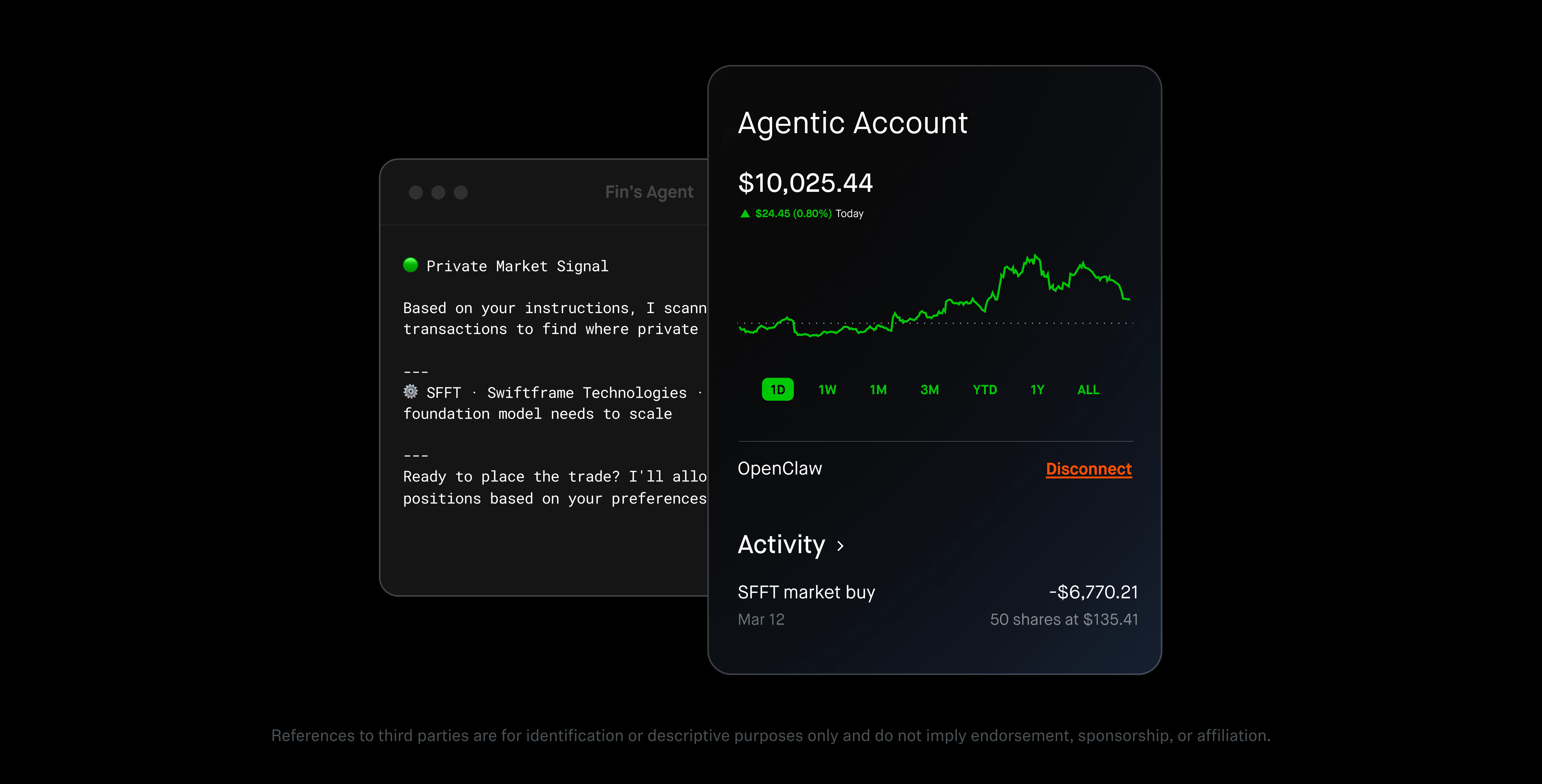
Customers can connect their own AI agents to Robinhood to help manage and automate trading and credit card purchases, with built-in safety controls and a real-time activity feed. Trade in a dedicated agentic account to stay in control of every trade your agent makes.
AI Analysis
Robinhood Agentic Trading enables users to connect their own AI agents to automate trading and credit card purchases within a dedicated agentic account. Core features include built-in safety controls to prevent unwanted actions, a real-time activity feed for transparency, and full user oversight of every trade. It addresses key pain points like time-intensive manual trading, emotional biases leading to poor decisions, and lack of reliable automation in personal investing. The value proposition centers on secure, intelligent AI-driven financial management while keeping users in control, combining Robinhood's brokerage infrastructure with emerging agentic AI technology.
The timing is favorable for 2025-2026 as AI agent technology matures rapidly with advanced LLMs, aligning with surging demand for automated fintech tools among retail investors. Industry trends show increasing adoption of AI in trading platforms, supportive regulatory shifts toward AI transparency in finance, and economic pressures favoring efficient investing. User appetite for hands-off yet controllable solutions is high post-AI hype. This represents Excellent Timing.
Feasibility is Medium. Technical integration leverages Robinhood's existing APIs and infrastructure, with strong scalability potential. However, high compliance risks (financial regulations, SEC oversight on automated trading), cybersecurity concerns with user-built agents, and operational costs for safety monitoring and real-time feeds pose challenges. Team fit is excellent for Robinhood but requires specialized AI safety expertise. Overall viable for an established player but not without significant regulatory and risk hurdles.
Primary segments: Tech-savvy retail investors and AI enthusiasts, aged 25-45, with interest in automation; concentrated in the US (Robinhood's core market), with potential expansion to Europe. TAM: Global robo-advisory and AI fintech market projected at $25B+ by 2026; SAM: US retail brokerage users (~30M active); SOM: Early AI agent adopters (~500K-1M). Core pain points: Insufficient time/expertise for optimal trading and fear of losing control in automation. Willingness to pay: High, via Robinhood Gold subscriptions or premium agent features.
Competition level: Medium. Direct competitors: 1. Alpaca (alpaca.markets) - trading API for custom algorithms; 2. Interactive Brokers (interactivebrokers.com) - API-driven algorithmic trading; 3. QuantConnect (quantconnect.com) - open-source algorithmic platform; 4. Wealthfront (wealthfront.com) - AI-powered robo-advisor; 5. Trade Ideas (trade-ideas.com) - AI stock scanner and automation. Advantages: Native Robinhood integration, agent-specific safety controls and dedicated account, real-time feed for user oversight. Disadvantages: Restricted to Robinhood ecosystem vs open APIs, relies on users building effective agents (vs fully managed solutions). Strong differentiation in 'bring your own agent' with safety focus.
Upgrade Pro to unlock full AI analysis
Similar Products

Equitybee Benchmark
Compare your startup equity grant for free.
▲ 218 votes

Cohere Parse 5
Turn complex docs, tables & images into AI-ready data
▲ 158 votes

Opaline
PostHog for team Claude Code and Codex sessions.
▲ 141 votes

Adapt
The company brain that gets work done
▲ 124 votes

Orus
Claude for investing in perpetuals
▲ 121 votes

WikiFix for Confluence
Find and fix issues in your knowledge base
▲ 86 votes