
Second Brain for AI
Persistent memory for Claude, ChatGPT & Cursor. Free.
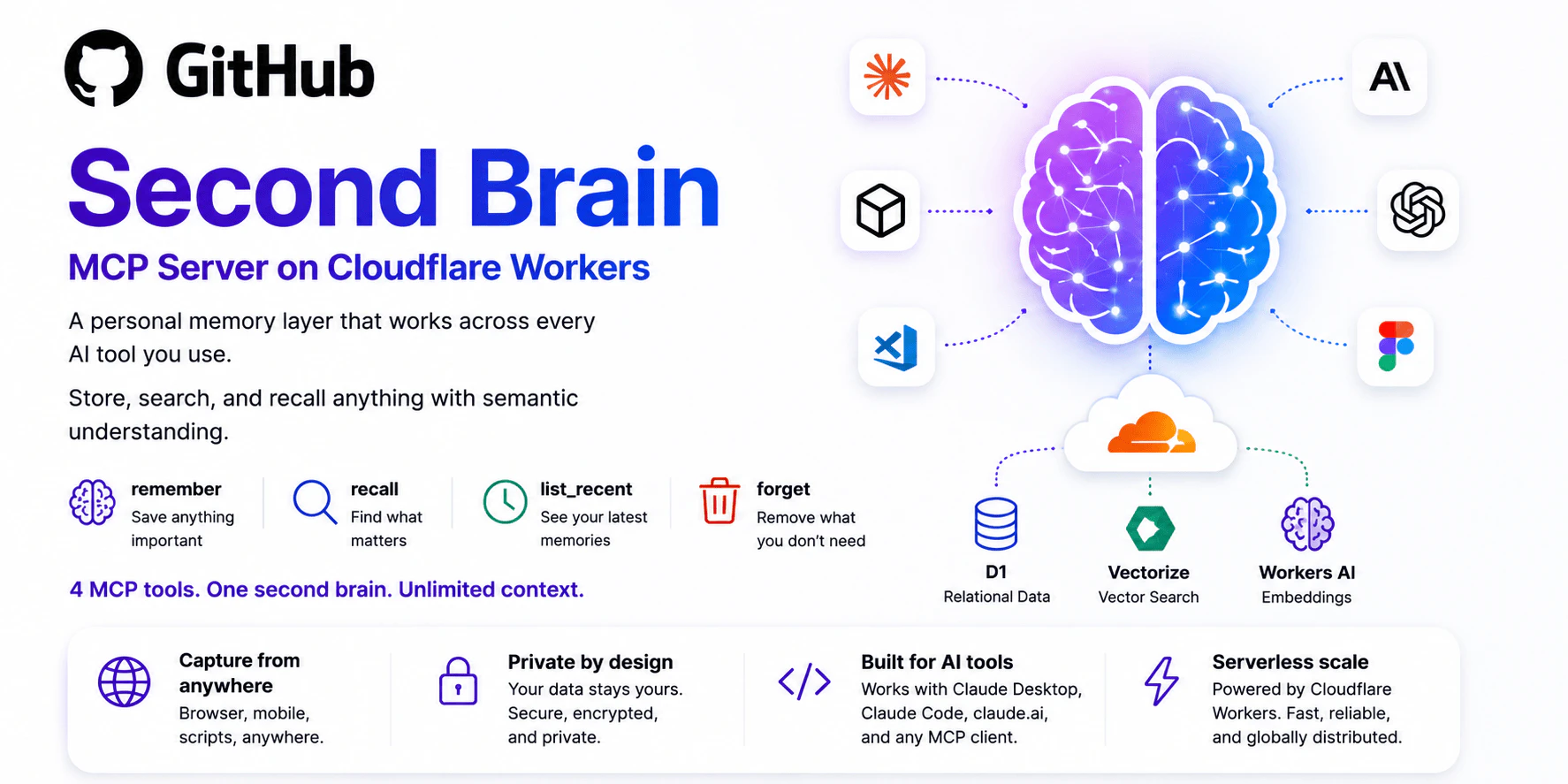
Every AI conversation starts from zero. Your projects, decisions, and preferences disappear as soon as you close the chat. Second Brain fixes that. It is a self-hosted memory layer that works with Claude, ChatGPT, Cursor, and any MCP client. You can store context once and recall it by meaning instead of keywords. It includes duplicate detection, semantic search, and a web UI. Built on Cloudflare, it offers a free tier and your data remains yours. MIT licensed.
AI Analysis
Second Brain for AI addresses the core pain point that every AI conversation resets to zero, causing loss of project context, decisions, and user preferences. It functions as a self-hosted persistent memory layer compatible with Claude, ChatGPT, Cursor, and any MCP client. Core features include semantic recall (by meaning rather than keywords), duplicate detection, semantic search, and a web UI. Built on Cloudflare with a free tier, it ensures users retain full data ownership. As an MIT-licensed open-source tool, its value proposition is providing continuity and personalization for AI workflows without vendor lock-in or costs.
In 2025-2026, AI adoption is exploding with growing demand for personalized, stateful agents beyond stateless chats. Vector search and embedding tech are mature, while trends toward AI coding tools (like Cursor) and long-term memory solutions align perfectly. User frustration with context loss is at a peak, and open-source/self-hosted preferences rise amid data privacy concerns. Economic tailwinds for productivity tools are strong. Excellent Timing.
High feasibility. Technical difficulty is manageable using mature vector DB and Cloudflare infrastructure (already implemented). Low dev/operation costs due to open-source model and serverless hosting. Minimal supply chain or compliance risks as a self-hosted software tool with MIT license. Strong scalability potential on Cloudflare. Ideal for small teams or solo developers with AI expertise.
Main target: Developers, AI engineers, and power users of Claude/ChatGPT/Cursor (ages 25-40, tech-savvy). Industries: Software development, AI research, indie hacking. Geographic: Global with concentration in North America, Europe, and Asia tech hubs. Estimated TAM for AI memory/context tools: $5B+ by 2026; SAM (dev tools): ~$500M; SOM: $10-50M. Core pain: repetitive context input and lost continuity. High willingness to pay for hosted/premium tiers beyond free self-hosted option.
Medium. Direct competitors: 1. Mem0 (mem0.ai) - managed AI memory; 2. Zep (getzep.com) - AI agent memory platform; 3. Letta (letta.com, formerly MemGPT) - stateful AI agents; 4. LangChain Memory modules. Advantages: Completely free/self-hosted, open-source (MIT), tight Cursor integration, simple semantic recall + duplicate detection, full data ownership. Disadvantages: Lacks polished enterprise features, managed hosting, and advanced analytics compared to commercial alternatives; requires self-setup.
Upgrade Pro to unlock full AI analysis
Similar Products

Cohere Parse 5
Turn complex docs, tables & images into AI-ready data
▲ 158 votes

Adapt
The company brain that gets work done
▲ 124 votes

Replay QA Security Scan
Automated Penetration Testing for AI-Built Apps
▲ 102 votes

WikiFix for Confluence
Find and fix issues in your knowledge base
▲ 86 votes

Audryo
Customer email your agent can operate.
▲ 68 votes

Refoid
Automate App Store refund responses and track every outcome
▲ 68 votes