
Seer Platform
The fastest way to go from idea to physical product
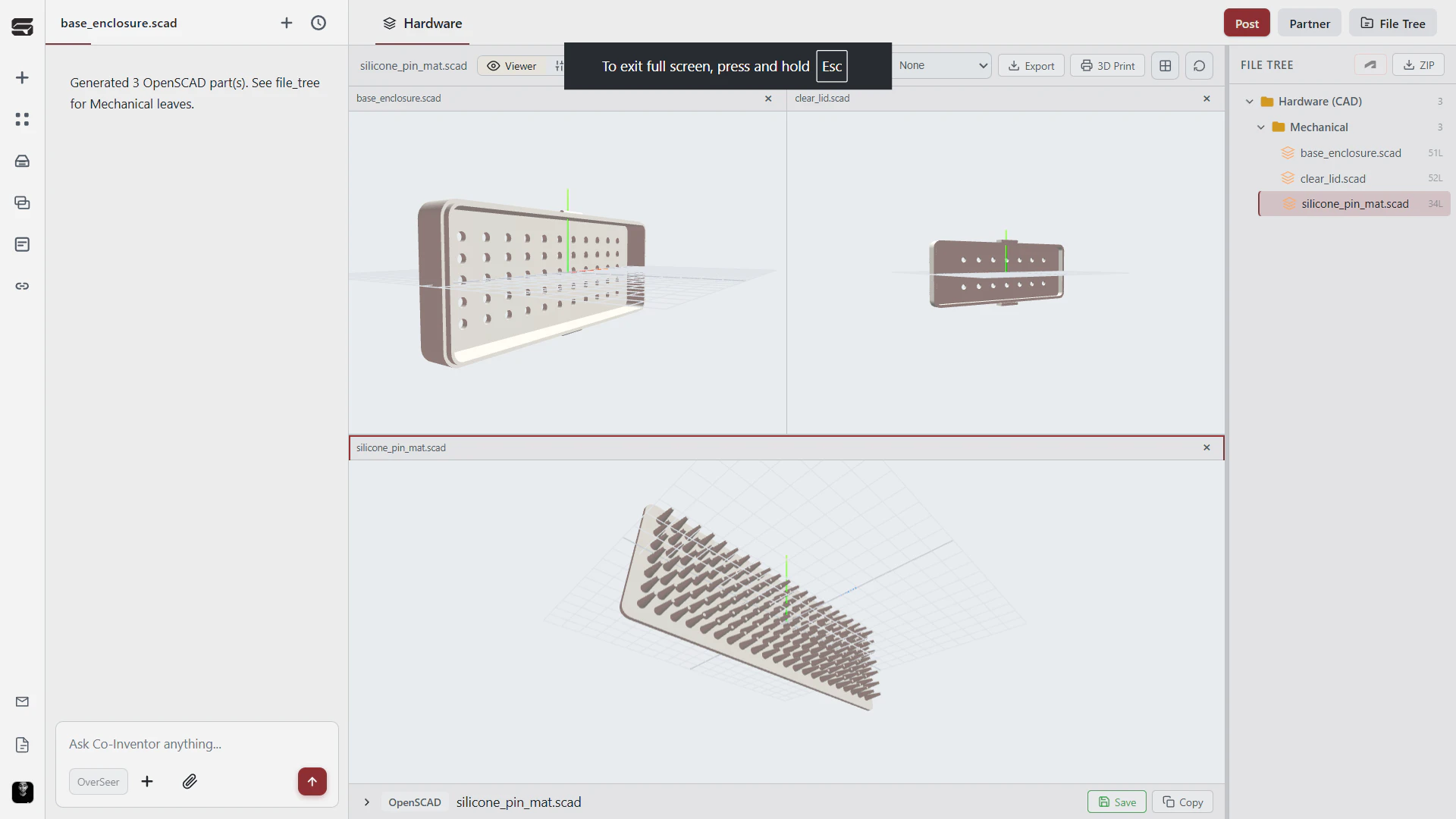
Seer is built for inventors, offering an AI-powered framework to develop physical products. It can design 3D objects, generate orthographics, write firmware, and perform market and patent research. These tools work individually or through “Invent” mode—an agent with product design–level expertise that can take your idea from concept to completion using both creative and engineering intelligence. The output is ready-to-manufacture prototypes, and you can order 3d printing from within Seer.
AI Analysis
Seer Platform is an AI-powered solution for inventors, enabling rapid development of physical products. Core features include generating 3D designs, orthographic drawings, firmware code, and conducting market/patent research. The standout 'Invent' mode functions as an expert agent that autonomously progresses ideas from concept to ready-to-manufacture prototypes using integrated creative and engineering capabilities. It solves major pain points such as the steep expertise barriers, lengthy timelines, and high complexity in hardware prototyping. The value proposition is being the fastest pathway from idea to tangible product, with in-app 3D printing orders, making invention more accessible and efficient.
In 2025-2026, timing is favorable with maturing multimodal AI for 3D generation and code synthesis, surging demand for AI agents in creative workflows, and economic emphasis on reshoring manufacturing and innovation. Technology maturity supports reliable AI tooling while user needs shift toward democratized hardware development amid maker culture growth. Policy support for tech-driven invention adds tailwinds. Excellent Timing.
Medium. High technical difficulty in ensuring AI outputs are precise, safe, and manufacturing-ready across design, firmware, and research domains, risking errors in physical products. AI inference and integration costs are substantial for operation. Supply chain partnerships for printing are feasible but patent research accuracy carries compliance risks. Scalability is strong as SaaS, yet requires skilled AI/hardware team. Overall viable with iteration but not without challenges.
Main segments: inventors, makers, hardware engineers, and early-stage product entrepreneurs. Demographics: tech-savvy professionals aged 25-45 with design/engineering backgrounds. Industries: consumer electronics, IoT, robotics, and independent product innovation. Geographic: global with concentration in US, Europe, and Asia tech hubs. Estimated market size: TAM $10B+ (CAD/3D printing software and services), SAM $1B (AI-assisted invention tools), SOM $100-200M. Core pain points: lack of multidisciplinary expertise and slow iteration from idea to prototype. High willingness to pay for time-saving, all-in-one platform via subscriptions.
Medium. Direct competitors: 1. Meshy.ai (meshy.ai) - AI text-to-3D generation. 2. Autodesk Fusion 360 (autodesk.com/fusion-360) - CAD/CAM with simulation tools. 3. Luma AI (lumalabs.ai) - AI for 3D reconstruction and generation. 4. Kaedim (kaedim3d.com) - AI 3D model creation. 5. Spline (spline.design) - 3D design for digital but expanding to physical. Advantages: unique all-in-one 'Invent' AI agent covering research, firmware, and manufacturing prep with integrated ordering; higher end-to-end automation. Disadvantages: potentially less refined individual tools vs specialized CAD leaders, newer market presence may mean smaller user base and trust building needed.
Upgrade Pro to unlock full AI analysis
Similar Products

Cohere Parse 5
Turn complex docs, tables & images into AI-ready data
▲ 158 votes

Opaline
PostHog for team Claude Code and Codex sessions.
▲ 141 votes

Adapt
The company brain that gets work done
▲ 124 votes

Replay QA Security Scan
Automated Penetration Testing for AI-Built Apps
▲ 102 votes

Refoid
Automate App Store refund responses and track every outcome
▲ 68 votes

Audryo
Customer email your agent can operate.
▲ 0 votes