
session-indexer
Semantic search over your own Claude Code session history
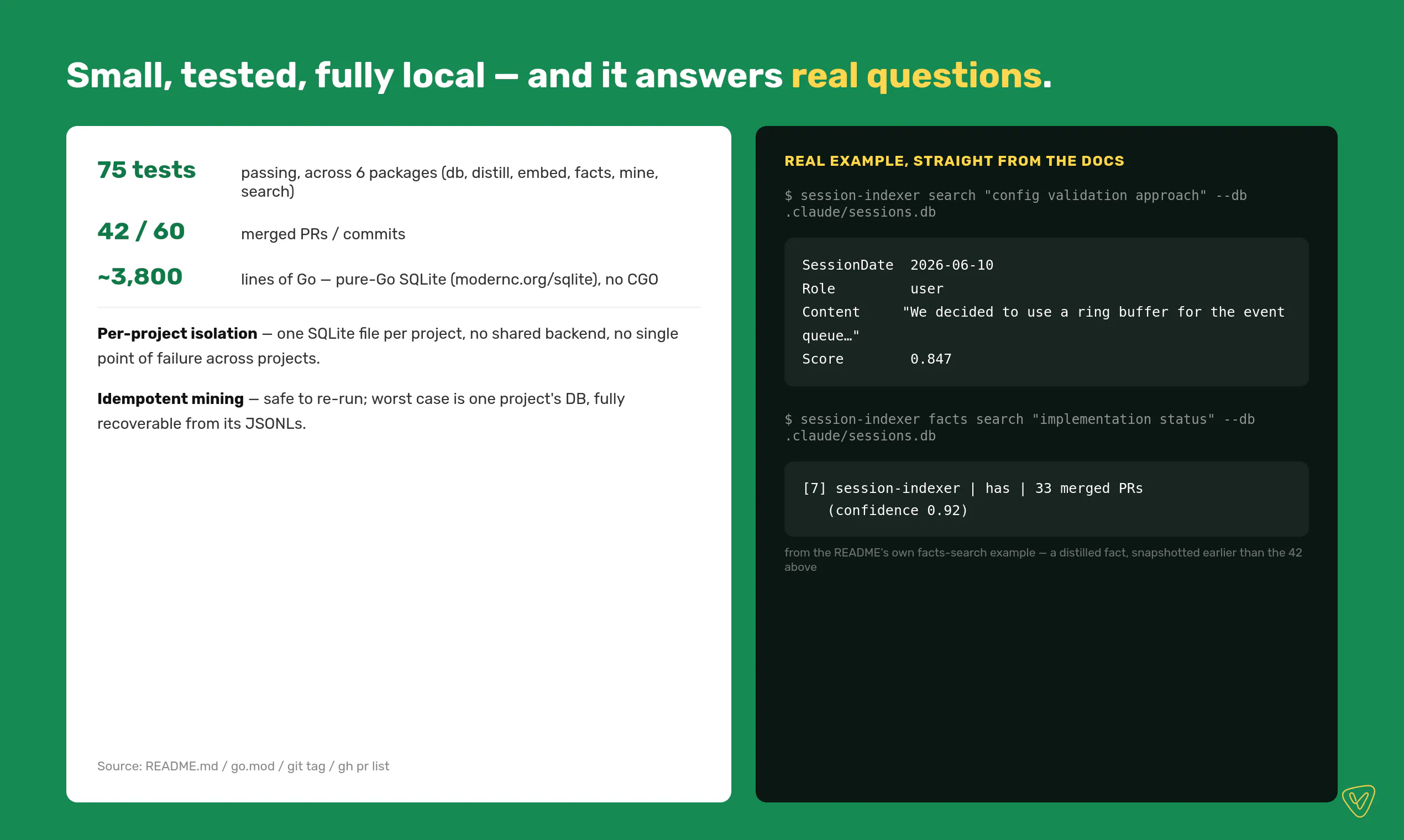
Per-project semantic search over your Claude Code session history — not a shared or centralized memory store. Indexes JSONL transcripts into a local SQLite file, retrieves via bge-m3 embeddings (Ollama) with automatic FTS5 BM25 fallback, and auto-injects relevant past context at session start. Companion to session-end: session-end gives "where I left off," session-indexer gives "what we decided" — same Stop/SessionStart hooks. Apache 2.0, 75 passing tests, go install and nothing to deploy.
AI Analysis
Session-indexer provides per-project semantic search over personal Claude Code session history. It indexes JSONL transcripts into a local SQLite file using bge-m3 embeddings via Ollama, with automatic FTS5 BM25 fallback, and auto-injects relevant past context at new session starts. As a companion to session-end, it solves the pain point of losing track of prior decisions and context in extended AI coding sessions. USP: fully local, private, not centralized; simple go install, open source (Apache 2.0). Value proposition: enhances developer productivity and continuity in long-term AI-assisted projects without privacy tradeoffs.
Favorable in 2025-2026 as AI coding tools like Claude see massive adoption, increasing demand for context retention in long projects. Local LLM tech like Ollama is maturing, privacy concerns drive demand for non-cloud solutions, and developer workflows are shifting toward personalized AI memory. Aligns with open-source AI trends and economic push for cost-effective tools. Excellent Timing.
High feasibility. Leverages mature, low-difficulty tech (Go, SQLite, Ollama embeddings). Minimal dev/operation costs as fully local with no infrastructure needed. No supply chain or major compliance risks (open source, local-only). Strong fit for solo/open-source teams, good scalability for individual use but not enterprise-scale. 75 tests indicate robustness.
Primary users: software developers and engineers using Claude for coding, focused on long-term projects (demographics: tech professionals, ages 25-45). Industries: software development, startups. Geographic: global, concentrated in US/Europe tech hubs. AI dev tools market shows strong demand; core pains are context loss and recall inefficiency. As free/open-source, willingness to pay is low but present for extensions/support; targets GitHub-active OSS users.
Low. Direct competitors: 1. Mem0 (mem0.ai), 2. Zep (getzep.com), 3. Continue.dev (continue.dev), 4. Aider (aider.chat), 5. Claude Projects (claude.ai). Advantages: strictly local/per-project (no data sharing), hybrid semantic+BM25 search, automatic context injection, simple setup and integration with session hooks. Disadvantages: tied to Claude/JSONL and Ollama, lacks cloud sync or team features, open-source model limits dedicated support compared to commercial alternatives.
Upgrade Pro to unlock full AI analysis
Similar Products

Cohere Parse 5
Turn complex docs, tables & images into AI-ready data
▲ 158 votes

Adapt
The company brain that gets work done
▲ 124 votes

Replay QA Security Scan
Automated Penetration Testing for AI-Built Apps
▲ 102 votes

WikiFix for Confluence
Find and fix issues in your knowledge base
▲ 86 votes

Audryo
Customer email your agent can operate.
▲ 68 votes

Refoid
Automate App Store refund responses and track every outcome
▲ 68 votes