
Shepherd Terminal
A persistent terminal for Codex and Claude side by side
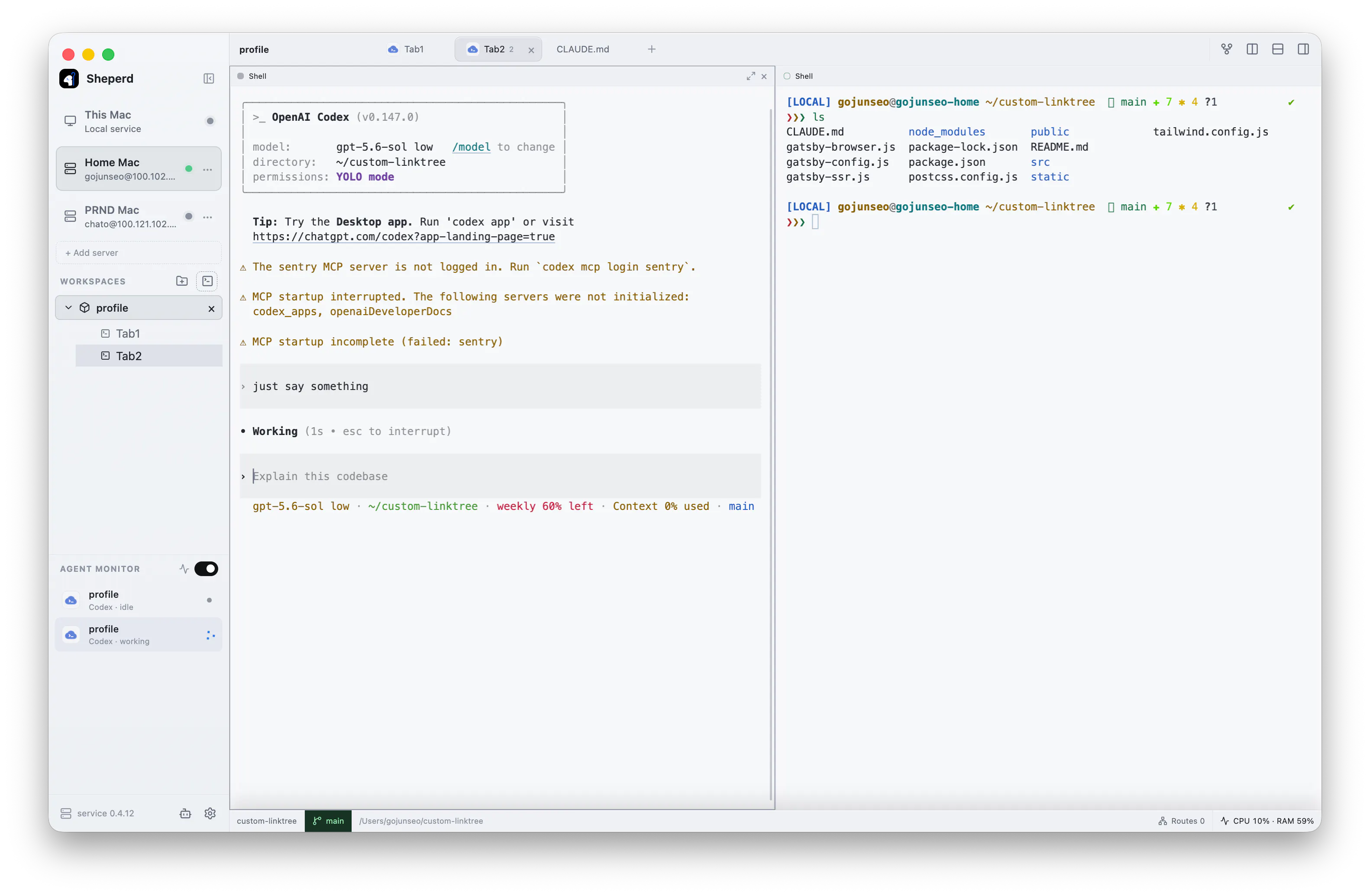
Run coding agents across tabs, panes, and remote machines. Shepherd keeps terminal sessions alive when the app closes, tracks which agents are working or waiting, and lets you return to their files and changes without losing context. Agents understand the current Shepherd context, control tabs and panes, and collect feedback through browser reviews, while you monitor every agent’s status in real time.
AI Analysis
Shepherd Terminal is a persistent terminal for running coding agents with Codex and Claude side by side across tabs, panes, and remote machines. Core features include keeping sessions alive after app closure, tracking agent statuses (working or waiting), context retention for files and changes, agent understanding of Shepherd environment, UI control by agents, feedback via browser reviews, and real-time monitoring. It solves major pain points like context loss in AI coding sessions, managing multiple parallel agents, and inefficient workflow resumption. USP is seamless continuity and oversight for AI-augmented development. Overall value proposition: boosts developer productivity and change management without friction.
The timing is favorable for 2025-2026 as AI coding agents mature rapidly with advanced models from OpenAI (Codex successors) and Anthropic (Claude). Developer demand for orchestration tools is surging due to agentic AI trends, remote work, and productivity pressures amid talent shortages. Positive economic environment for SaaS dev tools with no adverse policies. Excellent Timing.
Feasibility is High. Technical difficulty is moderate using established terminal emulation, containerization for persistence, and AI API integrations. Development and operation costs are reasonable for a SaaS/desktop hybrid. Low supply chain/compliance risks as a pure software dev tool. Strong scalability via cloud backends for remote sessions. Fits well for teams experienced in developer tools and AI.
Main segments: Software developers, AI engineers, and dev teams (ages 25-45) in technology and software industries. Geographic: Primarily North America, Europe, with global adoption via remote work. TAM for AI developer tools ~$10B+, SAM for agent management terminals ~$800M, SOM ~$80M initially. Core pain points: session/context loss and multi-agent oversight. High willingness to pay for productivity gains (likely subscription $10-50/mo).
Competition level: Medium. Direct competitors: 1. Aider (aider.chat), 2. Warp (warp.dev), 3. Cursor (cursor.com), 4. Continue.dev (continue.dev), 5. Replit Agents. Advantages: Superior persistence across app closures, dedicated multi-agent tracking with real-time status, deep context retention, and side-by-side Codex/Claude support. Disadvantages: Narrower than full IDEs like Cursor; as a newer tool, may have less integrations and brand recognition. Strong differentiation in agent orchestration for terminals.
Upgrade Pro to unlock full AI analysis
Similar Products

Cohere Parse 5
Turn complex docs, tables & images into AI-ready data
▲ 158 votes

Opaline
PostHog for team Claude Code and Codex sessions.
▲ 141 votes

Adapt
The company brain that gets work done
▲ 124 votes

Replay QA Security Scan
Automated Penetration Testing for AI-Built Apps
▲ 102 votes

Refoid
Automate App Store refund responses and track every outcome
▲ 68 votes

Audryo
Customer email your agent can operate.
▲ 63 votes