
Sim
Open-source workspace for AI agents and workflows
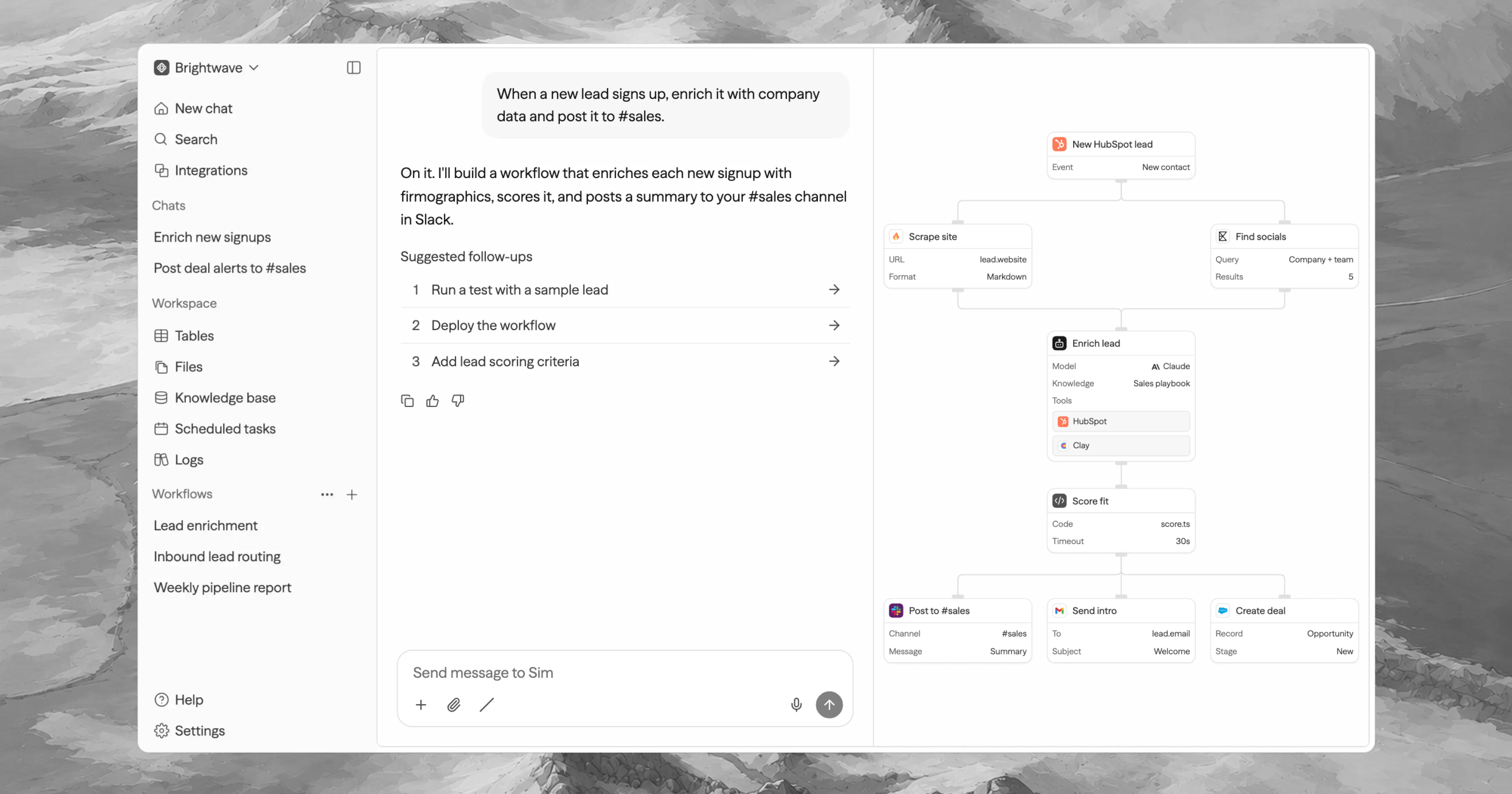
Sim is an open-source workspace to build agentic workflows. Connect your AI agents and workflows to 1,000+ integrations and LLMs.
AI Analysis
Sim is an open-source workspace for building agentic AI workflows. It lets users design, connect, and deploy AI agents and complex workflows integrated with 1,000+ tools and various LLMs. Key features include a unified visual workspace, seamless API connections, and community customization. It solves pain points like fragmented AI development tools, vendor lock-in, complex integration management, and lack of transparency in proprietary platforms. The USP is its fully open-source nature combined with extensive connectivity, offering flexibility and control. Value proposition: Empower developers and teams to rapidly build scalable, customizable AI solutions without high costs or restrictions.
In 2025-2026, market timing is highly favorable due to maturing LLM technology, surging demand for autonomous AI agents across industries, and a shift toward open-source to control costs amid economic uncertainty. User needs for integrated, customizable workflows are growing rapidly with AI adoption. Policy support for AI innovation further helps. This aligns perfectly with the agentic AI boom. Rating: Excellent Timing.
Overall feasibility is High. Technical difficulty is manageable by leveraging existing LLM APIs and open-source frameworks. Development and operation costs are lowered through community contributions. Scalability is strong via cloud and self-hosting options. Main risks involve maintaining 1,000+ integrations and compliance with data privacy. Fits well for teams experienced in AI/open-source. High scalability potential with growing AI ecosystem support. Rating: High.
Primary targets: AI/ML engineers, developers, product teams in tech startups and enterprises (ages 25-45), focused on software, automation, and AI industries. Geographic focus: Global, with high concentration in US, Europe, and China. TAM for AI dev tools ~$15B+, SAM for workflow/agent platforms ~$2B, SOM for open-source AI workspaces ~$300M. Core pain points: Integration complexity, workflow orchestration challenges, high proprietary tool costs. Willingness to pay: Medium-high for enterprise support, hosting, or premium features on top of free open-source core.
Competition level: Medium. Direct competitors: 1. LangChain (langchain.com), 2. CrewAI (crewai.com), 3. Dify (dify.ai), 4. n8n (n8n.io), 5. FlowiseAI (flowiseai.com). Advantages: Broad 1,000+ integrations, dedicated open-source workspace for agents, avoids lock-in. Disadvantages: Potentially less mature ecosystem than LangChain, may require more setup than no-code competitors, limited brand recognition vs. established players. Strong differentiation in visual agent workflow focus but faces pressure from both code-first and low-code tools.
Upgrade Pro to unlock full AI analysis
Similar Products

Cohere Parse 5
Turn complex docs, tables & images into AI-ready data
▲ 158 votes

Adapt
The company brain that gets work done
▲ 124 votes

Replay QA Security Scan
Automated Penetration Testing for AI-Built Apps
▲ 102 votes

WikiFix for Confluence
Find and fix issues in your knowledge base
▲ 86 votes

Audryo
Customer email your agent can operate.
▲ 68 votes

Refoid
Automate App Store refund responses and track every outcome
▲ 68 votes