
Step 3.7 Flash
Flash-speed agents model that can see and act
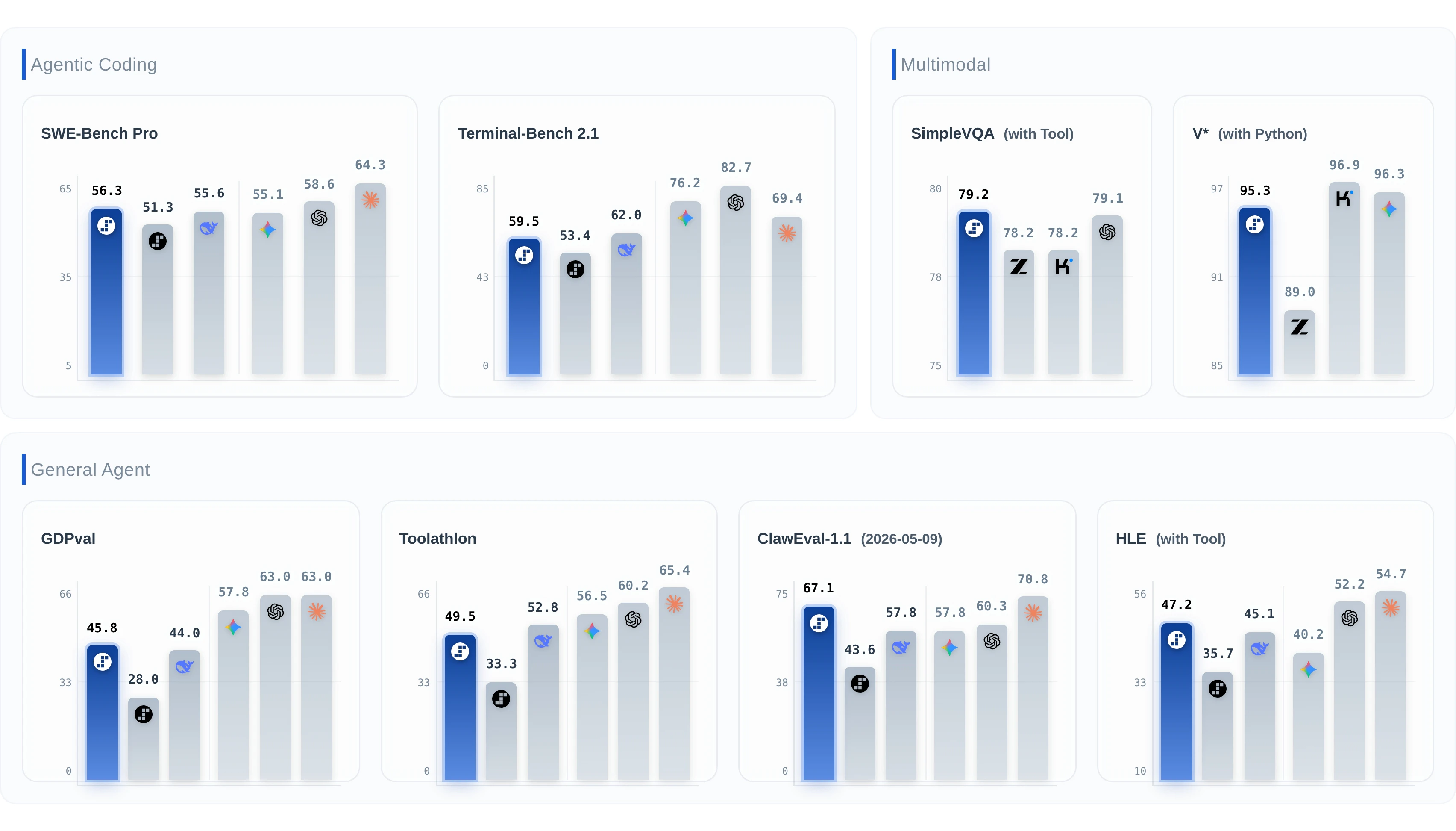
An Apache 2.0 open-weight Flash model for real-world agents. Step 3.7 Flash combines vision, coding, search, tool use, 256K context, ~11B active params, and up to 400 TPS.
AI Analysis
Step 3.7 Flash is an Apache 2.0 open-weight multimodal AI model optimized for real-world agents. Core features include vision understanding, coding, web search, tool use, 256K context length, ~11B active parameters, and exceptional inference speed up to 400 TPS. Its unique selling points are the 'flash-speed' performance combined with comprehensive agent capabilities in a fully open-source format. It addresses key user pain points such as slow agent response times, restricted context windows, high API costs, and lack of customization in proprietary models. The overall value proposition is to enable developers and organizations to build fast, capable, and transparent AI agents that can see, reason, and act autonomously without vendor lock-in.
The timing is highly favorable for 2025-2026. Industry trends show explosive growth in AI agents, multimodal models, and open-source AI to counter rising API costs and regulatory scrutiny. Technology for fast inference and long-context models has matured, while user demand for customizable, high-speed agent tools is surging amid economic pressures to automate workflows. Excellent Timing.
High. The model is already developed and released under Apache 2.0 with proven specs (~11B active params, 400 TPS), indicating manageable technical difficulty. Inference costs are low due to efficiency, and open-source distribution reduces operational burden while enabling community-driven scalability. Supply chain risks are minimal; main challenges are ongoing model maintenance and potential future AI compliance. Strong scalability potential for GitHub-based adoption.
Primary segments: AI/ML developers, software engineers, indie hackers, and AI startups building autonomous agents (demographics: 25-40 years old tech professionals). Industries: software development, automation, robotics, and enterprise AI integration. Geographic focus: Global, concentrated in US, China, Europe, and India. TAM for generative AI tools exceeds $100B, SAM for open-source multimodal models ~$10B, SOM for agent-specific models ~$1B+. Core pain points include latency in agent loops and closed ecosystems. High willingness to pay for hosted versions, fine-tuning, or enterprise support despite free base model.
Medium. Direct competitors: 1. Qwen2.5-VL (https://qwenlm.github.io/), 2. Llama 3.2 Vision (https://ai.meta.com/llama/), 3. Mistral Pixtral 12B (https://mistral.ai/), 4. DeepSeek-VL2 (https://github.com/deepseek-ai), 5. InternVL2 (https://github.com/OpenGVLab/InternVL). Advantages: Significantly higher speed (400 TPS), larger 256K context, agent-specific optimizations for tool use/search/coding, and fully open Apache 2.0 license. Disadvantages: Smaller parameter count may lead to lower performance on complex benchmarks versus larger competitors; less mature ecosystem than Meta or Alibaba offerings.
Upgrade Pro to unlock full AI analysis
Similar Products

Cohere Parse 5
Turn complex docs, tables & images into AI-ready data
▲ 158 votes

Opaline
PostHog for team Claude Code and Codex sessions.
▲ 141 votes

Adapt
The company brain that gets work done
▲ 124 votes

Tapfree for Chrome
Voice dictation that adapts to what’s on your screen
▲ 122 votes

CodeBurn
See where your AI coding spend actually goes
▲ 101 votes

WikiFix for Confluence
Find and fix issues in your knowledge base
▲ 86 votes