
Sutra
Decision Intelligence for hardware teams
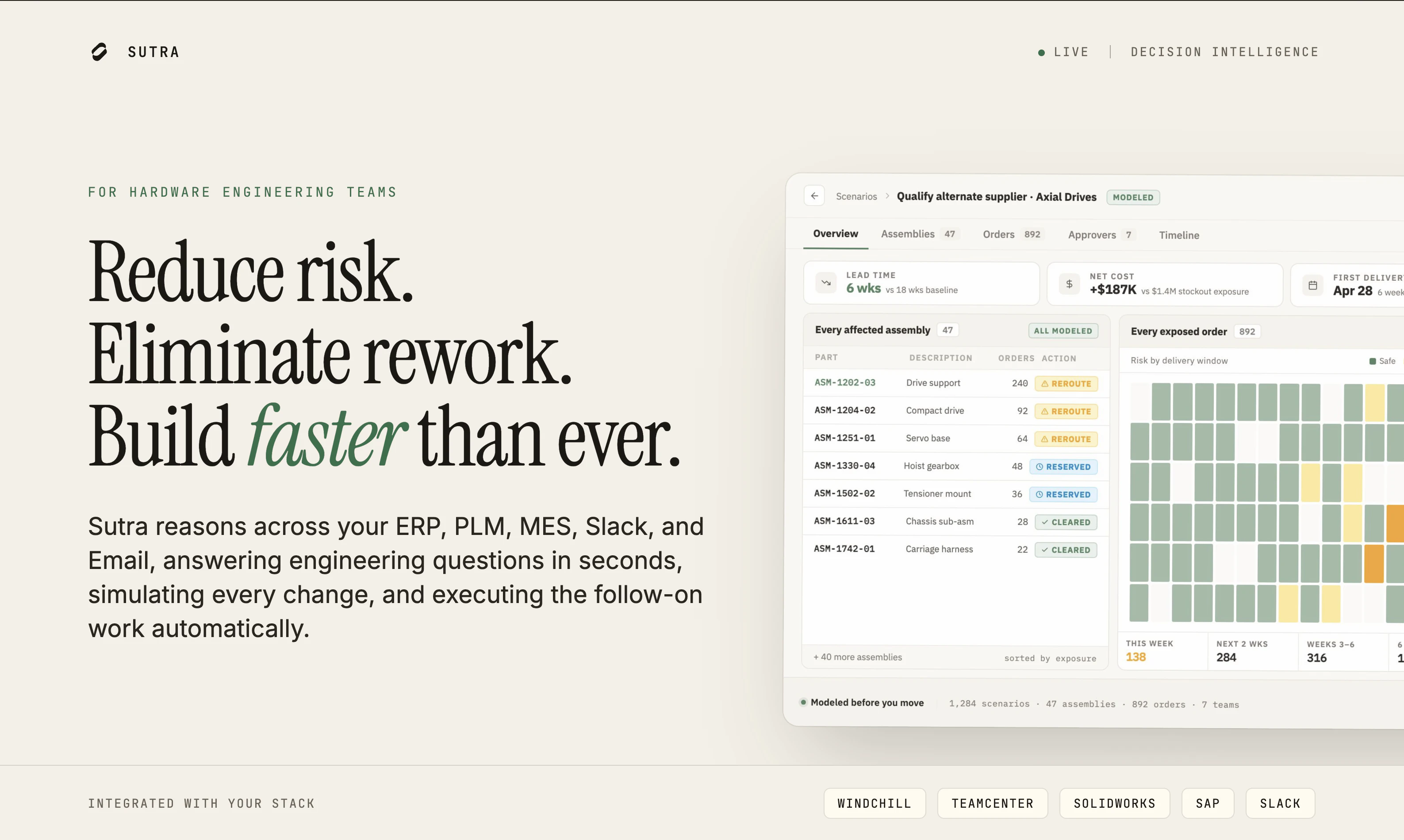
Sutra reasons across your ERP, PLM, MES, Slack, and Email, answering engineering questions in seconds, simulating the downstream impact of every change, and executing the follow-on work automatically.
AI Analysis
Sutra is an AI decision intelligence platform for hardware teams that integrates with ERP, PLM, MES, Slack, and Email. Core features include answering engineering questions in seconds, simulating downstream impacts of any change, and automatically executing follow-on tasks. It solves key pain points such as siloed data across complex systems, time-intensive manual analysis for change management, and coordination errors in hardware development. Unique selling points are its ability to reason across disparate tools like an expert engineer and automate workflows end-to-end. Overall value proposition: dramatically accelerate hardware innovation cycles, minimize costly mistakes, and free teams from repetitive tasks.
In 2025-2026, AI agent technologies and multimodal models have reached sufficient maturity for reliable enterprise reasoning and automation. Hardware sectors face intensifying pressures from supply chain volatility, sustainability regulations, and demand for faster iteration. User needs are shifting toward AI tools that reduce engineering overhead amid talent shortages. Favorable economic push for efficiency gains and AI adoption policies make this ideal. It is a good time due to tech readiness aligning with industry pain. Rating: Excellent Timing.
Technical difficulty is medium-high: requires sophisticated integrations and trustworthy AI simulation, but current LLM and API capabilities support it. Dev/operation costs are elevated for building secure connectors and maintaining accuracy. Supply chain risks are low (SaaS model); compliance risks center on data privacy in manufacturing. YC background suggests strong team fit. Scalability is high post-integration. Overall rating: Medium. Key reasons: Integration complexity balanced by advancing AI maturity and clear product scope.
Main target user segments: Hardware engineers, change managers, and ops leads in electronics, automotive, aerospace, and medtech industries (mid-to-large enterprises). Geographic distribution: Primarily US/Europe HQ with Asia manufacturing. Estimated market size: TAM for manufacturing AI/PLM software ~$20B+, SAM for decision automation ~$2-4B, SOM for hardware change intelligence ~$300-600M. Core user pain points: fragmented data requiring hours/days for impact assessment and manual follow-through. Potential willingness to pay: High (enterprise SaaS pricing likely $50K-$200K+/yr) due to direct ROI on engineering time savings and risk reduction.
Competition level: Medium. Direct competitors: 1. PTC Windchill (ptc.com), 2. Siemens Teamcenter (plm.automation.siemens.com), 3. Arena PLM (arena.com), 4. Aras Innovator (aras.com). Advantages vs competitors: superior AI natural language reasoning, predictive change simulation, and autonomous task execution not native to traditional PLM systems; seamless Slack/Email integration. Disadvantages: less established track record and potentially narrower breadth of core PLM functionality compared to incumbents; may require more upfront integration effort.
Upgrade Pro to unlock full AI analysis
Similar Products

Midjourney Scanner
60 second ultrasound-based full-body scanner that beats MRI
▲ 206 votes

Light Flip
Nostalgia for a time before smartphones
▲ 138 votes

NanoKVM-Go
Give your AI agent physical control over any screen
▲ 110 votes

Staff.rip
Describe a code change in plain language and ship it
▲ 75 votes

Tracea
Datadog for AI agents - traces, RCA, and team memory
▲ 72 votes

ClearMesh
A Git-like platform for datasets, models, and binary folders
▲ 61 votes