
Tabstack Browser Automation
Automate the web in your app or agent, no browser to host
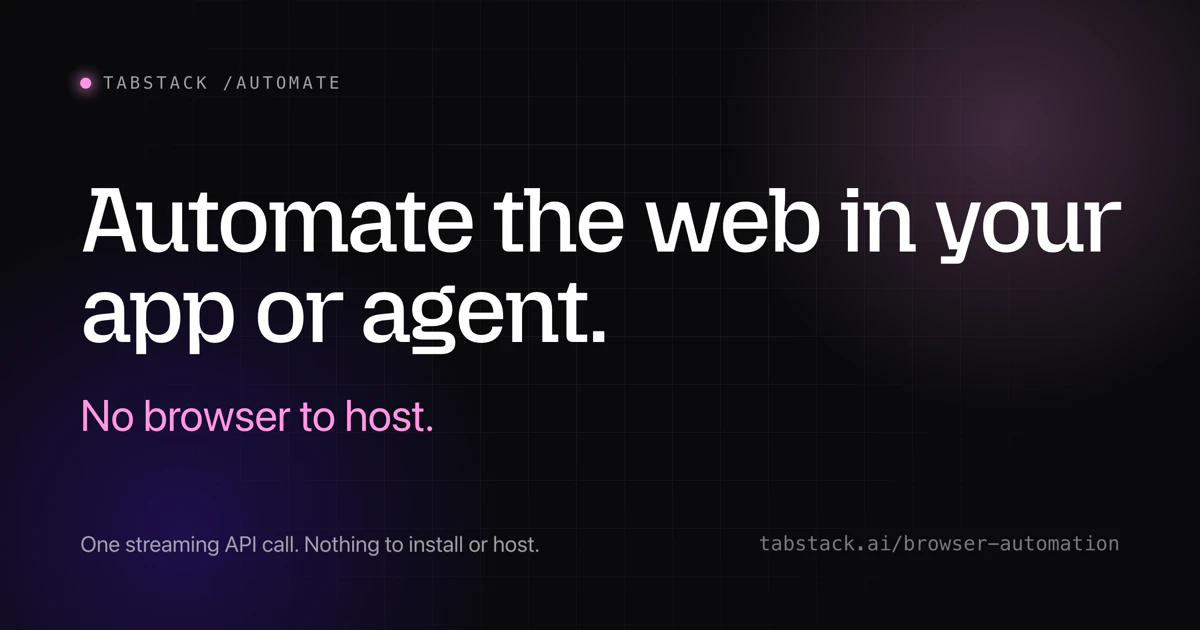
Give /automate a task in plain English and it drives a real browser to do it: navigate a site, click through a multi-step flow, fill a form, reach a page that only renders after interaction. The result streams back in one API call. It's an API you call, not a framework you install. Browser and LLM included, nothing to host, no concurrency ceiling. Accessibility-tree automation spends 60 to 80% fewer tokens than screenshot-based agents. Built by Mozilla. Ephemeral, no training on your data.
AI Analysis
Tabstack Browser Automation is an API that enables plain English instructions to drive a real browser for tasks like site navigation, multi-step clicks, form filling, and interacting with dynamic pages. Results stream back in one call. Core features: hosted service with included browser and LLM, no installation or hosting needed, no concurrency limits, and accessibility-tree approach reducing tokens by 60-80% vs screenshot agents. Built by Mozilla, sessions are ephemeral with no data training. It solves pains of managing browser infrastructure, complex frameworks like Selenium, high LLM costs, and unreliable web automation for AI agents. USP is simplicity, efficiency, and scalability for integrating web actions into apps or agents. Overall value: seamless, production-ready web automation.
2025-2026 sees explosive growth in AI agents and autonomous systems needing reliable web interaction. LLM-browser tech is maturing rapidly, user demand shifts toward simple API integrations over self-hosted frameworks, and economic push for AI productivity tools is strong. No major regulatory barriers for automation APIs. This aligns perfectly with the agentic AI boom, making it an ideal launch window before full commoditization. Excellent Timing.
Technical difficulty is moderate-high for stable cross-browser LLM control but lowered by Mozilla's established browser expertise. Operating costs are primarily cloud-based with good scalability and no user concurrency ceilings. Low supply chain risk, strong privacy compliance (ephemeral, no training on data). High scalability potential as fully hosted API. Team fit excellent given Mozilla backing. Overall rating: High.
Primary users: Developers and AI engineers building apps/agents (demographics: tech professionals 25-40 yrs), industries including AI, SaaS, automation services, e-commerce. Geographic focus: Global with concentration in US, Europe, East Asia. Estimated TAM for AI web automation ~$5-10B, SAM for browser APIs ~$1B, SOM ~$100M in early years. Core pains: unreliable dynamic web interactions and high token/infra costs. Strong willingness to pay for usage-based reliable API.
Medium. Direct competitors: 1. Skyvern (skyvern.com), 2. Browserbase (browserbase.com), 3. Anthropic Computer Use, 4. Playwright (microsoft.github.io/playwright). Advantages: 60-80% token savings via accessibility trees, fully managed API with streaming (no hosting/frameworks), Mozilla credibility, privacy focus. Disadvantages: Newer entrant so potentially less battle-tested than incumbents, may require prompt tuning. Strong differentiation on efficiency and simplicity.
Upgrade Pro to unlock full AI analysis
Similar Products

Cohere Parse 5
Turn complex docs, tables & images into AI-ready data
▲ 158 votes

Opaline
PostHog for team Claude Code and Codex sessions.
▲ 141 votes

Adapt
The company brain that gets work done
▲ 124 votes

Tapfree for Chrome
Voice dictation that adapts to what’s on your screen
▲ 122 votes

Replay QA Security Scan
Automated Penetration Testing for AI-Built Apps
▲ 102 votes

Refoid
Automate App Store refund responses and track every outcome
▲ 68 votes