
Tadata
The AI employee in Slack that reads the room.
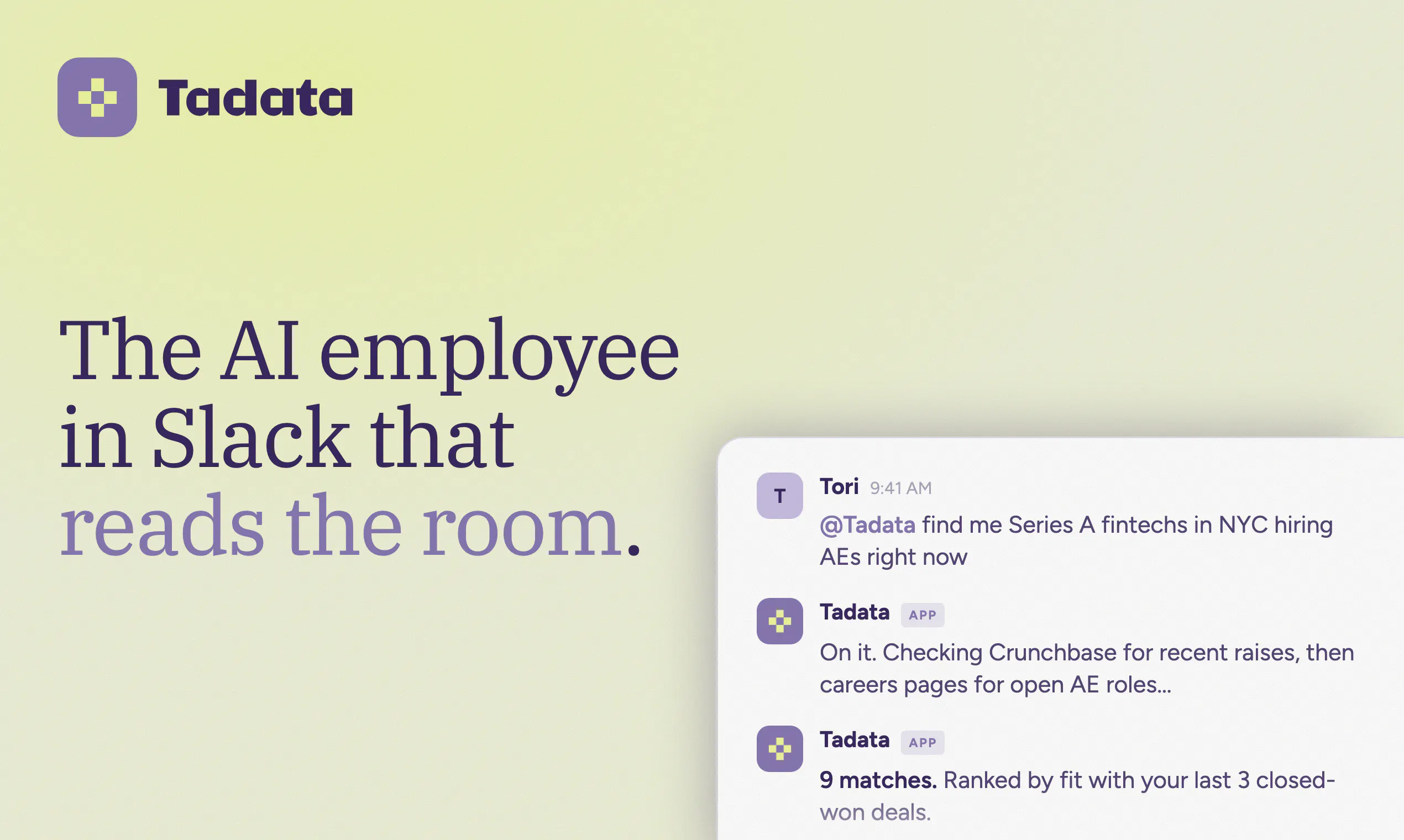
Tadata is the AI employee that lives in your Slack. It connects to your tools, learns your company and your preferences, and does work for your team.
AI Analysis
Tadata is an AI employee integrated into Slack that connects to team tools, learns company specifics and user preferences, and autonomously handles work. Core features include reading the room from conversations for context-aware responses, task automation, knowledge retrieval, and team assistance. It addresses pain points like communication overload, fragmented information across tools, manual coordination, and time lost on repetitive tasks. The USP is its ability to understand team dynamics and act as a proactive virtual colleague. Overall value: boosts productivity and efficiency within existing Slack workflows without needing new platforms.
In 2025-2026, with maturing LLM technology, surging adoption of AI agents in workplaces, and demand for seamless integrations in tools like Slack amid remote/hybrid work trends, timing is favorable. Economic focus on productivity and AI policy support add positives. This is Excellent Timing as AI teammates are transitioning from novelty to necessity.
Technically feasible with current Slack APIs, LLMs, and embedding tech for learning/memory. Medium development and operational costs due to AI inference and integration maintenance. Low supply chain risk but notable compliance risks around data privacy in enterprise settings. Good scalability potential once refined. Overall rating: Medium, as reliability in 'reading the room' accurately remains challenging without extensive training data.
Main segments: Software engineers, developers, product teams in tech startups and mid-sized companies (primarily US, Europe). Industries: Software Engineering, IT, digital products. TAM ~$20B+ AI workplace assistants market by 2026; SAM ~$2B for collaboration/Slack AI tools; SOM ~$150M for AI Slack employees. Core pains: Slack notification fatigue, lost context in threads, inefficient task delegation. High willingness to pay ($20-100/month per team) for proven time-saving AI.
Competition Level: Medium. Direct competitors: 1. Slack AI (slack.com/features/ai), 2. Moveworks (moveworks.com), 3. Lindy.ai (lindy.ai), 4. Harvey (harvey.ai), 5. Zapier AI Agents (zapier.com). Advantages: Deeper focus on contextual 'reading the room' and personalized learning/preferences. Disadvantages: Likely higher dependency on accurate integrations; as a newer tool, it may trail in feature breadth, enterprise security certifications, and proven case studies compared to incumbents. Differentiation via Slack-native autonomy is key but faces pricing pressure.
Upgrade Pro to unlock full AI analysis
Similar Products

Cohere Parse 5
Turn complex docs, tables & images into AI-ready data
▲ 158 votes

Adapt
The company brain that gets work done
▲ 124 votes

Replay QA Security Scan
Automated Penetration Testing for AI-Built Apps
▲ 102 votes

WikiFix for Confluence
Find and fix issues in your knowledge base
▲ 86 votes

Audryo
Customer email your agent can operate.
▲ 68 votes
Refoid
Automate App Store refund responses and track every outcome
▲ 68 votes